Selección de accesiones de tomate tolerantes al estrés hídrico basada en prueba de eflujo de iones
Barra lateral del artículo
Contenido principal del artículo
Resumen
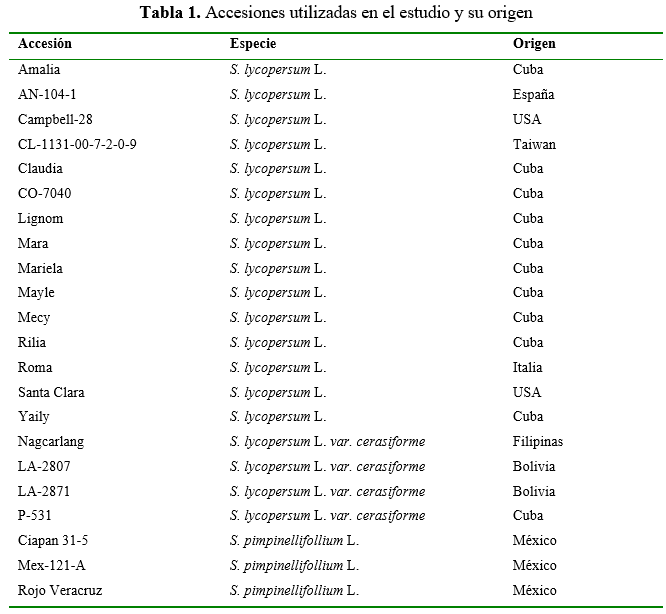
El estrés por déficit hídrico reduce el rendimiento y la productividad en tomate. El propósito de este estudio fue evaluar la tolerancia al estrés hídrico en 22 genotipos de tres especies de tomate e identificar accesiones tolerantes para su empleo y uso en programas de mejoramiento genético. Para ello, se midió el eflujo de sustancias que absorben radiación UV, en discos de hojas de plántulas de tomate de 21 días tratadas con PEG-6000 a 0 y 2 mPa. La respuesta del comportamiento en los genotipos fue diferenciada frente al estrés hídrico simulado con PEG-6000. Los genotipos pertenecientes a S. pimpinellifollium y S. lycopersicum variedad cerasiforme presentaron menores eflujos de fenoles en condiciones de déficit hídrico. Se identificaron genotipos que pueden ser seleccionados y utilizados para incrementar la tolerancia al estrés hídrico en el cultivo y formar parte del programa de mejoramiento de esta especie.
Detalles del artículo

Esta obra está bajo una licencia internacional Creative Commons Atribución-NoComercial 4.0.
Aquellos autores/as que tengan publicaciones con esta revista, aceptan los términos siguientes de la Licencia CC Reconocimiento-NoComercial 4.0 Internacional (CC BY-NC 4.0):
Usted es libre de:
- Compartir — copiar y redistribuir el material en cualquier medio o formato
- Adaptar — remezclar, transformar y crear a partir del material
El licenciador no puede revocar estas libertades mientras cumpla con los términos de la licencia.
Bajo las condiciones siguientes:
- Reconocimiento — Debe reconocer adecuadamente la autoría, proporcionar un enlace a la licencia e indicar si se han realizado cambios. Puede hacerlo de cualquier manera razonable, pero no de una manera que sugiera que tiene el apoyo del licenciador o lo recibe por el uso que hace.
- NoComercial — No puede utilizar el material para una finalidad comercial.
- No hay restricciones adicionales — No puede aplicar términos legales o medidas tecnológicas que legalmente restrinjan realizar aquello que la licencia permite.
La revista no se responsabiliza con las opiniones y conceptos emitidos en los trabajos, son de exclusiva responsabilidad de los autores. El Editor, con la asistencia del Comité de Editorial, se reserva el derecho de sugerir o solicitar modificaciones aconsejables o necesarias. Son aceptados para publicar trabajos científico originales, resultados de investigaciones de interés que no hayan sido publicados ni enviados a otra revista para ese mismo fin.
La mención de marcas comerciales de equipos, instrumentos o materiales específicos obedece a propósitos de identificación, no existiendo ningún compromiso promocional con relación a los mismos, ni por los autores ni por el editor.
Citas
Bayomi KEM, Abdel-Baset A, Nasar SMA, Al-Kady AEMA. Performance of some tomato genotypes under greenhouse conditions. Egyptian Journal of Desert Research. 2020;70(1):1-10. https://doi.org/10.21608/EJDR.2019.16947.1041
Monge-Pérez JE, Loría-Coto M. Determinación de criterios de selección para el rendimiento de tomate (Solanum lycopersicum L.) cultivado bajo invernadero. AIA Avances en Investigación Agropecuaria. 2022;25(1):7-19.
Jiang X, Zhao Y, Tong L, Wang R, Zhao S. Quantitative analysis of tomato yield and comprehensive fruit quality in response to deficit irrigation at different growth stages. HortScience. 2019;54(8):1409-1417. https://doi.org/10.21273/HORTSCI14180-19
Sousaraei N, Mashayekhi K, Mousavizadeh SJ, Akbarpour V, Medina J, Aliniaeifard S. Screening of tomato landraces for drought tolerance based on growth and chlorophyll fluorescence analyses. Horticulture, Environment, and Biotechnology. 2021;62:521-535. https://doi.org/10.1007/s13580-020-00328-5
Kumar V, Datir S, Khare T, Shriram V. Advances in biotechnological tools: Improving abiotic stress tolerance in rice. In: Hasanuzzaman M, Fujita M, Nahar K, Biswas JK, editors. Advances in Rice Research for Abiotic Stress Tolerance. Sawston, CA, USA: Elsevier Inc. 2019; Chapter 30:615-632. https://doi.org/10.1016/B978-0-12-814332-2.00030-7
Toor MD, Adnan M, Javed MS, Habibah UE, Arshad A, Mughees M, Ahmad R. Foliar application of Zn: Best way to mitigate drought stress in plants; A review. International Journal of Applied Research. 2020;6(8):16-20.
Méndez-Vázquez JR, Benavides-Mendoza A, Juárez-Maldonado A, Cabrera-De la Fuente M, Robledo-Olivo A, González-Morales S. Efecto del riego deficitario en la acumulación de compuestos antioxidantes en plantas de tomate. Ecosistemas y Recursos Agropecuarios. 2021;8(2):e2822. https://doi.org/10.19136/era.a8n2.2822
Redmann RE, Haraldson J, Gusta LV. Leakage of UV-absorbing substances as a measure of salt injury in leaf tissue of woody species. Physiologia Plantarum. 1986;67:87-91. https://doi.org/10.1111/j.1399-3054.1986.tb01267.x
Hassanein A, Ibrahim E, Ali RA, Hashem H. Differential metabolic responses associated with drought tolerance in Egyptian rice. Journal of Applied Biology & Biotechnology. 2021;9(4):37-46. https://doi.org/10.7324/JABB.2021.9405
ElBasyoni I, Saadalla M, Baenziger S, Bockelman H, Morsy S. Cell membrane stability and association mapping for drought and heat tolerance in a worldwide wheat collection. Sustainability. 2017;9(9):1606-1621. https://doi.org/10.3390/su9091606
Swapna S, Shylaraj KS. Screening for osmotic stress responses in rice varieties under drought condition. Rice Science. 2017;24(5):253-263. https://doi.org/10.1016/j.rsci.2017.04.004
Nijabat A, Bolton A, Mahmood-ur-Rehman M, Shah AI, Hussain R, Naveed RH, Ali A, Simon P. Cell membrane stability and relative cell injury in response to heat stress during early and late seedling stages of diverse carrot (Daucus carota L.) germplasm. HortScience. 2020;55(9):1446-1452. https://doi.org/10.21273/HORTSCI15058-20
Pastelín-Solano MC, Castañeda-Castro O. Afectaciones fisiológicas y bioquímicas en vitroplantas de caña de azúcar en respuesta al estrés hídrico y salino. Revista Mexicana de Ciencias Agrícolas. 2018;9(7):1483-1493. https://doi.org/10.29312/remexca.v9i7.1253
Krishna R. Ansari WA, Soumia PS, Yadav A, Jaiswal DK, Kumar S, Singh AK, Singh M, Verma JP. Biotechnological interventions in tomato (Solanum lycopersicum) for drought stress tolerance: Achievements and future prospects. BioTech. 2022;11(4):48. https://doi.org/10.3390/biotech11040048
Villalobos-López MA, Arroyo-Becerra A, Quintero-Jiménez A, Iturriaga G. Biotechnological advances to improve abiotic stress tolerance in crops. International Journal of Molecular Science. 2022;23(19):12053. https://doi.org/10.3390/ijms231912053