Efectos del quitosano en el crecimiento y rendimiento del rábano (Raphanus sativus L.) en invernadero
Barra lateral del artículo
Contenido principal del artículo
Resumen
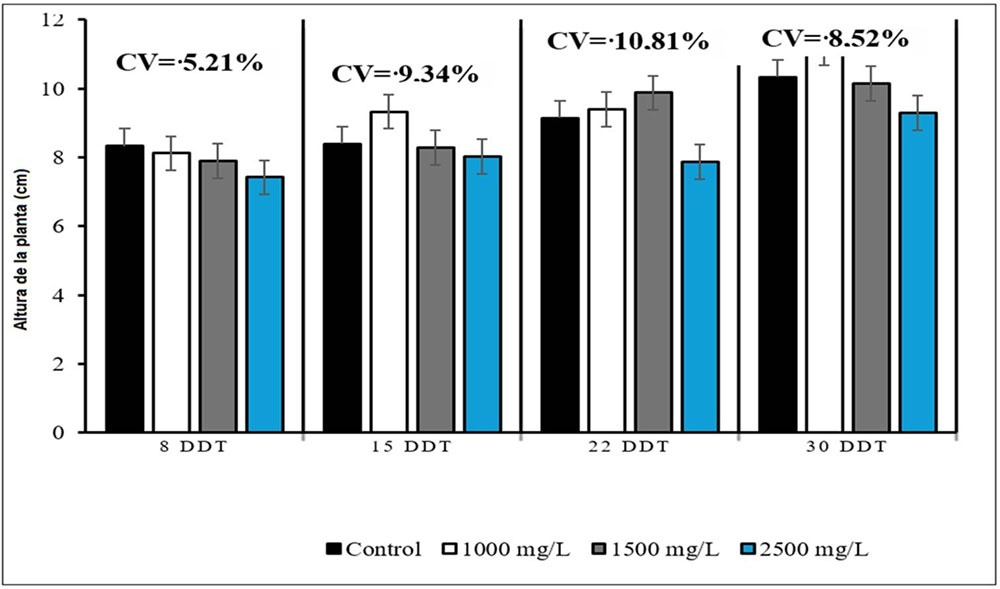
El quitosano es un biopolímero con actividad bioestimulante en cultivos hortícolas, aunque su efecto depende de la concentración aplicada y la especie vegetal. Se evaluó el efecto de dosis crecientes de quitosano sobre el crecimiento y rendimiento del rábano (Raphanus sativus L.) bajo condiciones de invernadero. El experimento se realizó en la finca experimental "La María", Universidad Técnica Estatal de Quevedo, Mocache, Los Ríos, Ecuador. Se aplicaron tres concentraciones de quitosano (1000, 1500 y 2500 mg L-1) más un testigo con agua destilada, distribuidos en un diseño de bloques completos al azar con cinco repeticiones. Las raíces de las plántulas fueron sometidas a inmersión durante una hora en las soluciones correspondientes antes del trasplante. Se evaluaron variables morfoagronómicas de crecimiento vegetativo y de producción. Los datos se analizaron mediante análisis de varianza y comparación de medias con la prueba de Tukey (p < 0,05). La dosis de 1000 mg L-1 estimuló el crecimiento vegetativo temprano, con mayores valores en longitud de planta, número, largo y ancho de hojas a los 15 días después del trasplante (DDT). La dosis de 1500 mg L-1 generó la mejor respuesta productiva, con valores superiores en diámetro polar y ecuatorial de raíz, peso fresco y rendimiento (3885,18 kg ha-1), equivalente a un incremento del 159 % respecto al testigo. Se concluye que el quitosano a 1500 mg L-1 constituye una alternativa bioestimulante con potencial agronómico para mejorar la productividad del rábano en condiciones de invernadero.
Detalles del artículo

Esta obra está bajo una licencia internacional Creative Commons Atribución-NoComercial 4.0.
Aquellos autores/as que tengan publicaciones con esta revista, aceptan los términos siguientes de la Licencia CC Reconocimiento-NoComercial 4.0 Internacional (CC BY-NC 4.0):
Usted es libre de:
- Compartir — copiar y redistribuir el material en cualquier medio o formato
- Adaptar — remezclar, transformar y crear a partir del material
El licenciador no puede revocar estas libertades mientras cumpla con los términos de la licencia.
Bajo las condiciones siguientes:
- Reconocimiento — Debe reconocer adecuadamente la autoría, proporcionar un enlace a la licencia e indicar si se han realizado cambios. Puede hacerlo de cualquier manera razonable, pero no de una manera que sugiera que tiene el apoyo del licenciador o lo recibe por el uso que hace.
- NoComercial — No puede utilizar el material para una finalidad comercial.
- No hay restricciones adicionales — No puede aplicar términos legales o medidas tecnológicas que legalmente restrinjan realizar aquello que la licencia permite.
La revista no se responsabiliza con las opiniones y conceptos emitidos en los trabajos, son de exclusiva responsabilidad de los autores. El Editor, con la asistencia del Comité de Editorial, se reserva el derecho de sugerir o solicitar modificaciones aconsejables o necesarias. Son aceptados para publicar trabajos científico originales, resultados de investigaciones de interés que no hayan sido publicados ni enviados a otra revista para ese mismo fin.
La mención de marcas comerciales de equipos, instrumentos o materiales específicos obedece a propósitos de identificación, no existiendo ningún compromiso promocional con relación a los mismos, ni por los autores ni por el editor.
Citas
Targino VA, Dias TJ, Sousa VFO, Silva MM, Ribeiro JES, Lopes AS, et al. Optimizing radish (Raphanus sativus L.) production through alternative nitrogen sources. Braz J Biol [Internet]. 2025 [cited 2025 Feb 20];85:e301745. Available from: https://doi.org/10.1590/1519-6984.301745
Raza QUA, Bashir MA, Rehim A, Ejaz R, Raza HMA, Shahzad U, et al. Biostimulants induce positive changes in the radish morpho-physiology and yield. Front Plant Sci [Internet]. 2022 [cited 2025 Feb 20];13:950393. Available from: https://doi.org/10.3389/fpls.2022.950393
Rouphael Y, Colla G. Editorial: Biostimulants in Agriculture. Front Plant Sci [Internet]. 2020 [cited 2025 Feb 20];11:40. Available from: https://doi.org/10.3389/fpls.2020.00040
Mounaimi S, Hamim A, El Boukhari MEM, Elarroussi H, Lyamlouli K. A comprehensive review of integrating biostimulants and biopesticides for organic berry farming. Front Sustain Food Syst [Internet]. 2024 [cited 2025 Feb 20];8:1452823. Available from: https://doi.org/10.3389/fsufs.2024.1452823
Du Jardin P. Plant biostimulants: Definition, concept, main categories and regulation. Sci Hortic [Internet]. 2015 [cited 2025 Feb 20];196:3-14. Available from: https://doi.org/10.1016/j.scienta.2015.09.021
Rojas-Pirela M, Carillo P, Lárez-Velásquez C, Romanazzi G. Effects of chitosan on plant growth under stress conditions: similarities with plant growth promoting bacteria. Front Plant Sci [Internet]. 2024 [cited 2025 Feb 20];15:1423949. Available from: https://doi.org/10.3389/fpls.2024.1423949
Suwanchaikasem P, Idnurm A, Selby-Pham J, Walker R, Boughton BA. The impacts of chitosan on plant root systems and its potential to be used for controlling fungal diseases in agriculture. J Plant Growth Regul [Internet]. 2024 [cited 2025 Feb 20];43(10):3424-45. Available from: https://doi.org/10.1007/s00344-024-11356-1
Reyes-Pérez J, Enríquez-Acosta EA, Ramírez-Arrebato MÁ, Zúñiga Valenzuela E, Lara-Capistrán L, Hernández-Montiel LG. Efecto del quitosano sobre variables del crecimiento, rendimiento y contenido nutricional del tomate. Remexca [Internet]. 2020 [cited 2025 Feb 20];11(3):457-65. Available from: https://doi.org/10.29312/remexca.v11i3.2392
Reyes-Pérez JJ, Ramos-Remache RA, Falcón A, Ramírez-Arrebato MÁ, Rodríguez-Pedroso AT, Rivero-Herrada M, et al. Efecto del quitosano sobre variables del crecimiento, absorción de nutrientes y rendimiento de Cucumis sativus. Centro Agrícola [Internet]. 2019 [cited 2025 Feb 20];46(4):53-60. Available from: https://ediciones.inca.edu.cu/index.php/ediciones/article/view/1451
Reyes-Pérez JJ, Rivero-Herrada M, Solórzano-Cedeño AE, Carballo-Méndez FDJ, Lucero-Vega G, Ruiz-Espinoza FH. Aplicación de ácidos húmicos, quitosano y hongos micorrízicos: influencia en el crecimiento y desarrollo de pimiento. Terra [Internet]. 2021 [cited 2025 Feb 20];39. Available from: https://doi.org/10.28940/terra.v39i0.833
Román-Doval R, Torres-Arellanes SP, Tenorio-Barajas AY, Gómez-Sánchez A, Valencia-Lazcano AA. Chitosan: properties and its application in agriculture in context of molecular weight. Polymers [Internet]. 2023 [cited 2025 Feb 20];15(13):2867. Available from: https://doi.org/10.3390/polym15132867
Malerba M, Cerana R. Chitosan effects on plant systems. Int J Mol Sci [Internet]. 2016 [cited 2025 Feb 20];17(7):996. Available from: https://doi.org/10.3390/ijms17070996
Xu C, Mou B. Chitosan as soil amendment affects lettuce growth, photochemical efficiency, and gas exchange. HortTechnology [Internet]. 2018 [cited 2025 Feb 20];28(4):476-80. Available from: https://doi.org/10.21273/HORTTECH04032-18
Farouk S, Mosa AA, Taha AA, Ibrahim HM, EL-Gahmery A. Protective effect of humic acid and chitosan on radish (Raphanus sativus L. var. sativus) plants subjected to cadmium stress. J Stress Physiol Biochem [Internet]. 2011 [cited 2025 Feb 20];7(2):99-116. Available from: https://www.jspb.ru/issues/2011/N2/JSPB_2011_7_2_99-116.pdf
Pincay-Manzaba D, Cedeño-Loor J, Espinosa Cunuhay K. Efecto del quitosano sobre el crecimiento y la productividad de Solanum lycopersicum. Centro Agricola [Internet]. 2021 [cited 2025 Feb 20];48(3):25-31. Available from: https://ediciones.inca.edu.cu/index.php/ediciones/article/view/1458
Sousa LDCD, Santos ARMD, Nogueira JC, Matos YCDS, Silva LJV, Calaça JDSG, et al. A adubação orgânica melhora o crescimento, produtividade e características físico-químicas do rabanete (Raphanus sativus L.) cv. Saxa. Research, Society and Development [Internet]. 2022 [cited 2025 Feb 20];11(11):e57111133423. Available from: https://doi.org/10.33448/rsd-v11i11.33423
Kumar S, Kumar P, Jatav V, Dukpa P, Suman S. Influence of organic manure and inorganic fertilizers on growth and yield of radish (Raphanus sativus L.) in Gird Region of Madhya Pradesh, India. IJPSS [Internet]. 2023 [cited 2025 Feb 20];35(20):244-52. Available from: https://doi.org/10.9734/ijpss/2023/v35i203804
Sharif R, Mujtaba M, Ur Rahman M, Shalmani A, Ahmad H, Anwar T, et al. The multifunctional role of chitosan in horticultural crops; A Review. Molecules [Internet]. 2018 [cited 2025 Feb 20];23(4):872. Available from: https://doi.org/10.3390/molecules23040872
Jin D, Lu Z, Song X, Ahammed GJ, Yan Y, Chen S. Improvement of yield and quality properties of radish by the organic fertilizer application combined with the reduction of chemical fertilizer. Agronomy [Internet]. 2024 [cited 2025 Feb 20];14(8):1847. Available from: https://doi.org/10.3390/agronomy14081847
Kumari S, Dhiman S, Saini A. Impact of bioinoculants and organic manures on growth and yield of radish. Biol Forum Int J [Internet]. 2024 [cited 2025 Feb 20];16(3):95-100. Available from: https://www.researchtrend.net/bfij/pdf/BFIJ-4773.pdf