Effect of extracts of Solanum pimpinellifolium and Nicotiana tabacum L. against the black weevil (Cosmopolites sordidus)
Article Sidebar
Main Article Content
Abstract
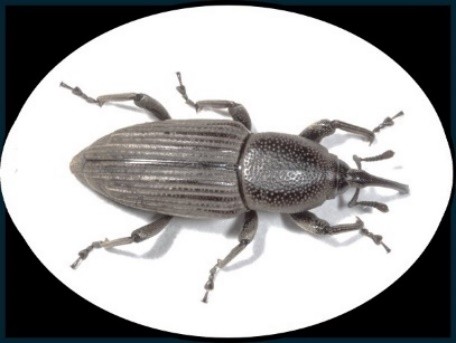
The objective of this research was to evaluate the bioinsecticidal effect of extracts of field tomato (Solanum pimpinellifolium) and tobacco (Nicotiana tabacum L.) against the black weevil (Cosmopolites sordidus). The extracts were obtained from dried leaves, ground, and bioactive compounds extracted with ethanol. Secondary metabolites (triterpenes, alkaloids, flavonoids, phenols, saponins, and reducing sugars) were identified. Insects were captured using Musa paradisiaca L. plantain pseudostem traps baited with cocoa placenta. Seven treatments with 10 replicates were established; each extract was exposed to a concentration of 20 %, 60 %, 100 %, and a control. Mortality was evaluated up to 12 days. The design was completely randomized; data were analyzed using ANOVA and Tukey's test (p<0.05). Morphological characterization of the weevil showed an elongated body measuring 10–14 mm, dark coloration, a prominent beak, bent antennae, and fused elytra with striations. Extracts from both plants induced mortality in C. sordidus, increasing with concentration and time; N. tabacum L. was significantly more effective than S. pimpinellifolium. In conclusion, phytochemical screening revealed the presence of bioactive compounds with similar insecticidal effects on tomato and tobacco. Morphological identification confirmed the species C. sordidus. The tobacco extract was more effective against the weevil, with mortality dependent on concentration and time, demonstrating a greater insecticidal effect than tomato.
Article Details

This work is licensed under a Creative Commons Attribution-NonCommercial 4.0 International License.
Those authors who have publications with this journal accept the following terms of the License Attribution-NonCommercial 4.0 International (CC BY-NC 4.0):
You are free to:
- Share — copy and redistribute the material in any medium or format
- Adapt — remix, transform, and build upon the material
The licensor cannot revoke these freedoms as long as you follow the license terms.
Under the following terms:
- Attribution — You must give appropriate credit, provide a link to the license, and indicate if changes were made. You may do so in any reasonable manner, but not in any way that suggests the licensor endorses you or your use.
- NonCommercial — You may not use the material for commercial purposes.
- No additional restrictions — You may not apply legal terms or technological measures that legally restrict others from doing anything the license permits.
The journal is not responsible for the opinions and concepts expressed in the works, they are the sole responsibility of the authors. The Editor, with the assistance of the Editorial Committee, reserves the right to suggest or request advisable or necessary modifications. They are accepted to publish original scientific papers, research results of interest that have not been published or sent to another journal for the same purpose.
The mention of trademarks of equipment, instruments or specific materials is for identification purposes, and there is no promotional commitment in relation to them, neither by the authors nor by the publisher.
References
Chiriguaya FDCU, Solís LKM, Peralta ERM, Pérez JDL, Guzmán ALS. Control de picudo negro en el cultivo de plátano (Musa paradisiaca). Rev Científica Multidiscip G-nerando [Internet]. 2024;5(1):501–13. Available from: https://doi.org/10.60100/rcmg.v5i1.209
Manu N, Schilling MW, Phillips TW. Natural and synthetic repellents for pest management of the storage mite Tyrophagus putrescentiae (Schrank)(Sarcoptiformes: Acaridae). Insects [Internet]. 2021;12(8):711. Available from: https://doi.org/10.3390/insects12080711
Orantes-García C, Moreno-Moreno RA, Caballero-Roque A, Farrera-Sarmiento O. Plantas utilizadas en la medicina tradicional de comunidades campesinas e indígenas de la Selva Zoque, Chiapas, México. Boletín Latinoam y del Caribe plantas Med y aromáticas [Internet]. 2018;17(5):503–21. Available from: https://www.blacpma.ms-editions.cl/index.php/blacpma/article/view/134
García-Sánchez AN, Chávez EC, Beache MB, Fuentes YMO, Ortiz JCD. Efecto de antibiosis, antixenosis y la variación natural de tricomas de especies silvestres y comerciales en tomate sobre el desarrollo de Bactericera cockerelli. Sci Agropecu [Internet]. 2023;14(4):501–9. Available from: http://dx.doi.org/10.17268/sci.agropecu.2023.041
Lara YDM, Morales PA, Garzón JS, Olaya JFP. Componentes bioactivos del tomate y su posible poder antimicrobiano: estudio in vitro. Rev Cuba Med Nat y Tradic [Internet]. 2020;3. Available from: http://www.revmnt.sld.cu/index.php/rmnt/article/view/124
Su T. Resistance and resistance management of biorational larvicides for mosquito control. J Florida Mosq Control Assoc [Internet]. 2022;69(1). Available from: https://doi.org/10.32473/jfmca.v69i1.130641
Villalta II. Toxicidad vegetal. La Univ [Internet]. 2015;(25). Available from: https://revistas.ues.edu.sv/index.php/launiversidad/article/view/799
Romero R, Morales P, Pino O, Cermeli M, González E. Actividad insecticida de seis extractos etanólicos de plantas sobre mosca blanca. Rev Protección Veg [Internet]. 2015;30:23–8. Available from: http://scielo.sld.cu/scielo.php?pid=S1010-27522015000400005&script=sci_arttext&tlng=en
Altieri MA, Nicholls CI, Dinelli G, Negri L. Towards an agroecological approach to crop health: reducing pest incidence through synergies between plant diversity and soil microbial ecology. npj Sustain Agric [Internet]. 2024;2(1):6. Available from: https://doi.org/10.1038/s44264-024-00016-2
Tavares WR, Barreto M do C, Seca AML. Aqueous and ethanolic plant extracts as bio-insecticides—Establishing a bridge between raw scientific data and practical reality. Plants [Internet]. 2021;10(5):920. Available from: https://doi.org/10.3390/plants10050920
Burgo Bencomo OB. El conocimiento tradicional y la etnobotánica en la gestión de la agricultura familiar. Rev Univ y Soc [Internet]. 2021;13(4):431–8. Available from: http://scielo.sld.cu/scielo.php?pid=S2218-36202021000400431&script=sci_arttext
Acosta Muñoz LE, Zoria Java J. Conocimientos tradicionales Ticuna en la agricultura de chagra y los mecanismos innovadores para su protección. Bol do Mus Para Emílio Goeldi Ciências Humanas [Internet]. 2012;7:417–33. Available from: https://doi.org/10.1590/S1981-81222012000200007
Tlak Gajger I, Dar SA. Plant allelochemicals as sources of insecticides. Insects [Internet]. 2021;12(3):189. Available from: https://doi.org/10.3390/insects12030189
Soto A. Manejo alternativo de ácaros plagas. Rev Ciencias Agrícolas [Internet]. 2013;30(2):34–44. Available from: https://revistas.udenar.edu.co/index.php/rfacia/article/view/1673
Nava-Pérez E, García-Gutiérrez C, Camacho-Báez JR, Vázquez-Montoya EL. Bioplaguicidas: una opción para el control biológico de plagas. Ra Ximhai [Internet]. 2012;8(3b):17–29. Available from: http://www.redalyc.org/articulo.oa?id=46125177003
Hernández Carvajal JE, Florez Orjuela Y, Vallejo GA. Evaluación de la actividad insecticida de Solanum macranthum (Dunal) sobre ninfas de los estadios IV y V de Rhodnius pallescens, Rhodnius prolixus, Rhodnius colombiensis. Rev Cuba Farm [Internet]. 2010;44(1):71–8. Available from: http://scielo.sld.cu/scielo.php?pid=S0034-75152010000100009&script=sci_arttext
López IC, Rivera VE, Yánez ÁW, Artieda JR, Elevación Villacres G. Evaluación de la actividad insecticida de Schinus molle sobre Premnotrypes vorax en papa. Agron Costarric [Internet]. 2017;41(2):93–101. Available from: http://dx.doi.org/10.15517/rac.v41i2.31302
López JJ, Chirinos DT, Ponce WH, Solórzano RF, Alarcón JP. Actividad insecticida de formulados botánicos sobre el gusano cogollero, Spodoptera frugiperda (Lepidoptera: Noctuidae). Rev Colomb Entomol [Internet]. 2022;48(1). Available from: https://doi.org/10.25100/socolen.v48i1.11739
Baguer EA, Menéndez-Álvarez E. El Mango (Mangifera indica L.) como modelo de estudios de los flavonoides. Rev Investig la Univ Le Cordon Bleu [Internet]. 2024;11(2):76–86. Available from: https://doi.org/10.36955/RIULCB.2024v11n2.007
García DSC, Yucailla VA, Lozano NVA, González YT. Efecto de biocida natural a base de (ambrosia peruviana, azadirachta indica) para el control de garrapatas en bovinos. Rev Investig Talent [Internet]. 2022;9(1):60–8. Available from: https://doi.org/10.33789/talentos.9.1.161
Molina-Maldonado JR, Ruiz-Sánchez E, Andueza-Noh RH, Garruña-Hernández R, Gutiérrez-Miceli FA, Santos LF da C-D, et al. Actividad biológica de extractos etanólicos de Ardisia compressa Kunth sobre la mosca blanca Bemisia tabaci (Gennadius 1889, Hemiptera: Aleyrodidae) y una cepa de Fusarium oxysporum Schltdl. Polibotánica [Internet]. 2025;(59):295–312. Available from: https://doi.org/10.18387/polibotanica.59.19
Solís LKM, Chiriguaya FDCU, Pizarro VHR, Peralta ERM. Uso del ácido piroleñoso como una alternativa para el manejo del cogollero (Spodoptera frugiperda), en el cultivo de maíz (Zea mays) con dos mecanismos de control. Rev Científica Multidiscip G-nerando [Internet]. 2024;5(1):997–1026. Available from: https://doi.org/10.60100/rcmg.v5i1.237
Velepucha YE, Guerrero JNQ, Batista RMG. Determinación de la eficiencia de diferentes trampas para el control de picudo negro (Cosmopolites sordidus G.) en banano orgánico. Rev Científica Agroecosistemas [Internet]. 2019;7(1):171–80. Available from: https://aes.ucf.edu.cu/index.php/aes/article/view/263