Bioprospecting of bacilli associated with Cuban wheat cultivars for the control of phytopathogenic fungi
Article Sidebar
Main Article Content
Abstract
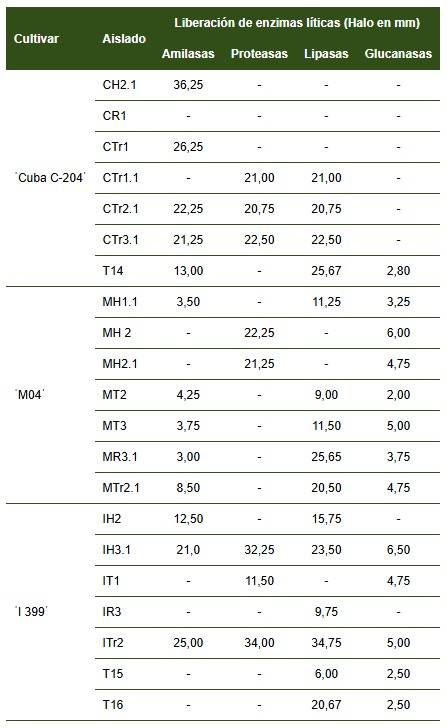
Wheat is a crop of great importance for global food security. In Cuba, it is a relevant species due to its consumption and the significant imports required to meet the country's needs. Among the factors affecting its yields are phytopathogenic fungi, which would be advisable to manage using biological alternatives. The aim of the present study was to characterize the antagonistic potential of Gram-positive bacilli from the rhizosphere and endosphere of wheat plants of the Cuban cultivars 'Cuba C-204', 'I 399', and 'M04'. Out of the 21 microorganisms isolated, 9 5% released lytic enzymes (56 % amylases, 40 % proteases, 68 % lipases, and 60 % glucanases); seven stood out for their results for three enzymes, and two for producing all of them. Three bacteria inhibited the growth of Fusarium sp., 13 affected Curvularia sp., four impacted Curvularia sp., six affected Bipolaris sp., and four affected Alternaria sp., with differences in the percentage of inhibition values among strains for each pathogen. Among the damages caused to the fungi, the most notable were growth arrest, mycelial coiling, abundant conidia production, and cellular lysis. The research allowed for the selection of isolates MH2, Mtr2.1, and MT3, from the cultivar 'M04', and isolate Crt2.1, from the cultivar 'Cuba C-204', which can be considered promising for further studies aimed at developing bioproducts for the biological control of wheat in Cuba.
Article Details

This work is licensed under a Creative Commons Attribution-NonCommercial 4.0 International License.
Those authors who have publications with this journal accept the following terms of the License Attribution-NonCommercial 4.0 International (CC BY-NC 4.0):
You are free to:
- Share — copy and redistribute the material in any medium or format
- Adapt — remix, transform, and build upon the material
The licensor cannot revoke these freedoms as long as you follow the license terms.
Under the following terms:
- Attribution — You must give appropriate credit, provide a link to the license, and indicate if changes were made. You may do so in any reasonable manner, but not in any way that suggests the licensor endorses you or your use.
- NonCommercial — You may not use the material for commercial purposes.
- No additional restrictions — You may not apply legal terms or technological measures that legally restrict others from doing anything the license permits.
The journal is not responsible for the opinions and concepts expressed in the works, they are the sole responsibility of the authors. The Editor, with the assistance of the Editorial Committee, reserves the right to suggest or request advisable or necessary modifications. They are accepted to publish original scientific papers, research results of interest that have not been published or sent to another journal for the same purpose.
The mention of trademarks of equipment, instruments or specific materials is for identification purposes, and there is no promotional commitment in relation to them, neither by the authors nor by the publisher.
References
Deligeorgakis C, Magro C, Skendi A, Gebrehiwot HH, Valdramidis V, Papageorgiou M. Fungal and toxin contaminants in cereal grains and flours: systematic review and meta-Analysis. Foods. 2023 Dec;12(23):4328. Available from: https://doi.org/10.3390/foods12234328.
Błaszczyk L, Salamon S, Mikołajczak K. Fungi inhabiting the wheat endosphere pathogens. 2021 Oct;10(10):1288. Available from: https://doi.org/10.3390/pathogens10101288.
Patiño-Moscoso MA, Osorio-Guerrero KV, Flórez-Gómez DL, Sarmiento-Moreno LF, Vargas-Ramírez DN. Identificación molecular y prevalencia de contaminantes fúngicos en semillas de cultivos semestrales. Scientia Agropecuaria. 2023 Jul-Sept;14(3):347- 358. Available from: https://doi.org/10.17268/sci.agropecu.2023.030.
Martín I, Gálvez L, Guasch L, Palmero D. Fungal pathogens and seed storage in the dry state. Plants. 2022 Nov;11(22):3167. Available from: https://doi.org/10.3390/plants11223167.
Pandit MA, Kumar J, Gulati S, Bhandari N, Mehta P, Katyal R, et al. Major biological control strategies for plant pathogens. Pathogens. 2022 Feb;11(2),273. Available from: https://doi.org/10.3390/pathogens11020273.
Calefi GG, Silva NBS, Alhatlani BY, Abdallah EM, Martins CHG. Harnessing nature’s arsenal: sustainable plant-based strategies for phytopathogen control. Front. Microbiol. 2025 Feb 4;16:1588462. Available from: https://doi.org/10.3389/fmicb.2025.1588462.
Casanovas Cosío E, Suárez del Villar Labastida A, Álvarez Sánchez A, Avilleira Cruz I. Valoración de la seguridad alimentaria cubana a partir de la superficie agrícola explotada y los rendimientos agrícolas. Rev Univ Soc. 2022 Sep-Oct;14(5):304-14. Available from: http://scielo.sld.cu/scielo.php?script=sci_arttext&pid=S2218-36202022000500304&lng=es
Kumari E, Kumari S, Das SS, Mahapatra M, Sahoo JP. Plant growth-promoting bacteria (PGPB) for sustainable agriculture: current prospective and future challenges. AgroEnvironmental Sustainability. 2023 Jun;1(3):274-285. Available from: https://doi.org/10.59983/s2023010309.
Wei X, Xie B, Wan C, Song R, Zhong W, Xin S, et al. Enhancing soil health and plant growth through microbial fertilizers: mechanisms, benefits, and sustainable agricultural practices. Agronomy. 2024 Mar;14(3):609. Available from: https://doi.org/10.3390/agronomy14030609.
Hernández A, Pérez J.M, Bosch D, Castro, N. Clasificación de los suelos de Cuba. Instituto Nacional de Ciencias Agrícolas e Instituto de Suelos. Mayabeque, Cuba: Ediciones INCA: 2015, 91p. Available from: https://ediciones.inca.edu.cu/index.php/ediciones/index
Paneque PVM, Calaña NJM, Calderón VM, Borges BY, Hernández GTC, Caruncho CM. Manual de técnicas analíticas para análisis de suelo, foliar, abonos orgánicos y fertilizantes químicos. La Habana, Cuba: Ediciones INCA; 2010. 157 p. Available from: https://ediciones.inca.edu.cu/index.php/ediciones/index
Madigan MT, Bender KS, Buckley DH, Sattley WM, Sthal DA. Brock biology of microorganisms. 15th ed. New York. Pearson; 2018. 1058 p. Available from: https://api.pageplace.de/preview/DT0400.9781292235196_A31976983/preview-9781292235196_A31976983.pdf
Herrera A. Manual de medios de cultivo. Editorial Científico Técnica;. 1985. 87 p. Available from: https://biblioteca.casadelacultura.gob.ec/bib/57747
Vera Loor M, Bernal A, Vera D, Leiva M, Rivero A, Agustín A. Antagonismo in vitro de bacterias endófitas formadoras de endosporas frente a Moniliophthora roreri H.C Evans. Revista de Protección Vegetal. 2020;35(2). 8 p. Available from: http://scielo.sld.cu/pdf/rpv/v35n2/2224-4697-rpv-35-02-e04.pdf.
STATGRAPHICS Plus version 5.0 [software]. Herndon, VA: Statgraphics Technologies, Inc.; 2000.
Rodríguez-Hernández MG, Gallegos-Robles MÁ, Rodríguez-Sifuentes L, Fortis-Hernández M, Luna-Ortega JG, González-Salas U. Cepas nativas de Bacillus spp. como una alternativa sostenible en el rendimiento de forraje de maíz. Terra Latinoamericana. 2020;38(2):313-21. Available from: https://doi.org/10.28940/terra.v38i2.690.
Ríos Y, García M, Sánchez J, Álvarez B. Potencialidades de la diversidad bacteriana asociada al trigo (Triticum aestivum L.) para estimular su crecimiento. Agrisost. 2022;28:1-10. Available from: https://revistas.reduc.edu.cu/index.php/agrisost/article/view/4045.
Govin-Sanjudo A, Rojas Badia MM, Jacquard C, Esmaeel Q. Exploring Fusarium Biocontrol, drought Tolerance, and plant growth promotion by Bacillus strains from Cuban wheat varieties. Biological Control. 2025 Jan;205:105776. Available from: https://doi.org/10.1016/j.biocontrol.2025.105776.
Rojas-Badía MM, Heydrich-Pérez M, Sánchez-Castro D, Tejera-Hernández B, Ríos-Rocafull Y, Lugo-Moya D. Bacterias del género Bacillus con potencialidades para la sostenibilidad agrícola en Cuba. Anales de la Academia de Ciencias de Cuba. 2022;12(1). Available from: http://www.revistaccuba.cu/index.php/revacc/article/view/1067.
Blanco EL, Castro Y. Antagonismo de rizobacterias sobre hongos fitopatógenos, y su actividad microbiana en el potencial biofertilizante, bioestimulante y biocontrolador. Revista Colombiana de Biotecnología. 2021 Jan-Jun;23(1):6-16. Available from: http://doi.org/10.15446/rev.colomb.biote.v23n1.84808.
Xue AG, Chen Y, Seifert K, Guo W, Blackwell BA, Harris LJ, et al. Prevalence of Fusarium spp. causing head blight of spring wheat, barley, and oat in Ontario during 2001-2017. an J Plant Pathol. 2022;44(3):392-402. Available from: https://doi.org/10.1080/07060661.2022.2087104.
Sandoval-Martínez ME, Osnaya-González M, Soto-Rojas L, Nava-Díaz C. Hongos asociados al manchado del grano del arroz: una revisión. Rev Fitotec Mex. 2022;45(4):509-517. Available from: https://doi.org/10.35196/rfm.2022.4.509.
Mata-Santoyo CI, Leyva-Mir SG, Camacho-Tapia M, Tovar-Pedraza JM, Huerta-Espino J, Villaseñor-Mir HE, García-León E. Aggressiveness of Bipolaris sorokiniana and Alternaria alternata isolates on wheat cultivars in Mexico. Rev Mex Fitopatol. 2018;36(3):432-43. Available from: http://dx.doi.org/10.18781/R.MEX.FIT.1803-3.
Valenzuela-Ruiz V, Parra-Cota FI, Santoyo G, de los Santos-Villalobos S. Potential biocontrol mechanisms of Bacillus sp. TSO2 against Bipolaris sorokiniana, spot blotch in wheat. ev Mex Fitopatol. 2022;40(2):230-9. Available from: https://doi.org/10.18781/R.MEX.FIT.2201-1.
Pedraza LA, Lopéz CA, Uribe-Vélez D. Mecanismos de acción de Bacillus spp. (Bacillaceae) contra microorganismos fitopatógenos durante su interacción con plantas. Acta Biol Colomb. 2020 Jan-Apr;25(1):112-25. Available from: https://doi.org/10.1546/abc.v25n1.75045.
Kulkova I, Dobrzyński J, Kowalczyk P, Bełźecki G, Kramkowski K. Plant Growth Promotion Using Bacillus cereus. Int J Mol Sci. 2023 Jun;24(11):9759. Available from: https://doi.org/10.3390/ijms24119759.
Shen N, Li S, Li SY, Zhang H, Jiang M. The siderophore‑producing bacterium, Bacillus siamensis Gxun‑6, has an antifungal activity against Fusarium oxysporum and promotes the growth of banana. gypt J Biol Pest Control. 2022;32(1):34. Available from: https://doi.org/10.1186/s41938-022-00533-7.
Toledo-Hernández E, Peña-Chora G, Toribio-Jiménez J, Romero-Ramírez Y, Bolaños-Dircio A, Velázquez-del Valle MG, Hernández-Lauzardo AN, León-Rodríguez R, Silvana Vero S. Isolated rhizobacteria of Jatropha curcas L.: antagonistic activity of phytopathogens and plant growth promoter. Rev Chapingo Ser Cienc For Ambient. 2021;27(2):181-98. Available from: https://doi.org/10.5154/r.rchscfa.2020.04.029.
Zárate-Ramos A, Quero-Carrillo AR, Miranda-Jiménez L, Nava-Díaz C, Robles-Yerena L. Fungicides and Bacillus subtilis against fungi isolated from commercial seed of side oats grama (Bouteloua curtipendula). Rev Mex Fitopatol. 2022;40(1):103-15. Available from: https://doi.org/10.18781/R.MEX.FIT.2104-4.
Orozco-Mosqueda MdC, Kumar A, Fadiji AE, Babalola OO, Puopolo G, Santoyo G. Agroecological management of the grey mould fungus Botrytis cinerea by plant growth-promoting Bacteria. Plants. 2023 Jan;12:637. Available from: https://doi.org/10.3390/plants12030637.
Ali MA, Ahmed T, Ibrahim E, Rizwan M, Chong KP, Yong JWH. A review on mechanisms and prospects of endophytic bacteria in biocontrol of plant pathogenic fungi and their plant growth-promoting activities. Heliyon. 2024 Feb 29;10(4):e31573. Available from: https://doi.org/10.1016/j.heliyon.2024.e31573.
Mejía-Bautista MÁ, Cristóbal-Alejo J, Pacheco-Aguilar JR, Reyes-Ramírez A. Bacillus spp. en el crecimiento y rendimiento de Capsicum chinense Jacq. Rev Mex Cienc Agríc. 2022 Jan;13(1):115-26. Available from: https://doi.org/10.29312/remexca.v13i1.2842
Tsotetsi T, Nephali L, Malebe M, Tugizimana, F. Bacillus for Plant Growth Promotion and stress resilience: what have we learned?. Plants. 2022 sep;11(19):2482. Available from: https://doi.org/10.3390/plants11192482.