Bioproducts and NPK fertilization in beans grown on Eutric Nitisols soils
Article Sidebar
Main Article Content
Abstract
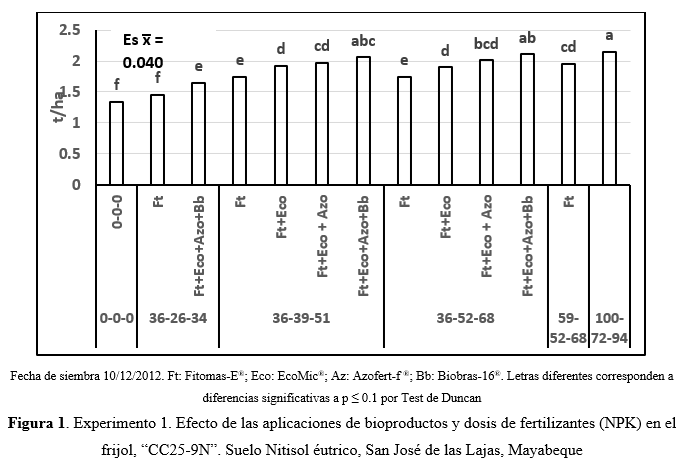
Beans are an important food in the Cuban diet and their production is limited by a deficient supply of nutrients, due to the difficult economic situation. Different bioproducts have been developed in the country that provide nutrients and/or increase the efficiency of nutrient utilization. This work was carried out to establish criteria for effectively managing bioproducts and their relationship with the required fertilizer doses. Five experiments were carried out in experimental areas of the National Institute of Agricultural Sciences, with the cultivar CC-25-9N in Eutric Nitisols soils, from 2013 to 2016. Various combinations of the bioproducts EcoMic®, Fitomas-E®, Azofert-f®, Biobras-16®, Quitomax®, and Pectimorf® were studied in randomized blocks, from the application of two to six and various doses of NPK fertilizer. A beneficial response to the combined application of bioproducts was found, depending on the dose of fertilizer applied and the maximum yield obtained. For yield levels between 1.96 and 2.05 t ha-1, it was necessary to apply doses of 36-39-51 kg ha-1 which decreased to 36-26-34 for yields between 1.6 and 1.8 t ha-1. The application of Quitomax® and Biobras-16® together with EcoMic®, Fitomas-E®, and Azofert-f® was effective and increased yields (p≤0.1) compared to when only one of the two was added. The inclusion of Pectimorf® was not efficient. The combined application of the bioproducts EcoMic®, Fitomas-E®, Azofert-f®, Biobras-16®, and Quitomax® to beans was effective even in the presence of low NPK fertilizer doses.
Article Details

This work is licensed under a Creative Commons Attribution-NonCommercial 4.0 International License.
Those authors who have publications with this journal accept the following terms of the License Attribution-NonCommercial 4.0 International (CC BY-NC 4.0):
You are free to:
- Share — copy and redistribute the material in any medium or format
- Adapt — remix, transform, and build upon the material
The licensor cannot revoke these freedoms as long as you follow the license terms.
Under the following terms:
- Attribution — You must give appropriate credit, provide a link to the license, and indicate if changes were made. You may do so in any reasonable manner, but not in any way that suggests the licensor endorses you or your use.
- NonCommercial — You may not use the material for commercial purposes.
- No additional restrictions — You may not apply legal terms or technological measures that legally restrict others from doing anything the license permits.
The journal is not responsible for the opinions and concepts expressed in the works, they are the sole responsibility of the authors. The Editor, with the assistance of the Editorial Committee, reserves the right to suggest or request advisable or necessary modifications. They are accepted to publish original scientific papers, research results of interest that have not been published or sent to another journal for the same purpose.
The mention of trademarks of equipment, instruments or specific materials is for identification purposes, and there is no promotional commitment in relation to them, neither by the authors nor by the publisher.
References
Suárez-Martínez SE, Ferriz-Martínez RA, Campos-Vega R, Elton-Puente JE, de la Torre-Carbot K, García-Gasca T. Bean seeds: leading nutraceutical source for human health. CyTA– Journal of Food. 2016; 14(1): 131–7. http://dx.doi.org/10.1080/19476337.2015.1063548
Programa Naciones Unidas para el Desarrollo (Ed). La cadena de valor del frijol común en Cuba. Estudio de su situación en siete municipios de las provincias Santi Spiritus y Villa Clara. Proyecto Agrocadenas. 2017.
Oficina Nacional de Estadísticas e Información (Ed.). Anuario Estadístico de Cuba 2021. Agricultura, Ganadería, Silvicultura y Pesca (Capítulo 9). Oficina Nacional de Estadísticas e Información. 2022.
Delgado Álvarez A. Coinoculación de rizobios y hongos micorrízicos arbusculares en cuatro cultivares de frijol común (Phaseolus vulgaris L.) sembrados en un suelo Ferralítico Rojo Lixiviado. Tesis de Maestría en Nutrición y Biofertilización de las Plantas. Instituto Nacional de Ciencias Agrícolas. 2022.
Oficina Nacional de Estadísticas e Información (Ed.) Anuario Estadístico de Cuba 2018. Oficina Nacional de Estadísticas e Información. 2019.
Ruiz L, Simó J, Rodríguez S, Rivera R. Las micorrizas en cultivos tropicales. Una contribución a la sostenibilidad agroalimentaria. Editorial Académica Española. 2012.
Gram G, Roobroeck D, Pypers P, Six J, Merckx R, Vanlauwe B. Combining organic and mineral fertilizers as a climate-smart integrated soil fertility management practice in sub-Saharan Africa: A meta-analysis. PLoS ONE. 2020; 15(9): e0239552. https://doi.org/10.1371/journal.pone.0239552
Chejara S, Malik K, Rani M, Bhardwaj A K. Integrated Nutrient Management: Concept, Constraints, and Advantages for A Sustainable Agriculture. Journal of Natural Resource Conservation and Management. 2021; 2(2): 85-94. https://doi.org/10.51396/ANRCM.2.2.2021.85-94
Antil R S, Raj D. Integrated nutrient management for sustainable crop production and improving soil health. In R. S. Meena (Ed.), Nutrient dynamics for sustainable crop production. 2020: 67-101. Springer Nature Singapore Pte Ltd. https://doi.org/10.1007/978-981-13-8660-2_3
Rivera R, Fernández Martín F, Ruiz Martínez L, González Cañizares P J, Rodríguez Yon Y, Pérez Ortega E, Fernández Suarez K, Martín Alonso G M, Simó González J, Sánchez Esmoris C, Riera Nelson M, de la Noval Pons B, Ruiz Sánchez M, Hernández Zardón A, Hernández Jiménez A, Plana Llerena R, Ramírez Pedroso J, Bustamante González C, Espinosa Cuellar A, Lara Franqui D. Manejo, integración y beneficios del biofertilizante micorrízico EcoMic® en la producción agrícola. Ediciones Instituto Nacional de Ciencias Agrícolas, Mayabeque, Cuba; 2020. Recuperado a partir de https://ediciones.inca.edu.cu/files/libros/beneficios del_biofertilizante_micorrízico.pdf
Morales-Mena B, Hernández-Forte I, Nápoles-García M C. Estabilidad microbiológica de los biofertilizantes Azofert®-F y Azofert®-S. Cultivos Tropicales. 2023; 44(3). https://cu-id.com/2050/v44n3e03. Recuperado a partir de https://ediciones.inca.edu.cu/index.php/ediciones/article/view/1734
Departamento de Suelos y Fertilizantes. Manual práctico para uso de bioproductos y fertilizantes líquidos. Ministerio de Agricultura. 2020.
Gaceta Oficial de la República de Cuba. Decreto-ley 64 “De la producción, desarrollo y uso de los biofertilizantes, bioestimulantes y bioplaguicidas de uso agrícola”. GOC-2023-515-O53. https://www.gaceta/oficial.gob.cu/es/gaceta-oficial-no-53-ordinaria-de-2023
Bertsch F. Absorción de nutrimentos por los cultivos. 1 era edición, San José, C.R. ACCS; 2003.
Reinprecht Y, Schram L, Marsolais F, Smith T H, Hill B, Pauls K P. Effects of Nitrogen Application on Nitrogen Fixation in Common Bean Production. Front. Plant Sci. 2020; 11:1172. https://doi.org/10.3389/fpls.2020.01172
Rivera R, González P J, Ruiz-Martinez L, Martin G, Cabrera A. Strategic Combination of Mycorrhizal Inoculants, Fertilizers, and Green Manures Improve Crop Productivity. Review of Cuban Research. In Qiang-Sheng Wu, Ying-Ning Zou, Yue-Jun He, Nong Zhou, editors. “New Research on Mycorrhizal Fungus”. Nova Publishers, USA. 2023. (eBook). https://doi.org/10.52305/GLXN2905
Witt C, Buresh R J, Peng S, Balasubramanian V, Doberman A. Nutrient Management. In: T. Fairhust; C. Witt; R. Buresh, A. Doberman, editors. Rice: A practical guide to nutrient management. 2nd Ed. International Rice Research Institute, International Plant Nutrition Institute, and International Potash Institute. 2007.
Hernández A, Pérez J, Bosch D, Castro N. Clasificación de los suelos de Cuba. Instituto Nacional de Ciencias Agrícolas, Cuba: Ediciones INCA. 2015. Available from: https://isbn.cloud/9789597023777/clasificacion-de-los-suelos-de-cuba-2015/
IUSS Working Group WRB. World Reference Base for Soil Resources. International soil classification system for naming soils and creating legends for soil maps. 4th edition. International Union of Soil Sciences (IUSS), Vienna, Austria. 2022.
Paneque V M, Calaña J M, Calderón M, Borges Y, Hernández T C, Caruncho C M. Manual de Técnicas analíticas para Análisis de suelo, foliar, abonos orgánicos y fertilizantes químicos. Ediciones Instituto Nacional de Ciencias Agrícolas. Mayabeque, Cuba. 2010. https://ediciones.inca.edu.cu/files/folletos/folleto_suelos.pdf
Herrera-Peraza R A, Furrazola E, Ferrer R L, Fernández R, Torres Y. Functional strategies of root hairs and arbuscular mycorrhizae in an evergreen tropical forest, Sierra del Rosario, Cuba. Revista CENIC Ciencias Biológicas. 2004; 35(2):113–123. https://revista.cnic.cu/index.php/RevBiol/article/view/119,9
Faure B, Benitez R, Rodriguez E, Grande O, Torres M, Pérez P. Guía Técnica para la producción de frijol común y maíz. 1ra ed. La Habana, Cuba: Instituto de Investigaciones en Fruticultura Tropical. 2014.
Corbera-Gorotiza J, Nápoles-García M C. Evaluación del efecto de rizobios y de un HMA en soya (Glycine max (L.) Merrill). Cultivos Tropicales. 2023; 44(2). https://cu-id.com/2050/v44n2e02 . Recuperado a partir de https://ediciones.inca.edu.cu/index.php/ediciones/article/view/1723
Crespo-Flores G, Ramírez J F, González P J, Hernández I. Coinoculación de cepas de rizobios y del hongo micorrízico arbuscular en Stylosanthes guianensis vc. CIAT-184. Revista Cubana de Ciencia Agrícola. 2014; 48(3):297-300. Recuperado a partir de Revista cubana de ciencia agrícola (unam.mx)
Crespo-Flores G, Ramírez-Tobías H M, Vallejo-Pérez M R, Méndez-Cortes H, González-Cañizares P J. Inoculación con rizobios y hongos micorrízicos arbusculares en plantas de Leucaena leucocephala en etapa de vivero y en sustrato con pH neutro. Tropical Grasslands Forrajes Tropicales. 2022; 10(2): 98-108. https://doi.org/10.17138/tgft(10)98-108
Freire J M, Faria S M, Zilli J E, Saggin Júnior O J, Camargo I S, Rouws J R C, Jesus E C. Symbiotic efficiency of inoculation with nitrogen-fixing bacteria and arbuscular mycorrhizal fungi in Tachigali vulgaris seedlings. Revista Árvore. 2020; 44: e4424. https://dx.doi.org/10.1590/1806-908820200000024
Kasanke S A, Cheeke T E, Moran J J, Roley S S. Tripartite interactions among free-living, N-fixing bacteria, arbuscular mycorrhizal fungi, and plants: Mutualistic benefits and community response to co-inoculation. Soil Science Society of America Journal. 2024; 88: 1000–13. https://doi.org/10.1002/saj2.20679
Espinosa A, Rivera R, Varela M, Perez A. Mycorrhizal inoculants on sweet potato (Ipomoea batata) in Eutric Cambisol soils of Cuba. Agronomía Mesoamericana. 2023; 34(3): 53725. https://doi.org/10.15517/am.2023.53725
Rivera R, Fernández F, Sánchez C, Bustamante C, Herrera R, Ochoa M. Efecto de la inoculación con hongos micorrizógenos (VA) y bacterias rizosféricas sobre el crecimiento de las posturas de cafeto. Cultivos Tropicales. 1997; 18(3): 15-23.
Pérez-Díaz A, Aranda-Azaharez R, Rivera R, Bustamante-González C A, Perez-Suarez Y. Indicadores de calidad para posturas microinjertadas de Theobroma cacao inoculadas con hongos micorrízicos arbusculares. Agronomía Mesoamericana. 2023; 34(2): 51102, https://doi.org/10.15517/am.v34i2.51102
Corbera J G, Nápoles M C. Efecto de la inoculación conjunta Bradyrhizobium elkanii-Hongos MA y la aplicación de un bioestimulador del crecimiento vegetal en soya (Glycine max (L.) Merrill), cultivar INCASOY-27. Cultivos Tropicales. 2013; 34(2): 5-11. Recuperado a partir de https://ediciones.inca.edu.cu/index.php/ediciones/article/view/418
Morejón-Pereda M, Herrera-Altuve J A, Ayra-Pardo C, González-Cañizares P J, Rivera-Espinosa R, Fernández-Parla Y, Peña-Ramírez E, Rodríguez P, Rodríguez-de la Noval C, de la Noval-Pons B. Alternatives in the nutrition of transgenic maize FR-Bt1 (Zea mays L.): response in growth, development, and production. Cultivos Tropicales. 2017; 38(4), 146-55. Recuperado a partir de https://ediciones.inca.edu.cu/index.php/ediciones/article/view/1414
Gonzalez-Cañizares P J, Ramirez-Pedroso J, Rosseaux R, Rivera R. Biofertilización con Gluconacetobacter diazotrophicus y Funneliformis mosseae en pasto guinea (Megathyrsus maximus vc. Likoni). Nota técnica. Cuban Journal of Agricultural Science. 2022; 56(3): 201-6. Recuperado a partir de Revista cubana de ciencia agrícola (unam.mx)
Dell Amico J, Morales D, Jerez E, Rodríguez P, Álvarez I, Martín R, Días Y. Efecto de dos variantes de riego y aplicaciones foliares de Pectimorf® en el desarrollo del frijol (Phaseolus vulgaris L.). Cultivos Tropicales. 2017; 38(3): 129–34. Recuperado a partir de https://ediciones.inca.edu.cu/index.php/ediciones/article/view/18
Lara-Acosta D, Ramírez-Yañez M, Leija-Salas A, Hernández-Delgado G,
Nápoles-García M C, Falcón-Rodríguez A B. Oligogalacturónidos como alternativa para incrementar la nutrición nitrogenada y el crecimiento en frijol común (Phaseolus vulgaris L.). Agronomia Mesoamericana. 2023; 34(3): 53817, https://doi.org/10.15517/am.2023.53817