Participatory Varietal Selection (PVS): a rice breeding approach aimed at the target population
Article Sidebar
Main Article Content
Abstract
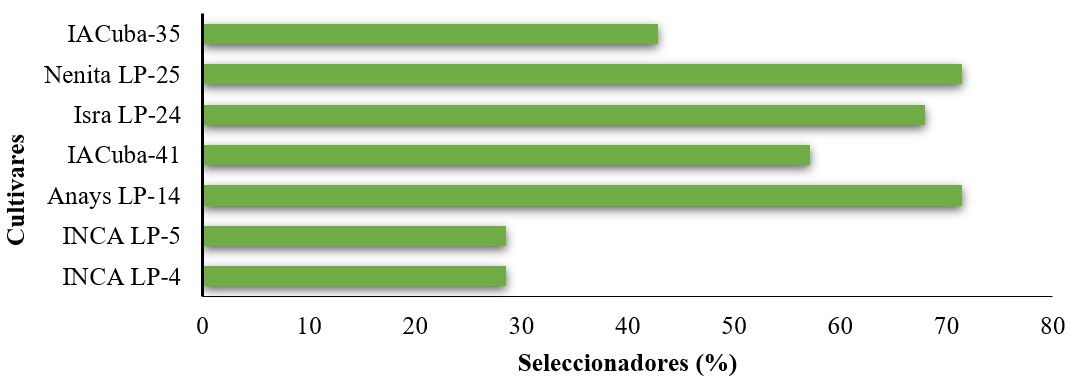
Participatory Varietal Selection combines the interests of producers and breeders to obtain and adopt promising rice genotypes that respond better to different soil and climatic conditions. The work was carried out in Los Palacios municipality, Pinar del Río Province, Cuba, with the objective to identify the cultivars with greater acceptance and the agronomic criteria of greater consideration from the perspective of the participants. The participatory selection was carried out at the Agrodiversity Fair where 18 cultivars were exposed and researchers from Paraguay and Panama participated, as well as Cuban actors from both sexes linked to the rice productive chain. The cultivars with the greatest acceptance and the most relevant agronomic criteria were identified. The most selected cultivars were Anays LP-14, Nenita LP-25 and Isra LP-24 and the characters most taken into account at the time of the participatory selection were: plant erection, number of panicles/m2, number of grains/panicle, pest resistance and cycle. These activities constitute an excellent space for training and feedback in order to stimulate and strengthen the learning and interaction process of various stakeholders, as well as to accelerate the adoption of cultivars, enrich and maintain the genetic diversity of this crop and at the same time to increase yields.
Article Details

This work is licensed under a Creative Commons Attribution-NonCommercial 4.0 International License.
Those authors who have publications with this journal accept the following terms of the License Attribution-NonCommercial 4.0 International (CC BY-NC 4.0):
You are free to:
- Share — copy and redistribute the material in any medium or format
- Adapt — remix, transform, and build upon the material
The licensor cannot revoke these freedoms as long as you follow the license terms.
Under the following terms:
- Attribution — You must give appropriate credit, provide a link to the license, and indicate if changes were made. You may do so in any reasonable manner, but not in any way that suggests the licensor endorses you or your use.
- NonCommercial — You may not use the material for commercial purposes.
- No additional restrictions — You may not apply legal terms or technological measures that legally restrict others from doing anything the license permits.
The journal is not responsible for the opinions and concepts expressed in the works, they are the sole responsibility of the authors. The Editor, with the assistance of the Editorial Committee, reserves the right to suggest or request advisable or necessary modifications. They are accepted to publish original scientific papers, research results of interest that have not been published or sent to another journal for the same purpose.
The mention of trademarks of equipment, instruments or specific materials is for identification purposes, and there is no promotional commitment in relation to them, neither by the authors nor by the publisher.
References
Begna T. Importance of Participatory Variety Selection and Participatory Plant Breeding in Variety Development and Adoption. Advances in Crop Science and Technology. 2022;10: 497. Available from: https://www.researchgate.net/profile/Temesgen-Begna/publication/359203518_importance-of-participatory-variety-selection-and-participatory-plant-breeding-in-variety-development-and-adoption/links/622e1c5b97401151d2172115/importance-of-participatory-variety-selection-and-participatory-plant-breeding-in-variety-development-and-adoption.pdf
Krishna VV, Veettil PC. Gender, caste, and heterogeneous farmer preferences for wheat varietal traits in rural India. PLoS ONE. 2022;17(8): e0272126. https://doi.org/10.1371/journal.pone.0272126
Weltzien E, Rattunde F, Christinck A, Isaacs K, Ashby J. Gender and Farmer Preferences for Varietal Traits. In Plant Breeding Reviews, I. Goldman (Ed.). 2019. https://doi.org/10.1002/9781119616801.ch7
Fatondji Y, Adoukonou H, Sognigbe N, Gandonou C, Vodouhè RS. Farmers’ preferences for varietal traits, their knowledge and perceptions in traditional management of drought constraints in rice cropping in Benin: Implications for Rice Breeding. Journal of Agricultural Science. 2020;12(11). doi:10.5539/jas.v12n11p56.
Aristya VE, Taryono, Trisyono YA, Mulyo JH. Stakeholder preferences on major characteristics of promising rice lines. IOP Conf. Ser. Earth Environ. Sci. 2021; (686), 012056. doi:10.1088/1755-1315/686/1/012056.
Burman D, Maji B, Singh S, Mandal S, Sarangi SK, Bandyopadhyay BK, Bal A.R, Sharma DK, Krishnamurthy SL, Singh HN, et al. Participatory evaluation guides the development and selection of farmers’ preferred rice varieties for salt- and flood-affected coastal deltas of South and Southeast Asia. Field Crops Res. 2018, 220, 67–77. https://doi.org/10.1016/j.fcr.2017.03.009
Ceccarelli S, Grando S. Return to Agrobiodiversity: Participatory Plant Breeding. Diversity 2022;14: 126. https://doi.org/10.3390/d14020126
Díaz S, Morejón R, Maqueira L, Echevarría A, Cruz A, Roján O. Selección participativa de cultivares de soya (Glycine max, L.) en Los Palacios, Pinar del Río, Cuba, Cultivos Tropicales. 2019; 40(4):1-13. Available from: https://www.redalyc.org/journal/1932/193263189002/193263189002.pdf
Díaz S, Morejón R, Maqueira L, Echevarría A, Cruz A. Selección participativa de cultivares de frijol (Phaseolus vulgaris L.) en Los Palacios, Pinar del Río. Cultivos Tropicales. 2021; 42(4). Available from: https://www.redalyc.org/journal/1932/193270002008/193270002008_2.pdf.
Viera FJ, Hernández L, Viera D. Fitomejoramiento participativo del frijol común (Phaseolus vulgaris L.) en el municipio Manatí, Cuba. Agronomía y Ambiente. Argentina. 2022; 22(1). Available from: http://agronomiayambiente.agro.uba.ar/index.php/AyA/article/view/200
Escalona L, Estrada A, Álvarez A. Selección participativa de cultivares de Phaseolus vulgaris L. en la Finca “La Victoria”, municipio Guisa, Granma. Avances. 2023; 25(1): 80-95. Available from: http://avances.pinar.cu/index.php/publicaciones/article/view/738/2065
MINAG. Instructivo Técnico Cultivo de Arroz. Instituto de Investigaciones del Arroz, MINAG. 2014. 73 p. Available from: https://isbn.cloud/9789597210863/instructivo-tecnico-cultivo-de-arroz/
Akter S, Erskine W, Spyckerelle L, et al. The impact of women’s access to agricultural extension on cropping practices in Timor-Leste. Food Security. 2020; 12, p. 449-463. https://doi.org/10.1007/s12571-020-01007-0
Pérez NJ, González MC, Cristo E. Diversidad fenotípica de cultivares cubanos de arroz obtenidos por el INCA en el período 1984-2020. Cultivos Tropicales. 2022; 43(4). Available from: https://ediciones.inca.edu.cu/index.php/ediciones/article/view/1717
Rice KG, Ashby JS. An efficient method for classifying perfectionists. Journal of Counseling Psychology, 2007; 54(1):72–85. https://doi.org/10.1037/0022-0167.54.1.72
Katiyar D, Srivastava KK, Prakash S, Kumar M, Gupta M. Study correlation coefficients and Path Analysis for Yield and its Component characters in Rice (Oryza sativa L.). Journal of Pharmacognosy and Phytochemistry. 2019; 8(1):1783-1787. Available from: https://www.phytojournal.com/archives/2019/vol8issue1/PartAD/8-1-424-708.pdf.
Acevedo MA, Silva R, Álvarez R, Torres O, Reyes E. Environmental stratification of rice by genotype x environment interaction analysis using five methods.Agronomía Mesoamericana. 2019; 31(1): 43–57. https://doi.org/10.15517/am.v31i1.35187
Jeevula BN, Eswara NPR, Ramesh PB, Srividhya A. Correlation and path coefficient analysis of rice genotypes for their yield components under drought condition. Journal of Pharmacognosy and Phytochemistry 2019; 8(4): 784-787. Available from: https://www.phytojournal.com/archives/2019/vol8issue4/PartN/8-4-76-967.pdf
Mervat MA, Osman A, Zidan A, Nada AM. Path coefficient analysis and correlation for some yield and its attributes in rice (Oryza sativa L.). Journal Plant Production, Mansoura University. 2019; 10(7): 539- 542. Available from: https://jpp.journals.ekb.eg/article_53550_0bd7d3a1cf3ff808ffd7d87d678e75e4.pdf
Dhungana B, Gautam J, Adhikari A, Ale P, Adhikari A, Subedi S, Adhikari BB, Dhakal KH. Varietal evaluation and preference analysis of sixteen released rice varieties in Bhojad, Chitwan, Nepal. International Journal of Environmental & Agriculture Research. 2022; 8(3): 73-78. https://doi.org/10.5281/zenodo.6402287
Aristya VE, Trisyono YA, Mulyo JH. Participatory varietal selection for promising rice lines. Sustainability 2021 ;13, 6856. https://doi.org/10.3390/su13126856
Morejón R, Díaz S, Díaz GS, Pérez N, Ipsán D. Algunos aspectos del manejo de la semilla de arroz por productores del sector cooperativo campesino en dos localidades de Pinar del Río. Cultivos Tropicales. 2014; 35(2):80-5. Available from: https://www.redalyc.org/pdf/1932/193230070010.pdf
Ramchander S, Andrew MT, Souframanien J, Arumugam M. Genetic diversity, allelic variation and marker trait associations in gamma irradiated mutants of rice (Oryza sativa L.), International Journal of Radiation Biology. 2022; 98(1), 90-99, https://doi.org/10.1080/09553002.2021.1987568.
Bissah MN, Kotey DA, Tongoona P, Egbadzor KF, Gracen V, Danquah EY. Factors influencing rice production in the south-eastern belt of Ghana. Heliyon. 2022; 8 e12404. https://doi.org/10.1016/j.heliyon.2022.e12404.
Makino Y, Hirooka Y, Homma K, Kondo R, Liu TS, Tang L. Effect of flag leaf length of erect panicle rice on the canopy structure and biomass production after heading. Agronomy & Crop Ecology. 2022; 25(1). https://doi.org/10.1080/1343943X.2021.1908152
Tesfaye D. Participatory variety selection of field pea (Pisum sativum L.) and tools to understand farmer’s selection criteria in major field pea producing areas of south Eastern Arsi Zone of Ethiopia. Research International Journal of Plant Science and Ecology. 2021: 001-006. https://doi.org/10.37179/rijpse.000002
Martey E, Etwire PM, Adogoba DS, Tengey TK. Farmers’ preferences for climate-smart cowpea varieties: implications for crop breeding programs. Climate and Development, 2021;14(2), 105–120. https://doi.org/10.1080/17565529.2021.1889949
Goa Y, Bassa D, Gezahagn G, Chichaybelew M. Farmers Participatory Evaluation of Chickpea Varieties in Mirab Badwacho and Damot Fullasa districts of southern Ethiopia. Hydrol Current Res. 2017;8: 264. https://doi.org/10.4172/2157-7587.1000264
De Haan S, Salas E, Fonseca C, Gastelo M, Amaya N, Bastos C, Hualla V, Bonierbale M. Selección participativa de variedades de papa (SPV) usando el diseño mama y bebe: una guía para capacitadores con perspectiva de género. Centro Internacional de la Papa, Lima (Perú), 2017, p. 82. https://doi.org/10.4160/9789290604754