Optimization of in vitro disinfection and establishment of Tithonia diversifolia ICACuba Oc-10
Article Sidebar
Main Article Content
Abstract
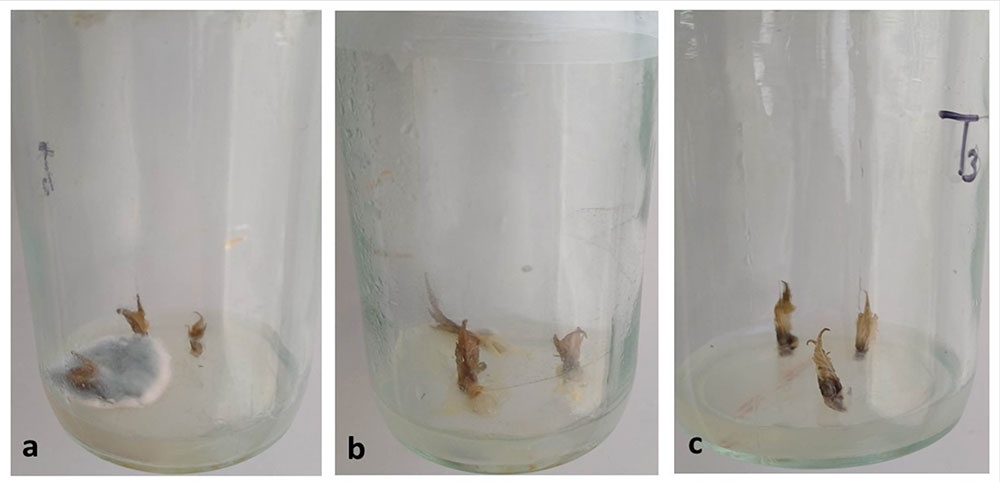
Disinfection and in vitro establishment are critical stages in tissue culture. In Tithonia diversifolia, the response to these phases is unknown; therefore, the objective of the following study was to optimize surface disinfection with sodium hypochlorite (NaClO) and the in vitro establishment of apical buds of T. diversifolia ICACuba Oc-10. The research was carried out at the Plant Biotechnology Laboratory of the Faculty of Agronomy at the Agrarian University of Havana, using apical buds of T. diversifolia ICACuba Oc-10 as plant material for in vitro implantation. The experiment followed a completely randomized design with four treatments consisting of 1, 4, and 6 % NaClO, and a control with sterile distilled water. At seven days, the variables percentage of total contaminated explants, explants contaminated with fungi and bacteria were evaluated, and sprouting was assessed at ten days during the in vitro establishment phase. The 6 % NaClO concentration was most effective for surface disinfection of apical buds of T. diversifolia ICACuba Oc-10 and for eliminating fungal and bacterial contamination at seven days of in vitro establishment. Fungal contamination was found in all treatments with NaClO concentrations below 6 %; however, bacterial contamination only occurred in the control. No explant sprouting was observed at ten days, suggesting the need for a longer establishment period.
Article Details

This work is licensed under a Creative Commons Attribution-NonCommercial 4.0 International License.
Those authors who have publications with this journal accept the following terms of the License Attribution-NonCommercial 4.0 International (CC BY-NC 4.0):
You are free to:
- Share — copy and redistribute the material in any medium or format
- Adapt — remix, transform, and build upon the material
The licensor cannot revoke these freedoms as long as you follow the license terms.
Under the following terms:
- Attribution — You must give appropriate credit, provide a link to the license, and indicate if changes were made. You may do so in any reasonable manner, but not in any way that suggests the licensor endorses you or your use.
- NonCommercial — You may not use the material for commercial purposes.
- No additional restrictions — You may not apply legal terms or technological measures that legally restrict others from doing anything the license permits.
The journal is not responsible for the opinions and concepts expressed in the works, they are the sole responsibility of the authors. The Editor, with the assistance of the Editorial Committee, reserves the right to suggest or request advisable or necessary modifications. They are accepted to publish original scientific papers, research results of interest that have not been published or sent to another journal for the same purpose.
The mention of trademarks of equipment, instruments or specific materials is for identification purposes, and there is no promotional commitment in relation to them, neither by the authors nor by the publisher.
References
Rivera-Herrera, J. E., Ruíz-Vásquez, T., Chará-Orozco, J., Gómez-Leyva, J. F. & Barahona-Rosales, R. Fases de desarrollo y propagación de ecotipos destacados de Tithonia diversifolia (Hemsl.) A. Gray. Revista mexicana de ciencias pecuarias. 2021; 12(3): 811-827. Available from: https://doi.org/10.22319/rmcp.v12i3.5720
Murgueitio, E. Tithonia diversifolia, una Asterácea diferente: su función en los sistemas sostenibles de producción agropecuaria. Cuban Journal of Agricultural Science. 2023; 57: 1-9. Available from: https://cjascience.com/index.php/CJAS/article/view/1090
Ruíz, T. E., J. Febles, G., Alonso, J., Torres, V., Valenciaga, N., Galindo, J., Mejías, R. & Medina , Y. Comportamiento agronómico en pastoreo de materiales destacados de Tithonia diversifolia en Cuba. Avances en investigación Agropecuaria. 2023; 27(1): 136-145. Available from: https://doi.org/10.53897/RevAIA.23.27.26
Nikoloff, N. No siempre sale todo bien. In: Plantas de probeta: manual para la propagación de plantas por cultivo de tejidos in vitro. Sharry, S. E., Adema, M. & Abedini, W. (eds). Ed. Universidad Nacional de La Plata (EDULP), Buenos Aires, Argentina; 2015. ISBN: 978-950-34-1254-1. pp. 1-102. Available from: https://libros.unlp.edu.ar/index.php/unlp/catalog/book/407
Ramírez, C. L. A., Granados, M. J. E. & Carreño, G. N. E. Evaluación del efecto de tratamientos de desinfección con hipoclorito de sodio sobre segmentos nodales de Guadua angustifolia Kunth para el establecimiento del cultivo in vitro. Revista de Investigación Agraria y Ambiental. 2014; 5(1): 155-169. Available from: https://doi.org/10.22490/21456453.944
Díaz, L. M. I., Flor, B. B. A., Enciso, G. C. R. & González, S. L. R. El carbón activado y las condiciones de oscuridad en la micropropagación de banana variedad Nanicão. Revista Colombiana de Biotecnología. 2016; 18(2): 140-146. Available from: http://dx.doi.org/10.15446/rev.colomb.biote.v18n2.55618
Murashige, T. & Skoog, F. A revised medium for rapid growth and biossays with tobacco tissue culture. Physiologia Plantarum. 1962; 15: 473-497. Available from: https://doi.org/10.1111/j.1399-3054.1962.tb08052.x
Fisher, R. A. & Yates, F. Statistical Tables for Biological, Agricultural and Medical Research. Ed. Oliver & Boyd, Edinburgh and London; 1958. p. 146. Available from: https://digital.library.adelaide.edu.au/server/api/core/bitstreams/21f22d02-4a39-4650-8f09-71434ad02897/content
Font, H., et al. Paquete estadístico ComparPro versión 1. Departamento de Biomatemática, Instituto de Ciencia Animal, San José de las Lajas, Mayabeque, Cuba, 2007. Available from: https://scholar.google.com/scholar?hl=es&as_sdt=0%2C5&q=Font%2C+H.%2C+Noda%2C+A.%2C+Torres%2C+V.%2C+Herrera+M.%2C+Lizazo+D.%2C+Sarduy%2C+L.+%26+Rodr%C3%ADguez%2C+L.+ComparPro+versi%C3%B3n+1.+Instituto+de+Ciencia+Animal%2C+Dpto+Biomatem%C3%A1tica%3B+2007.&btnG
Díaz-Lezcano, M. I., Pereira-Báez, K. D., Brítez -Moreira, J. R., Mongelós-Franc, J. Y. & Mussi-Cataldi, C. E. Efecto de la concentración del hipoclorito de sodio sobre la contaminación y oxidación de meristemas en la micropropagación de banano. Reportes Científicos De La FACEN. 2025; 14(2): 156-164. Available from: https://doi.org/10.18004/rcfacen.2023.14.2.156
Ancasi, R., Montero, J., Ferreira, N. & Muñoz, I. Determinación un mejor medio de cultivo en la fase de establecimiento para la propagación in vitro de plátano (Musa paradisiaca L). Journal of the Selva Andina Research Society. 2016; 7(2): 104-111. Available from: http://www.scielo.org.bo/pdf/jsars/v7n2/v7n2_a08.pdf
Quezada, M. A. E. & Almanza, L. L. C. Efecto de diferentes concentraciones y tiempos de inmersión de hipoclorito de sodio en el establecimiento in vitro de Asaí (Euterpe precatoria Mart). Apthapi. 2023; 9(3): 2572-2582. Available from: https://doi.org/10.53287/hayv6872nv19u
Dutra, L. F. & da Silva, N. D. G. Estabelecimiento In Vitro de Erva-Mate (Ilex paraguariensis St. Hil.). Embrapa Clima Temperado. 2009; 215: 1-7. Available from: http://www.infoteca.cnptia.embrapa.br/bitstream/doc/747440/1/comunicado215.pdf
Sivanesan, I., Muthu, M., Gopal, J., De Shadma, T., Doo Hwan, K. & Wook Oh, K. A fumigation-based surface sterilization approach for plant tissue culture. International Journal of Environmental Research and Public Health. 2021; 18(5): 11. Available from: https://doi.org/10.3390/ijerph18052282
Borges G., M., Estrada A., E., Pérez R., I., & Meneses R., S. Uso de distintos tratamientos de desinfección en el cultivo in vitro de Dioscorea alata L. clon caraqueño. Revista Colombiana de Biotecnología. 2009; 11(2): 127-135. Available from: https://revistas.unal.edu.co/index.php/biotecnologia/article/view/11747
Lapiz-Culqui, Y. K., Tejada-Alvarado, J. J., Meléndez-Mori, J. B., Vilca-Valqui, N. C., Huaman-Huaman, E. & Oliva, M. Establecimiento y multiplicación in vitro de papayas de montaña: Vasconcellea chachapoyensis y Vasconcellea x Heilbornii. Bioagro. 2021; 33(2): 135-142. Available from: https://doi.org/10.51372/bioagro332.7