Effect of Bioenraiz® inoculation and its final fermentation on the growth and physiology of rice (Oryza sativa L.), cultivar ¨Selección 1¨
Article Sidebar
Main Article Content
Abstract
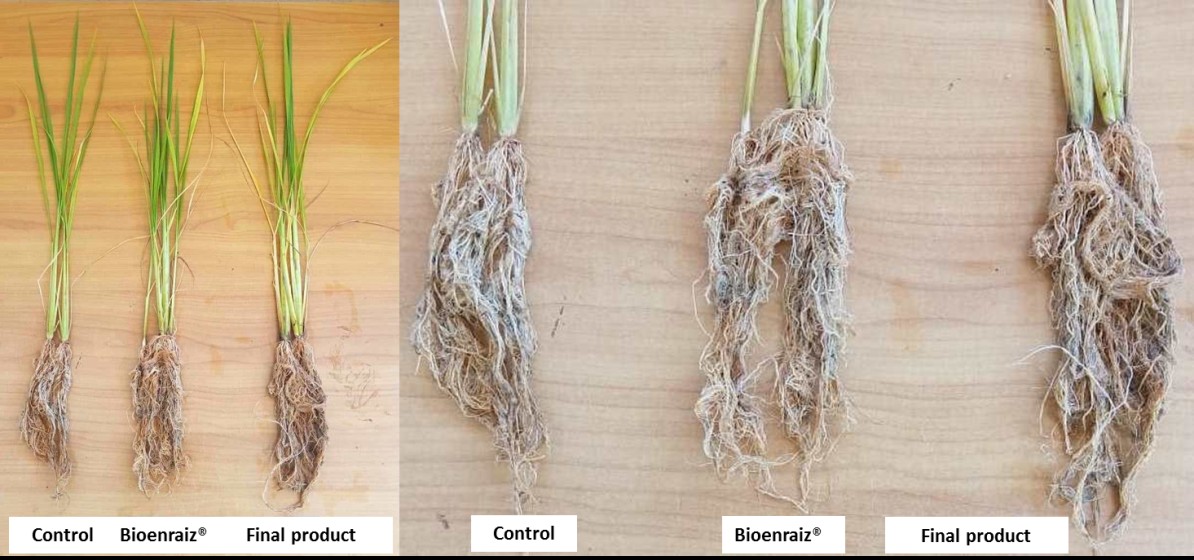
A little evidence in Cuba addresses the biostimulant effect of Bioenraiz® in agriculture which has high concentration of metabolites with auxinic activity. The objective of the work was determine the effect of Bioenraiz® and the final product resulting from the fermentation with the strain Rhizobium sp. on the growth and some physiological parameters of the rice cultivar “Selección 1”. Seedlings roots of rice cultivar “Selección 1” were soaked in both bioproducts for twenty minutes, and later they were transplanted into pots with Red Ferralitic soil. The plants were maintained in semi-controlled conditions for 60 days and then the plant height, root length, dry weight of the aerial and root parts, the total content of chlorophylls a, b and total chlorophylls and the total content of carotenoids were determined. Bioenraiz® produced positive effects on the root length and root dry weight of rice plants. No effect of both products was seen on the chlorophyll and carotenoid content. This is the first report in Cuba when a beneficial effect of Bioenraiz® was showed in rice crop.
Article Details

This work is licensed under a Creative Commons Attribution-NonCommercial 4.0 International License.
Those authors who have publications with this journal accept the following terms of the License Attribution-NonCommercial 4.0 International (CC BY-NC 4.0):
You are free to:
- Share — copy and redistribute the material in any medium or format
- Adapt — remix, transform, and build upon the material
The licensor cannot revoke these freedoms as long as you follow the license terms.
Under the following terms:
- Attribution — You must give appropriate credit, provide a link to the license, and indicate if changes were made. You may do so in any reasonable manner, but not in any way that suggests the licensor endorses you or your use.
- NonCommercial — You may not use the material for commercial purposes.
- No additional restrictions — You may not apply legal terms or technological measures that legally restrict others from doing anything the license permits.
The journal is not responsible for the opinions and concepts expressed in the works, they are the sole responsibility of the authors. The Editor, with the assistance of the Editorial Committee, reserves the right to suggest or request advisable or necessary modifications. They are accepted to publish original scientific papers, research results of interest that have not been published or sent to another journal for the same purpose.
The mention of trademarks of equipment, instruments or specific materials is for identification purposes, and there is no promotional commitment in relation to them, neither by the authors nor by the publisher.
References
MINAG. Modificaciones al Instructivo Técnico Para el Cultivo del Arroz. La Habana, Cuba. 2022. 30p
Bogusz P, Rusek P, Brodowska MS. Suspension fertilizers: How to reconcile sustainable fertilization and environmental protection. Agriculture. 2021; 11(10): 1-14. ISSN: 2077-0472
Rani L, Thapa K, Kanojia N, Sharma N, Singh S, Grewal AS, et al. An extensive review on the consequences of chemical pesticides on human health and environment. Journal of cleaner production. 2021; 283: 124657. https://doi.org/10.1016/j.jclepro.2020.124657
Concha Vidal C, Doerner P. The impact of the rhizobia–legume symbiosis on host root system Architecture. Journal of Experimental Botany. 2020; 71(13): 3902–3921. https://doi.org/10.1093/jxb/eraa198
Barquero M, Poveda J, Laureano-Marín AM, Ortiz-Liébana N, Brañas J, González-Andrés F. Mechanisms involved in drought stress tolerance triggered by rhizobia strains in wheat. Frontiers in Plant Science. 2022; 13, 1036973. https://doi.org/10.3389/fpls.2022.1036973
Kumar H, Sanodiya JD. Influence of biofertilizer and organic manures on growth and yield of baby corn (Zea mays L.) in Prayagraj condition. The Pharma Innovation Journal. 2022; 11(8): 891–89. ISSN (P): 2349-8242
Verma, M, Singh A, Dwivedi DH, Arora NK. Zinc and phosphate solubilizing Rhizobium radiobacter (LB2) for enhancing quality and yield of loose leaf lettuce in saline soil. Environmental Sustainability. 2020; 3(2): 209-218. https://doi.org/10.1007/s42398-020-00110-4
Manzano-Gómez LA, Rincón-Rosales R, Flores-Felix JD, Gen-Jimenez A, Ruíz-Valdiviezo VM, Ventura-Canseco LMC, et al. Cost-Effective Cultivation of Native PGPB Sinorhizobium Strains in a Homemade Bioreactor for Enhanced Plant Growth. Bioengineering. 2023; 10(8): 960. https://doi.org/10.3390/bioengineering10080960
FAO. Food Outlook Biannual Report on Global Food Markets. 2023. Available online: http://www.fao.org/economic/est/estcommodities/oilcrops/oilcrop-policies/en/ (accessed on 10 Noviembre 2023).
Hernández I, Nápoles MC. Rhizobia Promote Rice (Oryza sativa L.) Growth: First Evidence in Cuba. In: González F, Zúñiga D, Ormeño E, editors. Microbial Probiotics for Agricultural Systems: Advances in agronomics use. Springer Nature Switzerland AG; 2019. p. 155–168. dpi:10.1007/978-3-030-17597-9_10
Hernández I, Taulé C, Pérez-Pérez R, Battistoni F, Fabiano E, Rivero D, et al. Endophytic rhizobia promote the growth of Cuban rice cultivar. Symbiosis. 2021a; 85(2), 175–190. https://doi.org/10.1007/s13199-021-00803-2
Hernández I, Pérez-Pérez R, Nápoles MC, Maqueira LA, Rojan O. Rhizospheric rhizobia with potential as biofertilizers from Cuban rice cultivars. Agronomía Colombiana. 2021b; 39(1), 22-33. https://doi.org/10.15446/agron.colomb.v39n1.88907
Beiro O, Echevarría ME, Fraga R, Suárez A, Domínguez J, Trujillo A, et al. Toxicidad aguda por contacto del Bioenraiz® en abejas (Apis mellifera). Revista de Toxicología. 2003. 39-50. ISSN 1697-0748.
González ME, Rosales PR, Castilla Y, Lacerra JA, Ferrer M. Effect of Bioenraiz® as stimulant of coffee plants (Coffea arabica L.) germination and the development. Cultivos Tropicales. 2015; 36 (1): 73–79
Arnon DI. Copper enzymes in isolated chloroplasts. Polyphenoloxidase in Beta vulgaris. Plant physiology.1949; 24(1): 1–15. https://doi.org/10.1104/pp.24.1.1
Chi F, Yang P, Han F, Jing Y, Shen S. Proteomic analysis of rice seedlings infected by Sinorhizobium meliloti 1021. Proteomics. 2010; 10(9): 1861-1874. https://doi.org/10.1002/pmic.200900694
Duca DR, Glick BR. Indole-3-acetic acid biosynthesis and its regulation in plant-associated bacteria. Applied microbiology and biotechnology. 2020; 104: 8607-8619. https://doi.org/10.1007/s00253-020-10869-5
Gao JL, Wang LW, Xue J, Tong S, Peng G, Sun YC, et al. Rhizobium rhizophilum sp. nov., an indole acetic acid-producing bacterium isolated from rape (Brassica napus L.) rhizosphere soil. International Journal of Systematic and Evolutionary Microbiology. 2020; 70(9): 5019-5025. https://doi.org/ 10.1099/ijsem.0.004374
Singh A, Yadav VK, Chundawat RS, Soltane R, Awwad NS, Ibrahium HA, et al. Enhancing plant growth promoting rhizobacterial activities through consortium exposure: A review. Front. Bioeng. Biotechnol. 2023; 11: 1099999. https://doi.org/10.3389/fbioe.2023.1099999
Kashyap BK, Solanki MK, Pandey AK, Prabha S, Kumar P, Kumari B. Bacillus as plant growth promoting rhizobacteria (PGPR): a promising green agriculture technology. In: Ansari, R., Mahmood, I. editors. Plant Health Under Biotic Stress; 2019. p. 219–236. https://doi.org/10.1007/978-981-13-6040-4 _11
Suhameena B, Devi S, Gowri R, Kumar A. Utilization of Azospirillum as a Biofertilizer–an overview. International Journal of Pharmaceutical Sciences and Research. 2020; 62(22): 141–145. ISSN 0976 –044X
Díaz AAV, Quintal-Vargas YY, Chale-Dzul JB, Santillán-Fernández A, Ferrera-Cerrato R, López-Hernández M. Isolation and selection of rhizospheric bacteria with biofertilizing potential for corn cultivation. Agro Productividad. 2021; 14(1): 69-73. https://doi.org/10.32854/agrop.v14i14.1854
Ferreira NS, Matos GF, Meneses CHSG, Reis Rouws JRC, Schwab S, Schwab S. Interaction of phytohormone-producing rhizobia with sugarcane mini-setts and their effect on plant development. Plant Soil. 2020; 451, 221–238. https://doi.org/10.1007/s11104-019-04388-0
Velazco A, Castro R. Estudio de la inoculación de Azospirillum brasilense en el cultivo del arroz (Variedad A´82) en condiciones de macetas. Cultivos Tropicales. 1999; 20(1): 5–9. ISSN: 1819-4087.
Degiovanni V, Berrio LE, Charry RE. Producción Eco- Eficiente del arroz en Amárica Latina. 1st ed. Cali, Colombia: Editorial Centro Internacional de Agricultura Tropical; 2010. 513 p. ISBN: 978-958-694-103-7
Duan C, Mei Y, Wang Q, Wang Y, Li Q, Hong M, et al. Rhizobium inoculation enhances the resistance of alfalfa and microbial characteristics in copper-contaminated soil. Frontiers in Microbiology. 2022; 12, 781831. https://doi.org/10.3389/fmicb.2021.781831
Hussain A, Faizan S. Rhizobium induced modulation of growth and photosynthetic efficiency of Lens culinaris Medik. Grown on fly ash amended soil by antioxidants regulation. Environmental Science and Pollution Research. 2023; 30(16): 46295–46305. https://doi.org/10.1007/s11356-023-25616-2
Taiz L, Zeiger E, Moller IM, Murphy A. Plant physiology and development. 6th ed. La Sunderland, USA: Sinauer Associates; 2015. 761 p.
Agha MS, Haroun SA, Abbas MA, Sofy MR, Mowafy AM. Growth and Metabolic Response of Glycine max to the Plant Growth‑Promoting Enterobacter Delta PSK and Bradyrhizobium japonicum Under Salinity Stress. Journal of Plant Growth Regulation. 2023; 42: 5816–5830. https://doi.org/10.1007/s00344-023-10967-4 2023