Influences of the meteorological variations on the avocado cultivars flowering of the antillean group
Article Sidebar
Main Article Content
Abstract
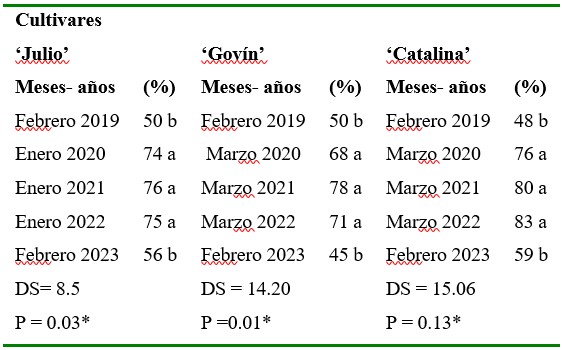
The flowering-inducing stimulus of avocado trees grown under a tropical climate is a short-term water deficit, capable of stopping vegetative growth. The objective of this work was to analyze the influence of meteorological conditions on the expression of flowering in three avocado cultivars of the Antillean group. During 2019-2023 in cv. ʻJulio̕ (early), ʻGovín̕ (middle) and ʻCatalinaʼ (late) grafted onto the cv. ʻPerreroʼ, 10 years old, planted at 6 m x 10 m on a Red Ferralitic soil, phenological observations were made using the BBCH scale on 10 randomly selected trees with a fortnightly periodicity. The percentage of the flowered tree was determined and climatic variations were evaluated through meteorological variables: maximum and minimum temperatures, temperature amplitude, precipitation and number of days with rain. The relationships between flowering intensity and meteorological variables were established for two months before the sampling date through Principal Component Analysis. The highest percentage of flowering occurred for ʻJulioʼ in January 76 %; ʻGovínʼ and ʻCatalinaʼ in March, 72 and 80 %, respectively. Meteorological variations influenced from two months before flowering, explaining around the 70 % of the accumulated variance by first two components. The association between slightly cold temperatures and a water deficit during the dry period favored the induction of the avocado flowering.
Article Details

This work is licensed under a Creative Commons Attribution-NonCommercial 4.0 International License.
Those authors who have publications with this journal accept the following terms of the License Attribution-NonCommercial 4.0 International (CC BY-NC 4.0):
You are free to:
- Share — copy and redistribute the material in any medium or format
- Adapt — remix, transform, and build upon the material
The licensor cannot revoke these freedoms as long as you follow the license terms.
Under the following terms:
- Attribution — You must give appropriate credit, provide a link to the license, and indicate if changes were made. You may do so in any reasonable manner, but not in any way that suggests the licensor endorses you or your use.
- NonCommercial — You may not use the material for commercial purposes.
- No additional restrictions — You may not apply legal terms or technological measures that legally restrict others from doing anything the license permits.
The journal is not responsible for the opinions and concepts expressed in the works, they are the sole responsibility of the authors. The Editor, with the assistance of the Editorial Committee, reserves the right to suggest or request advisable or necessary modifications. They are accepted to publish original scientific papers, research results of interest that have not been published or sent to another journal for the same purpose.
The mention of trademarks of equipment, instruments or specific materials is for identification purposes, and there is no promotional commitment in relation to them, neither by the authors nor by the publisher.
References
Cañizares J. Los Aguacateros. Editor Pueblo y Educación. Inst. Cubano del Libro, La Habana, Cuba; 1973; 282 p. Available from: https://www.institutocubanodellibro.cu
Bernal J, Díaz C. Actualización tecnológica y buenas prácticas agrícolas (BPA) en el cultivo de aguacate. En: Actualización tecnológica y buenas prácticas agrícolas (BPA) en el cultivo de aguacate; 2020. Available from: https://doi.org/10.21930/agrosavia.manual.7403831
Cuba. Tercera Comunicación Nacional a la Convención Marco de las Naciones Unidas sobre Cambio Climático. Ministerio de Ciencia, Tecnología y Medio Ambiente. 2020; 403 p. ISBN: 978-59-300-170-0. Available from: http://www.ccc.insmet.cu
Maeda T, Yonemoto Y, Hossain MA. Timing of floral differentiation in four avocado (Persea americana Mill.) cultivars on the main island of Okinawa Prefecture, Japan. Journal of Agriculture and Crops. 2023;9(3):408-12. Available from: https://doi.org/10.32861/jac.93.408.412
Fichet, LT. Reguladores de crecimiento para el control de giberelinas en la floración, cuaja y área foliar en palto. Revista Red Agrícola. 2021; N° 122. Available from: https://hdl.handle.net/20.500.14001/
Rodríguez MNN, Medina W, Rohde W, González AC, Ramírez PIM, Fuentes JLL, et al. Caracterización morfológica, bioquímica y molecular de cultivares de aguacatero (Persea americana Mill.) en Cuba. Proceedings V World Avocado Congress (Actas V Congreso Mundial del Aguacate) 2003; p47-53. Available from: https://www.researchgate.net/publication/237723515
Jiménez VR, Pérez CF, Zamora BD, Velázquez PJB. Cristian -Vanessa un cultivar de aguacate tardío para las condiciones de Cuba. Agrisost. 2015; 21(3): 10-28 ISSN 1025-0247. Available from: http://www.agrisost.reduc.edu.cu
Alcaraz ML, Thorpb TG, Hormaza JI. Phenological growth stages of avocado (Persea americana) according to the BBCH scale. Scientia Horticulturae. 2013; 164: 434–39. Available from: http://dx.doi.org/10.1016/j.scienta.2013.09.051.
Davenport TL. Avocado flowering. Hort. Rev. Westport Conn. 1986; 8: 257-89. Available from: https://www.researchgate.net
Romero JAS, Villeda MI. Manual Técnico del cultivo del aguacate en Honduras. Fundación Hondureña de Investigación Agrícola (FHIA). 2020; editor DICTA. [Cited 2025 March 31] Internet 50 p. Available from: www.dicta.gob.hn
Betancourt MG, Peralta AM, Garlobo GRG, et al. Capítulo 3. Programas que comprenden medidas para facilitar la adecuada adaptación al cambio climático. Gutiérrez TP, Alpízar MT. In: República de Cuba, Tercera Comunicación Nacional a la Convención Marco de las Naciones Unidas sobre Cambio Climático. 2020; 403 p. Editor Ministerio de Ciencia, Tecnología y Medio Ambiente. ISBN: 978-959-300-170-0, Available from: http://www.ccc.insmet.cu
Betancourt MG, Noriega CMC. Fisiología del mango y su relación con el clima. En: Cultivo y Comercialización del Mango. Instituto de Investigaciones en Fruticultura Tropical. La Habana, Cuba. 2022; 257 p. ISBN 978-959-296-068-8. Available from: https://www.undp.org
Ramírez JGG, Henao JCR, Diaz CAD, Peña AJQ, León N, Parra AC, et al. Phenological variations of avocado cv. ʻHassʼ and their relationship with thermal time under tropical conditions. Heliyon. 2023;9: e19642. Available from: https://doi.org/10.1016/j.heliyon.2023.e19642
Avilán LE, Soto M, Pérez C, Marín M, Rodríguez RJ. Comportamiento fenológico de la raza antillana de aguacate en la región centro-norte costera de Venezuela. Agronomía Tropical. 2009; 59(1):5-14. Available from: https://www.researchgate.net › publication › 26266942
Romero AMS. Comportamiento fisiológico del aguacate (Persea americana Mill.) Variedad ʻLorenaʼ en la zona de Mariquita, Tolima. Colombia. 2012; [Cited 2024 January 15] Internet 16 p. Available from: https://repositorio.unal.edu.co/bitstream/handle/unal/9437/790700.2012.pdf?sequence=1&isAllowed=y
Salazar M, Jehiner BF. Influencia de la temperatura y la humedad relativa en el periodo de floración y cosecha de palto (Persea americana Mill.) orgánico cv. ʻHassʼ en Virú, la Libertad”; 2015. [Cited 2024 January 15] Internet Available from: https://dspace.unitru.edu.pe/bitstream/handle/UNITRU/4126/SALAZAR%20MANRIQUE%20Frank.pdf?sequence=1&isAllowed=y .
Acosta RA, Mauk LR, Santiago P L, Lovatt CJ. Effects of temperature, soil moisture and light intensity on the temporal pattern of floral gene expression and flowering of avocado buds (Persea americana cv. ʻHassʼ). Scientia Horticulturae. 2021; 280: 109940. Available from: https://doi.org/10.1016/j.scienta.2021.109940
Vázquez AHD, Saavedra R, Beitia EM, Guerrero JC, Sánchez C. Cartilla de estados fenológicos-tipo en aguacate ʻHassʼ para la localidad de Roldanillo, Valle del Cauca. Proyecto Incremento de la competitividad sostenible en la agricultura de ladera en todo el departamento, Valle del Cauca, Occidente 1st ed., marzo, Bogotá, D. C., Colombia. Editor Universidad Nacional de Colombia. 2022. 36 p. ISBN impreso: 978-958-794-806-6 ISBN digital: 978-958-794-807-3. Available from: https://ladera.palmira.unal.edu.co
García JS, Salazar AH, Ceballos NA. Current overview of ʻHassʼ avocado in Colombia. Challenges and opportunities: A review. Ciencia Rural. 2021;51(8):1-9. Available from: https://doi.org/10.1590/0103-8478cr2020090
García JSA, da Silva DP, Salazar AH, Espinoza RAI, Ceballos NA. Phenology of ʻHassʼ avocado in the Andean Tropics of Caldas, Colombia. Revista Brasileira de Fruticultura. 2022; 44 (5). Available from: https://doi.org/10.1590/0100-29452022252
Hormaza I, Alcaraz L. Fisiología de la floración y cuajado. Capítulo 2. En: Namesny A, Conesa C, Hormaza I, Lobo G, editores. Cultivo, poscosecha y procesado de aguacate. SPE3, s.l., Valencia, España; 2020. p. 47-60. Available from:
https://www.poscosecha.com › biblioteca › publicaciones
Montazar A, Faber B, Corwin D, Pourreza A, Snyder RL. Quantifying evapotranspiration and crop coefficients of California ’Hass’ avocado affected by various environmental and plant factors. Agricultural Water Management. 2025; 313:10948. Available from: https://doi.org/10.1016/j.agwat.2025.109481
FAO. Informe Técnico No. 4, Listos para el cambio: Adaptando la producción de aguacate al cambio climático. División de Mercados y Comercio. Organización de las Naciones Unidas para la Alimentación y la Agricultura. 2023. CC7119ES/1/08.23. 5p. Available from: www.fao.org/markets-and-trade