Evaluation of rice advanced lines (Oryza sativa L.) obtained by hybridization in Los Palacios, Cuba
Article Sidebar
Main Article Content
Abstract
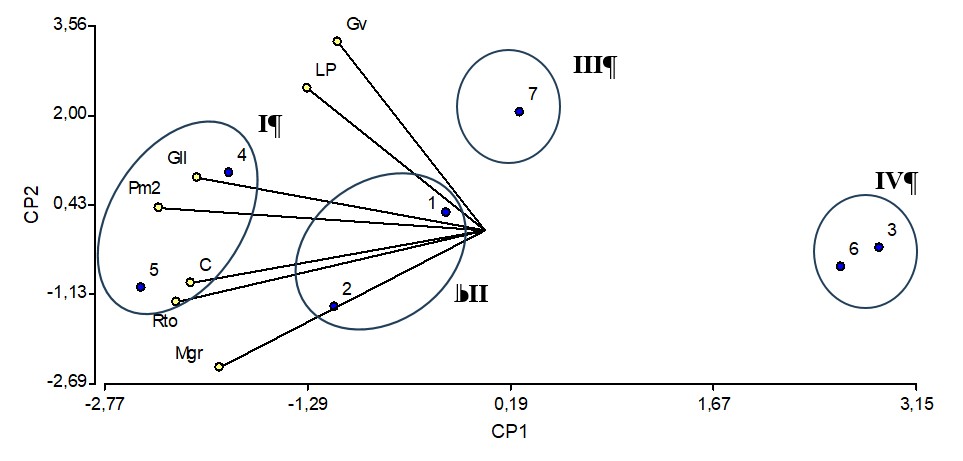
The obtaining new rice cultivars more productive in a context increasingly influenced by the effects of climate change and heterogeneous growing conditions, constitutes an important challenge for breeders. This research was developed with the objective of studying the behavior of seven advanced rice lines under flooded conditions and selecting the best ones to move on to a higher phase. A completely randomized experimental design with three repetitions was used and the genotypes constituted the treatments. The obtained information was processed through univariate and multivariate analyses. The results showed strong correlations of yield with panicles per square meter, 1000 grain mass and cycle. The Principal Components Analysis explains 83% of the total variance in its first two axes and the proposed multiple linear regression analysis model manifests more than 85 % of the yield variability. The combination of univariate and multivariate analyzes facilitated the identification of lines G/L 4, 5, 2, 3 as the most promising to include in validation studies.
Article Details

This work is licensed under a Creative Commons Attribution-NonCommercial 4.0 International License.
Those authors who have publications with this journal accept the following terms of the License Attribution-NonCommercial 4.0 International (CC BY-NC 4.0):
You are free to:
- Share — copy and redistribute the material in any medium or format
- Adapt — remix, transform, and build upon the material
The licensor cannot revoke these freedoms as long as you follow the license terms.
Under the following terms:
- Attribution — You must give appropriate credit, provide a link to the license, and indicate if changes were made. You may do so in any reasonable manner, but not in any way that suggests the licensor endorses you or your use.
- NonCommercial — You may not use the material for commercial purposes.
- No additional restrictions — You may not apply legal terms or technological measures that legally restrict others from doing anything the license permits.
The journal is not responsible for the opinions and concepts expressed in the works, they are the sole responsibility of the authors. The Editor, with the assistance of the Editorial Committee, reserves the right to suggest or request advisable or necessary modifications. They are accepted to publish original scientific papers, research results of interest that have not been published or sent to another journal for the same purpose.
The mention of trademarks of equipment, instruments or specific materials is for identification purposes, and there is no promotional commitment in relation to them, neither by the authors nor by the publisher.
References
Liu Y, Zhao S, Gao X, Fu S., Song C, Dou Y, Lin J. Combined laser-induced breakdown spectroscopy and hyperspectral imaging with machine learning for the classification and identification of rice geographical origin. RSC advances, (2022). 12(53), 34520-34530.
Rezvi HUA, Tahjib‐Ul‐Arif M, Azim MA, Tumpa TA, Tipu MMH, Najnine F, Brestič M. Rice and food security: Climate change implications and the future prospects for nutritional security. Food and Energy Security, 2023. 12(1), e430. DOI: 10.1002/fes3.430.
Álvarez R, Reyes E, Alvarado A, Valera E, Linarez Y, Ramos N, Hernández E, De la Cruz R. Caracteres morfológicos asociados a la calidad del grano de la variedad de arroz Venezuela 21. Hatun Yachay Wasi, 2023. 2(1), 42 - 53. Available from: https://doi.org/10.57107/hyw.v2i1.34
Bin Rahman AR, Zhang J. Trends in rice research: 2030 and beyond. Food and Energy Security. 2023;12(2), e390. doi: 10.1002/fes3.390.
Moreno R, Biagio R, Giannetti F, Feni A. Assessing the sustainability of rice production in Brazil and Cuba, Journal of Agriculture and Food Research. 2021(4), 100152. Available from: https://doi.org/10.1016/j.jafr.2021.100152.
Pérez NJ, González MC, Cristo E. Diversidad fenotípica de cultivares cubanos de arroz obtenidos por el INCA en el período 1984-2020. Cultivos Tropicales. 2022, 43(4). Available from: https://ediciones.inca.edu.cu/index.php/ediciones/article/view/1717.
Hernández A, Echeverría F, Abdelnour A, Valdez M, Boch J, Gatica A. Rice breeding in the new era: Comparison of useful agronomic traits. Current Plant Biology. 2021;27(100211). ISSN 2214-6628. doi: 10.1016/j.cpb.2021.100211.
Hernández A, Pérez J, Bosch D, Castro N. Clasificación de los suelos de Cuba 2015. Instituto Nacional de Ciencias Agrícolas. Cuba: Ediciones INCA. 2015. 93 p. Available from: https://isbn.cloud/9789597023777/clasificacion-de-los-suelos-de-cuba-2015/.
MINAG. Instructivo Técnico Cultivo de Arroz. Instituto de Investigaciones del Arroz. MINAG. 2014. 73 p. Available from: https://isbn.cloud/9789597210863/ instructivo-tecnico-cultivo-de-arroz/.
IRRI. Standard Evaluation System (SES) for Rice. Quinta Edición. Filipinas. 2013. 55p. Available from: https://www.clrri.org/ver2/uploads/SES_5th_edition.pdf.
Parimala K, Surender CH, Hari AS, Sudheer S, Narender S. Studies on genetic parameters, correlation and path analysis in rice (Oryza sativa L.). J Pharmacogn Phytochem 2020;9(1):414-417. Available from: https://www.phytojournal.com/ archives/2020.v9.i1.10459/studies-on-genetic-parameters-correlation-and-path-analysis-in-rice-oryza-sativa-l.
Fentie DB, Abera BB, Ali HM. Association of Agronomic Traits with Grain Yield of Lowland Rice (Oryza Sativa L.) Genotypes. International Journal of Research in Agricultural Sciences. 2021; 8(3). Available from: https://www.researchgate.net/profile/Dejen-Fentie-2/publication/365991076_Association_of_Agronomic_Traits _with_Grain_Yield_of_Lowland_Rice_Oryza_Sativa_L_Genotypes/links/638b54942c563722f23569f3/Association-of-Agronomic-Traits-with-Grain-Yield-of-Lowland-Rice-Oryza-Sativa-L-Genotypes.pdf.
Jasmin S Agalya. Assessment of variability parameters and diversity of panicle architectural traits associated with yield in rice (Oryza sativa L.). Plant Science Today. 2024,11(1). doi: 10.14719/pst.2658.
Degiovanni VM, Martínez CP, Motta OF. Producción eco-eficiente del arroz en América Latina. CIAT. 2010. Available from: https://cgspace.cgiar.org/server/ api/core/bitstreams/104df36d-0c6a-4a75-a449-3842ea064e75/content.
Singh VK, Wahi N, Mishra SK, Singh BD, Singh NK. Studies on Genetic variability, correlation analysis, character association and path analysis of phenotypic characteristics of twelve mega varieties of rice and its near-isogenic lines carrying high grain number per panicle QTL qGN4,1. Current Trends in Biotechnology and Pharmacy. 2022;16(1):35–45. doi: 10.5530/ctbp.2022.1.4.
Gunasekaran A, Seshadri G, Ramasamy S, Muthurajan R, Karuppasamy KS. Identification of Newer Stable Genetic Sources for High Grain Number per Panicle and Understanding the Gene Action for Important Panicle Traits in Rice. Plants. 2023;12,250. doi: 10.3390/plants12020250.
Devkota KP, Devkota M, Moussadek R, Nangia V. Genotype environment agronomic management interaction to enhance wheat yield in the Mediterranean rainfed environments of Morocco: II. Process based modeling. European Journal of Agronomy. 2023;151(126973). ISSN 1161-0301. doi: 10.1016/j.eja.2023.126973.
Mai W, Abliz B, Xue X. Increased Number of Spikelets per Panicle Is the Main Factor in Higher Yield of Transplanted vs. Direct-Seeded Rice. Agronomy. 2021;11(2479). doi: 10.3390/agronomy11122479.
Gengmi Li, Jiuyou Tang, Jiakui Zheng, Chengcai Chu. Exploration of rice yield potential: Decoding agronomic and physiological traits. The Crop Journal. 2021,9(3):577-589. ISSN 2214-5141. doi: 10.1016/j.cj.2021.03.014.
Maysoun M, Khaled FM, Abdelmoaty B. Definition of selection criterion using correlation and path coefficient analysis in rice (Oryza sativa L.) genotypes. Bulletin of the National Research Centre. 2020,44:143. doi: 10.1186/s42269-020-00403-y.
Science Direct. Effect of Rice Breeding Process on Improvement of Yield and Quality in China. Rice Science. 2020,27(5):363−367. doi: 10.1016/j.rsci.2019.12.009.
Nikzad M, Mazlooma P, Arabzadehb B, Moghadama MN, Ahmadia T. Application of correlation coefficients and principal components analysis in stability of quantitative and qualitative traits on rice improvement cultivation. Brazilian Journal of Biology. 2024;84(e268981). doi: 10.1590/1519-6984.268981.
Díaz SH, Morejón R. Comportamiento y selección de líneas avanzadas de arroz obtenidas por el programa de mejoramiento en Los Palacios. Cultivos Tropicales. 2017;38(1):90-97. Available from: http://scielo.sld.cu/scielo.php?script=sci_arttext&pid=S0258-59362017000 100010&lng=es&nrm=iso.
Morejón R, Díaz SH. Selección de líneas promisorias de arroz (Oryza sativa L.) provenientes del programa de mejoramiento genético en Los Palacios. Cultivos Tropicales. 2015;36(4):127-133. Available from: http://scielo.sld.cu/scielo.php?script=sci_arttext&pid=S0258-59362015000400017&lng=es&nrm=iso.
Liu Q, Yang X, Tzin V, Peng Y, Romeis J, Li Y. Plant breeding involving genetic engineering does not result in unacceptable unintended effects in rice relative to conventional cross-breeding. 2020. doi: 10.1111/tpj.14895.
Shrestha J, Subedi S, Kushwaha UKS, Maharjan B. Evaluation of growth and yield traits in rice genotypes using multivariate analysis. Heliyon. 2021;7(e07940). doi: 10.1016/j.heliyon.2021.e07940.
Thakur K, Sarma MK. Genetic diversity and principal component analysis in cultivated rice (Oryza sativa L.) varieties of Assam. The Indian Journal of Agricultural Sciences. 2023; 93(2):145–150. doi: 10.56093/ijas.v93i2.132052.
Shanmugam R, Ramanathan A, Anandhi P, Sassikumar D. Unravelling genetic diversity of South Indian rice landraces based on yield and its components. Electronic Journal of Plant Breeding. 2023;14(1):160-169. Available from: https://www.ejplantbreeding.org/ index.php/EJPB/article/view/4576.
Chowdhury N, Islam S, Mim MH, Akter S, Naim J, Nowicka B, Hossain MA. Characterization and genetic analysis of the selected rice mutant populations. SABRAO J. Breed, Genet. 2023;55(1): 25-37. doi: 10.54910/sabrao2023.55.1.3.
Devkota S, Raut SK, Shrestha S, Poudel U. Genetic Variability for Growth and Yield Traits in Rice. Journal of Tikapur Multiple Campus. 2023;6:236-248. ISSN: 2382-5227. Available from: https://www.researchgate.net/profile/Sheela-Devkota/publication/372550694_Journal of_Tikapur_Multiple_Campus_Published_by_Research_Management_Cell_RMC_Tikapur_Multiple_Campus_Genetic_Variability_for_Growth_and_Yield_Traits_in_Rice/links/64be24b78de7ed28babe82d5/Journal-of-Tikapur-Multiple-Campus-Published-by-Research-Management-Cell-RMC-Tikapur-Multiple-Campus-Genetic-Variability-for-Growth-and-Yield-Traits-in-Rice.pdf.
Li G, Tang J, Zheng J, Chu C. Exploration of rice yield potential: Decoding agronomic and physiological traits. The Crop Journal. 2021;9(3):577-589. doi: 10.1016/j.cj.2021.03.014.