Green synthesis of silver nanoparticles (AgNPs) using Rosmarinus officinalis extract and evaluation of their preservative effect on Malus domestica
Article Sidebar
Main Article Content
Abstract
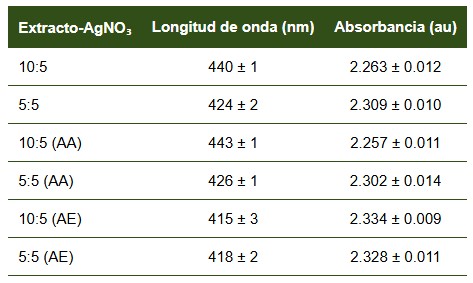
Green synthesis of silver nanoparticles (AgNPs) using plant extracts represents a sustainable approach for food preservation applications. In this study, aqueous and ethanolic extracts of Rosmarinus officinalis were employed as reducing and stabilizing agents for the formation of AgNPs, which were characterized by UV-Vis spectroscopy, showing surface plasmon resonance peaks between 415 and 443 nm. Phytochemical screening confirmed the presence of key bioactive metabolites, polyphenols, flavonoids, tannins, and saponins that supported nanoparticle formation and stability. Antimicrobial activity, assessed through disk diffusion against Escherichia coli ATCC 25922, revealed larger inhibition zones in ethanolic formulations, indicating a synergistic effect between extract constituents and AgNPs. When applied to Malus domestica fruits, the hybrid extract AgNPs system effectively reduced browning, firmness loss, and microbial deterioration during 15 days of storage. These findings highlight the potential of naturally derived AgNPs as a functional and sustainable alternative for extending the shelf life of fresh fruits and enhancing postharvest preservation technologies.
Article Details

This work is licensed under a Creative Commons Attribution-NonCommercial 4.0 International License.
Those authors who have publications with this journal accept the following terms of the License Attribution-NonCommercial 4.0 International (CC BY-NC 4.0):
You are free to:
- Share — copy and redistribute the material in any medium or format
- Adapt — remix, transform, and build upon the material
The licensor cannot revoke these freedoms as long as you follow the license terms.
Under the following terms:
- Attribution — You must give appropriate credit, provide a link to the license, and indicate if changes were made. You may do so in any reasonable manner, but not in any way that suggests the licensor endorses you or your use.
- NonCommercial — You may not use the material for commercial purposes.
- No additional restrictions — You may not apply legal terms or technological measures that legally restrict others from doing anything the license permits.
The journal is not responsible for the opinions and concepts expressed in the works, they are the sole responsibility of the authors. The Editor, with the assistance of the Editorial Committee, reserves the right to suggest or request advisable or necessary modifications. They are accepted to publish original scientific papers, research results of interest that have not been published or sent to another journal for the same purpose.
The mention of trademarks of equipment, instruments or specific materials is for identification purposes, and there is no promotional commitment in relation to them, neither by the authors nor by the publisher.
References
Novais, C.; Molina, A.K.; Abreu, R.M.V.; Santo-Buelga, C.; Ferreira, I.C.F.R.; Pereira, C.; Barros, L. Natural l. J. Agric. Food Chem. 2022, 70, 2789-2805. Available from: doi: http://doi.org/10.1021/acs.jafc.1c07533.
Meziane, H.; Zraibi, L.; Albusayr, R.; Bitari, A.; Oussaid, A.; Hammouti, B.; Touzani, R. Rosmarinus Officinalis Linn. Unveiling its multifaceted nature in nutrition, diverse applications, and advanced extraction methods. J. Umm Al-Qura Univ. Appl. Sci. 2025, 11, 9-37. Available from: doi: http://doi.org/10.1007/s43994-024-00144-y.
Adeyemi, J.O.; Fawole, O.A. Metal-based nanoparticles in food packaging and coating technologies: A Review. Biomolecules 2023, 13, 1092. Available from: doi: http://doi.org/10.3390/biom13071092.
Pardo, L.; Arias, J.; Molleda, P. Elaboración de nanopartículas de plata sintetizadas a partir de extracto de hojas de romero (Rosmarinus Officinalis L.) y su uso como conservante. La Granja 2021, 35. Available from: doi: http://doi.org/10.17163/lgr.n35.2022.04.
Solano-Doblado, L.G.; Alamilla-Beltrán, L.; Jiménez-Martínez, C. Películas y recubrimientos comestibles funcionalizados. TIP Rev. Espec. In Cienc. Quím.-Biológicas. 2018, 21, 30-42. Available from: doi: http://doi.org/10.22201/fesz.23958723e.2018.0.153.
Karnwal, A.; Malik, T. Exploring the untapped potential of naturally occurring antimicrobial compounds: novel advancements in food preservation for enhanced safety and sustainability. Front. Sustain. Food Syst. 2024, 8, 1307210. Available from: doi: http://doi.org/10.3389/fsufs.2024.1307210.
Liao, Z.; Ali, M.H.; Tu, D.; Xiong, S.; Suleiman, N. Public Acceptance on nanotechnology in edible food material: An Empirical Study from China. Int. J. Econ. Manag. 2025, 19, 67-84. Available from: doi: http://doi.org/10.47836/ijeam.19.1.05.
Flores-Villa, E.; Sáenz-Galindo, A.; Castañeda-Facio, A.O.; Narro-Céspedes, R.I. Romero (Rosmarinus Officinalis L.): Su origen, importancia y generalidades de sus metabolitos secundarios. TIP Rev. Espec. En Cienc. Quím.-Biológicas 2020, 23. Available from: doi: http://doi.org/10.22201/fesz.23958723e.2020.0.266.
Guidotti-Takeuchi, M.; De Morais Ribeiro, L.N.D.M.; Dos Santos, F.A.L.; Rossi, D.A.; Lucia, F.D.; De Melo, R.T. Essential oil-based nanoparticles as antimicrobial agents in the food industry. Microorganisms 2022, 10, 1504. Available from: doi: http://doi.org/10.3390/microorganisms10081504.
Colín-Álvarez, M.D.L.; Calderón-Domínguez, G.; Rojas-Candelas, L.E.; Rentería-Ortega, M. Revisión: Aplicación de la nanotecnología como innovación en recubrimientos alimentarios. Pädi Bol. Científico Cienc. Básicas E Ing. ICBI 2024, 12, 21-33. Available from: doi: http://doi.org/10.29057/icbi.v12iEspecial.12127.