Morphological changes in in vitro propagated pineapple varieties (‘MD-2’ and ‘Champaka F-153’) during the growth phase under field conditions
Article Sidebar
Main Article Content
Abstract
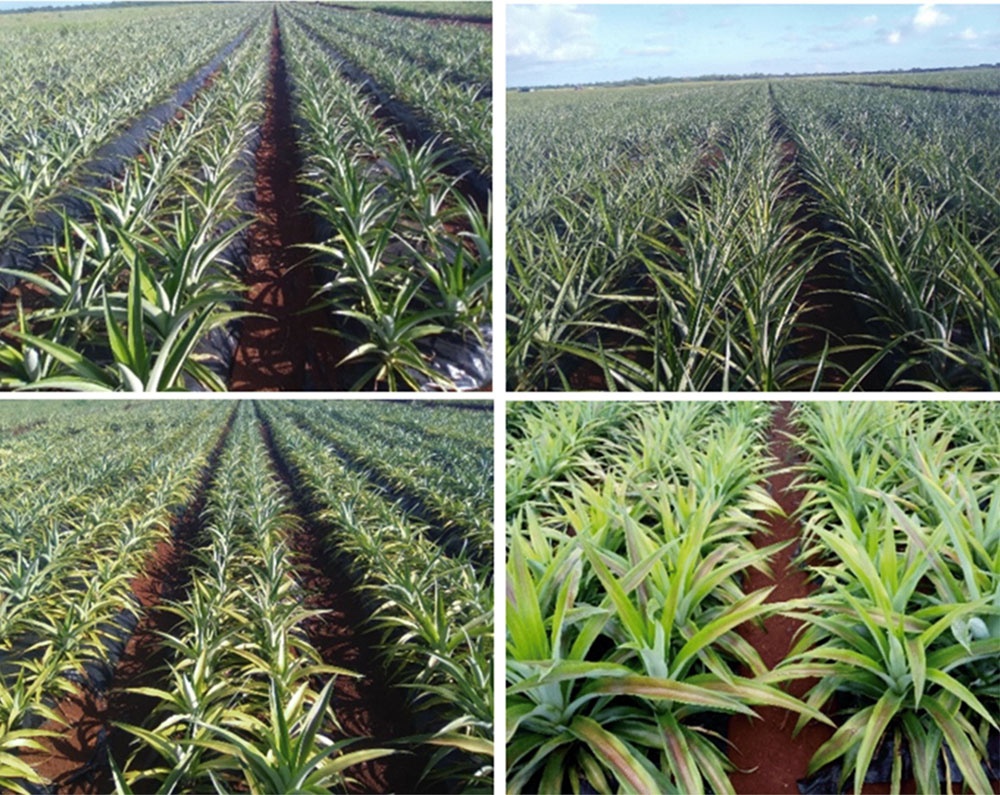
In vitro multiplication is a feasible technique for the accelerated propagation of pineapple (Ananas comosus var. comosus), particularly when introducing new varieties at a commercial scale. This study was conducted at the “Pineapple Production” Base Business Unit, part of the Ceballos Agroindustrial Company, to compare the field performance of two micropropagated pineapple varieties, hybrid ‘MD-2’ and ‘Champaka F-153’, under the edaphoclimatic conditions of Ciego de Ávila, Cuba. Plants were established at a density of 68,000 ha⁻¹ in double rows on raised beds covered with plastic mulch. A randomized complete block design with three replications per treatment was used. Every 90 days, 20 homogeneous plants per plot were randomly selected and evaluated for: survival rate, plant fresh mass, plant length, number of roots, number of leaves, and fresh mass, length, and width of the “D” leaf. Results indicated that ‘Champaka F-153’ reached 99 % survival after 90 days, while ‘MD-2’ reached 96 %. During this period, fresh mass increased by 226 g in ‘Champaka F-153’ and 156 g in ‘MD-2’, with significant differences between varieties. However, at 270 days, no significant differences were observed in the number of leaves, the number of roots, or the fresh mass of the “D” leaf. These findings suggest initial differences in adaptation and growth that tend to level off during later vegetative stages.
Article Details

This work is licensed under a Creative Commons Attribution-NonCommercial 4.0 International License.
Those authors who have publications with this journal accept the following terms of the License Attribution-NonCommercial 4.0 International (CC BY-NC 4.0):
You are free to:
- Share — copy and redistribute the material in any medium or format
- Adapt — remix, transform, and build upon the material
The licensor cannot revoke these freedoms as long as you follow the license terms.
Under the following terms:
- Attribution — You must give appropriate credit, provide a link to the license, and indicate if changes were made. You may do so in any reasonable manner, but not in any way that suggests the licensor endorses you or your use.
- NonCommercial — You may not use the material for commercial purposes.
- No additional restrictions — You may not apply legal terms or technological measures that legally restrict others from doing anything the license permits.
The journal is not responsible for the opinions and concepts expressed in the works, they are the sole responsibility of the authors. The Editor, with the assistance of the Editorial Committee, reserves the right to suggest or request advisable or necessary modifications. They are accepted to publish original scientific papers, research results of interest that have not been published or sent to another journal for the same purpose.
The mention of trademarks of equipment, instruments or specific materials is for identification purposes, and there is no promotional commitment in relation to them, neither by the authors nor by the publisher.
References
Torres-Avila A, Aguilar-Ávila J, Santoyo-Cortés VH, Martínez-González EG, Aguilar-Gallegos N. Innovation in the pineapple value chain in Mexico: Explaining the global adoption process of the ‘MD-2’ hybrid. Agricultural Systems. 2022;198:103386. Available from: https://doi.org/10.1016/j.agsy.2021.103386
Vázquez Jiménez J, Bartholomew D, Wilkerson C, Hoogenboom G, Vargas Leitón B. Optimizing agronomic practices for pineapple (Ananas comosus (L.) Merr. ‘MD-2’ cultivar) production based on growth stages. Fruits. 2023;78(3):1-10. Available from: https://doi.org/10.17660/th2023/001
Rodríguez-Alfonso D, Isidrón-Pérez M, Alfonso-González D, Grajal-Martín MJ, Hormaza-Uroz JI, Herrera-Isidrón L. Diversity of pineapple genetic resources in Cuba: threats and actions for minimizing losses. Revista Fitotecnia Mexicana. 2017;40(1):93-101. Available from: https://doi.org/10.35196/rfm.2017.1.93-101
Aguilera-Arango GA, Puentes-Díaz CL, Morillo-Coronado Y. Importance of genetic resources of pineapple (Ananas comosus (L.) Merr. var. comosus) in Colombia. Agronomía Mesoamericana. 2022;33(2). Available from: https://doi.org/10.15517/am.v33i2.47233
Uriza-Ávila DE, Torres-Ávila A, Aguilar-Ávila J, Santoyo-Cortés VH, Zetina-Lezama R, Rebolledo-Martínez A. La piña mexicana frente al reto de la innovación. Avances y retos en la gestión de la innovación. Colección Trópico Húmedo. Universidad Autónoma Chapingo (UACH); México 2018. Available from: https://www.google.com/url?sa=t&source=web&rct=j&opi=89978449&url=https://repositorio.chapingo.edu.mx/items/6728c88a-69a6-4835-974f-0aa3d9973566
Rebolledo-Martínez A, Peralta-Antonio N, Rebolledo-García RL, Becerril-Román AE, Rebolledo-Martínez L, Jaén-Contreras D, et al. Nitrogen, phosphorus and potassium content in different organs of pineapple cultivars at different planting density. Tropical and Subtropical Agroecosystems. 2023;26(2):081. Available from: https://doi.org/10.56369/tsaes.4567
Rodríguez R, Becquer R, Pino Y, López D, Rodríguez RC, Lorente González GY. Fruits production of pineapple (Ananas comosus (L.) Merr.) ‘MD-2’ from vitroplants. Cultivos Tropicales. 2016;37(especial):40-8. Available from: http://dx.doi.org/10.13140/RG.2.1.4732.3765
Isidrón M. Caracterización del germoplasma de piña colectado en Cuba mediante prospección Nacional: Localización, diversidad genética y situación actual. Cultivos Tropicales. 2003;24(1):65-71. Available from: http://ediciones.inca.edu.cu/index.php/ediciones/article/view/603
Rodríguez-Alfonso D, Isidrón-Pérez M, Barrios O, Fundora Z, Hormaza JI, Grajal-Martín MJ. Minimal morphoagronomic descriptors for Cuban pineapple germplasm characterisation. Horticultural Science (Prague). 2020;47(1):28-35. Available from: https://doi.org/10.17221/60/2018-HORTSCI
Ávila R, Rodríguez R. Introduction and diversification of new pineapple cultivars in Ceballos Agroindustrial Enterprise, Cuba. Newsletter of the Workgroup Pineapple, International Society for Horticultural Science. 2019;(26):26-7. Available from: https://www.google.com/url?sa=t&source=web&rct=j&opi=89978449&url=https://scholarspace.manoa.hawaii.edu/bitstreams/e1559406-7fbb-40fc-b062-4ffed123b8b7/download
Abdi G. Optimizing in vitro nutrient and ex vitro soil mediums-driven responses for multiplication, rooting, and acclimatization of pineapple (Ananas comosus (L.) Merr.) cv. Smooth Cayenne. Plant Cell, Tissue and Organ Culture. 2026;158(1):12. Available from: https://doi.org/10.1007/s11240-026-02845-2
Saha I, Dolui D, Ghosh A, Sarkar B, De AK, Adak MK. Assessment of Irradiation Stress in Crop Plants with Modern Technical Advances. En: Sustainable Agriculture in the Era of Climate Change. Springer; 2020. p. 235-49. Available from: https://doi.org/10.1007/978-3-030-86893-4
Restrepo-Díaz H, Sánchez-Reinoso AD. Ecophysiology of fruit crops: A glance at its impact on fruit crop productivity. En: Srivastava AK, Hu C, editores. Fruit Crops. Elsevier; 2020. p. 59-66. Available from: https://doi.org/10.1016/C2018-0-05145-5
Sinaga AOY, Marpaung DSS. Abiotic stress-induced gene expression in pineapple as a potential genetic marker. Advanced Agrochem. 2024;3(2):133-42. Available from: https://doi.org/10.1016/j.aac.2024.01.002
Fischer G, Orduz-Rodríguez JO, Amarante CVT. Sunburn disorder in tropical and subtropical fruits. A review. Revista Colombiana de Ciencias Hortícolas. 2022;16(3):e15703. Available from: https://doi.org/10.17584/rcch.2022v16i3.15703
Munné-Bosch S, Vincent C. Physiological mechanisms underlying fruit sunburn. Critical Reviews in Plant Sciences. 2019;38(2):140-57. Available from: https://doi.org/10.1080/07352689.2019.1635919
Pérez-Bonachea L, Gómez-Kosky R, Martínez M. Caracterización en campo de plantas de piña (Ananas comosus (L.) Merr.) cultivar ‘Cayena Lisa Serrana’ genéticamente modificadas en las generaciones T3 y T4. Biotecnología Vegetal. 2025;25(2):89-102. Available from: https://revista.ibp.co.cu/index.php/BV/index
Bhowmick N, Deb P, Munsi P, Ghosh SK. Morphological characterization and performance of different pineapple (Ananas comosus) varieties in northern parts of West Bengal. The Indian Journal of Agricultural Sciences. 2022;92(5):567-71. Available from: https://doi.org/10.56093/ijas.v92i5.124072
Rodríguez-Escriba RC, Rodríguez-Cartaya ID, Lorente GY, López D, Izquierdo RE, Borroto LS. Efecto del déficit hídrico sobre cambios morfo-fisiológicos y bioquímicos en plantas micropropagadas de piña MD-2 en la etapa final de aclimatización. Cultivos Tropicales. 2016;37:64-73. Available from: https://ediciones.inca.edu.cu/index.php/ediciones/index
Liang Z, Zhang H, Jin X, Zhai P, Zhao Y, Li C, et al. Effect of Different Fertilizer Models on the Growth, Development, Yield and Quality of Pineapple in Tropics. Chinese Journal of Tropical Crops. 2022;43(11):2345-54. Available from: https://doi.org/10.3969/j.issn.1000-2561.2022.11.014
González JL. Yield and Quality of Fruits of Pineapple Cultivars Treated With CPA With Respect to Planting Date and Density. International Journal of Agronomy. 2025;2025:8891234. Available from: https://doi.org/10.1155/2025/8891234
Bartholomew DP, Paull RE, Rohrbach KG, editores. The Pineapple: Botany, Production and Uses. CABI Publishing; 2003. ISBN: 978-0-85199-503-8. Available from: https://ediciones.inca.edu.cu/index.php/ediciones/index
Aragon C, Carvalho L, Gonzalez J, Escalona M, Amancio S. The physiology of ex vitro pineapple (Ananas comosus L. Merr. var. MD-2) as CAM or C3 is regulated by the environmental conditions. Plant Cell Reports. 2012;31(4):757-69. Available from: https://doi.org/10.1007/s00299-011-1195-7
Rodríguez R, Lorente G, Rodríguez R, Pérez O, García O, Lobaina Y. Evaluation of three fertilization systems for ‘MD-2’ pineapple plants. Acta Horticulturae. 2019;1239:27-32. Available from: https://doi.org/10.17660/ActaHortic.2019.1239.15
Darnaudery M, Fournier P, Léchaudel M. Low-input pineapple crops with high quality fruit: promising impacts of locally integrated and organic fertilisation compared to chemical fertilisers. The Journal of Agricultural Science. 2024;1-12. Available from: https://doi.org/10.1017/S002185962400015X
Villalobos-Olivera A, Lorenzo-Feijoo JC, Quintana-Bernabé N, Leiva-Mora M, Bettoni JC, Martínez-Montero ME. Morpho-anatomical and physiological assessments of cryo-derived pineapple plants (Ananas comosus var. comosus) after acclimatization. Horticulturae. 2023;9(7):841. Available from: https://doi.org/10.3390/horticulturae9070841