Vulnerability and adaptive capacity in coffee plantations in the lowlands of Cuba in the face of climate change
Article Sidebar
Main Article Content
Abstract
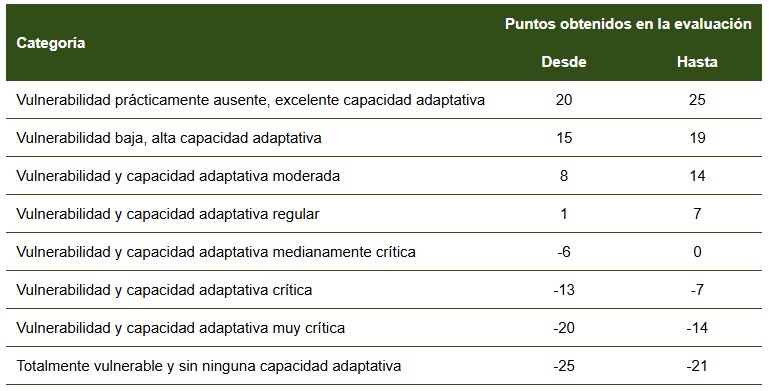
In recent years, the impact of climate change on coffee production has intensified. Coffee growers must implement agronomic practices in their production systems to adapt and minimize the risks of climate variations. The objective of the research was to analyze, through surveys, the vulnerability and adaptive capacity to climate change on coffee farms in low-lying, flat areas of Cuba, receiving technical advice. Coffee cultivation was established on four low-lying producer farms in central-western Cuba with specialized technical advice. The analysis of vulnerability and adaptive capacity to climate change was conducted using a diagnostic tool. Rising temperatures, decreasing rainfall and regularity, and the risk of hurricanes and tropical storms were the climatic variables that caused concern for producers. The agronomic actions implemented in the production systems allowed three of these to be classified as vulnerable with moderate adaptive capacity; and one to be classified as low vulnerability with high adaptive capacity. Farmers in the low-lying plains of west-central Cuba have an understanding of climatic variables related to coffee cultivation. Coffee farms using agroforestry systems with integrated technical practices have shown that coffee cultivation is possible while reducing vulnerability and increasing adaptive capacity to climate change.
Article Details

This work is licensed under a Creative Commons Attribution-NonCommercial 4.0 International License.
Those authors who have publications with this journal accept the following terms of the License Attribution-NonCommercial 4.0 International (CC BY-NC 4.0):
You are free to:
- Share — copy and redistribute the material in any medium or format
- Adapt — remix, transform, and build upon the material
The licensor cannot revoke these freedoms as long as you follow the license terms.
Under the following terms:
- Attribution — You must give appropriate credit, provide a link to the license, and indicate if changes were made. You may do so in any reasonable manner, but not in any way that suggests the licensor endorses you or your use.
- NonCommercial — You may not use the material for commercial purposes.
- No additional restrictions — You may not apply legal terms or technological measures that legally restrict others from doing anything the license permits.
The journal is not responsible for the opinions and concepts expressed in the works, they are the sole responsibility of the authors. The Editor, with the assistance of the Editorial Committee, reserves the right to suggest or request advisable or necessary modifications. They are accepted to publish original scientific papers, research results of interest that have not been published or sent to another journal for the same purpose.
The mention of trademarks of equipment, instruments or specific materials is for identification purposes, and there is no promotional commitment in relation to them, neither by the authors nor by the publisher.
References
Guerrero-Carrera J, Jaramillo-Villanueva JL, Vargas-López S, Guerrero-Carrera J, Jaramillo-Villanueva JL, Vargas-López S. Impacto potencial del cambio climático en la producción de café bajo un enfoque ricardiano. Agricultura, sociedad y desarrollo. junio de 2025;22(2):200-23. Available from: https://doi.org/10.22231/asyd.v22i2.1680
Alzate-Navarro A, Castro-Díaz R. Ordenamiento territorial, cambio climático, y género en Medellín. Bitácora Urbano Territorial. 8 de julio de 2024;34(2):136-47. Available from: https://doi.org/10.15446/bitacora.v34n2.113555
Robles EOL, Silva IC, Pulido SJB. Efectos del cambio climático en la gestión sostenible del recurso suelo. TECNOCIENCIA Chihuahua. 31 de diciembre de 2022;16(3):e1097-e1097. Available from: https://doi.org/10.54167/tch.v16i3.1097
Febles G, Ruiz TE. El cambio climático global y sus repercusiones en Cuba. Acciones para el futuro. Revista Cubana de Ciencia Agrícola. 2009;43(4):337-344. Available from: https://research.fit.edu/media/site-specific/researchfitedu/coast-climate-adaptation-library/latin-america-and-caribbean/cuba-hispanola-jamaica/Febles--Ruiz.--2009.--Global-CC--its-Repercussions-in-Cuba.--[ESP].pdf
Bazán GG. Cambio climático, una realidad que amenaza el futuro de la producción de café. Revista Latinoamericana de Difusión Científica. 2023;5(9):90-113. Available from: https://doi.org/10.38186/difcie.59.07
Jaramillo-Villanueva JL, Guerrero-Carrera J, Vargas-López S, Bustamante-González Á. Percepción y adaptación de productores de café al cambio climático en Puebla y Oaxaca, México. Ecosist Recur Agropec. 11 de marzo de 2022;9(1):1-13. Available from: https://doi.org/10.19136/era.a9n1.3170
Hernandez-Castan J, Calderón GTH. Percepción de los efectos del cambio climático y prácticas de adaptación de los caficultores del Estado de Puebla, México. Revista Bio Ciencias [Internet]. 2 de marzo de 2023 [citado 1 de noviembre de 2025];10(e1419). Available from: https://revistabiociencias.uan.edu.mx/index.php/BIOCIENCIAS/article/view/1419
Silva JBC da, Pinto PAL de A. Impactos socioeconômicos das mudanças climáticas na produção do café: uma revisão sistemática da literatura. Revista Brasileira de Climatologia. 19 de julio de 2024;35:155-78. Available from: https://ojs.ufgd.edu.br/rbclima/article/view/17626
Juárez-Sánchez JP, Apodaca C, Ramírez Valverde B, Méndez J, Díaz R, Juárez-Sánchez JP, et al. Transformation of the coffee landscape before the agricultural policy and climatic variability in indigenous spaces of Puebla. Revista de geografía Norte Grande. septiembre de 2024;(88):1-19. Available from: http://www.scielo.cl/scielo.php?script=sci_abstract&pid=S0718-34022024000200111&lng=en&nrm=iso&tlng=en
Parada-Molina PC, Barradas-Miranda VL, Ceballos GO, Cervantes-Pérez J, Cabrera CRC. Aptitud climática para Coffea arabica L. ante eventos climáticos extremos: Importancia de la cobertura arbórea. Scientia Agropecuaria. 28 de febrero de 2022;13(1):53-62. Available from: https://dx.doi.org/10.17268/sci.agropecu.2022.005
Farfán-Valencia, F. Caficultura bajo sombrío. En Centro Nacional de Investigaciones de Café, Guía más agronomía, más productividad, más calidad. Cenicafé; 2021. Available from: https://doi.org/10.38141/10791/0014_8
Díaz W, Caro P, Bustamante C, Sánchez C, Rodríguez M, Vázquez E, et al. Instructivo Técnico Café Arábico (Coffea arabica Lin). Cuba; 2013. Available from: https://scholar.google.com/scholar?hl=es&as_sdt=0%2C5&q=Instructivo+T%C3%A9cnico+Caf%C3%A9+Ar%C3%A1bico+%28Coffea+arabica+Lin%29.&btnG=
Descamps P. Técnicas para la producción sostenible de café frente al cambio climático: Acciones climáticas en el sector agropecuario. San José, Costa Rica: Instituto Nacional de Innovación y Transferencia en; 2017. Available from: http://www.platicar.go.cr/images/buscador/documents/pdf/2018/Caf_Tcnicas_CC.pdf
Schulz C, De Melo Virginio Filho E, Detlefsen G, Alvarado LD, Chocooj M. Análisis sobre vulnerabilidad y capacidad adaptativa al cambio climático de fincas cafetaleras en Guatemala. 14 de agosto de 2021;N°51-2021:194-201. Available from: https://www.researchgate.net/publication/357934888_Analisis_sobre_vulnerabilidad_y_capacidad_adaptativa_al_cambio_climatico_de_fincas_cafetaleras_en_Guatemala
Lopez Mendez L, Torrealba C. Vulnerabilidad y capacidad adaptativa al cambio climático en dos sistemas productivos cafetaleros de Lara, Venezuela. 2 de agosto de 2024. Available from: https://www.google.com/url?sa=t&source=web&rct=j&opi=89978449&url=https://www.researchgate.net/publication/382825162_Vulnerabilidad_y_capacidad_adaptativa_al_cambio_climatico_en_dos_sistemas_productivos_cafetaleros_de_Lara_Venezuela
Negrín YF, González CAB, Salina VP, Esmoris CS, Espinosa RR. Vulnerabilidad y capacidad adaptativa al cambio climático en fincas cafetaleras de Jibacoa, Cuba. Agronomía & Ambiente [Internet]. 2 de agosto de 2024 [citado 31 de octubre de 2025];44(1). Available from: http://agronomiayambiente.agro.uba.ar/index.php/AyA/article/view/286
Torres NAM, León GS de. Sequía y producción de café: percepción campesina en la Huasteca Potosina. Entreciencias: Diálogos en la Sociedad del Conocimiento. 14 de marzo de 2023;11(25):1-15. Available from: https://doi.org/10.22201/enesl.20078064e.2023.25.84264
Otero Martín M, Barcia Sardiñas S. Manifestaciones de la sequía meteorológica en la provincia de Villa Clara (Cuba) en el período 2000-2017. Ingeo. 19 de diciembre de 2018;(70):197-226. Available from: https://www.redalyc.org/journal/176/17664421010/17664421010.pdf
Sánchez EFG, Arauz FJC. Prácticas de adaptación al cambio climático en la producción de café, San Rafael del Norte (Nicaragua). Revista Científica Tecnológica 2025;8(1):20-40. Available from: https://revistas.unan.edu.ni/index.php/ReVTec/article/view/4997
Serna, C. A., Farfán, F. Implementación de prácticas de adaptación a eventos climáticos extremos en el sector cafetero de Colombia. Estudio de caso en fincas de Salamina (Caldas), Balboa y Santuario (Risaralda) [Internet]. Available from: https://biblioteca.cenicafe.org/bitstream/10778/1104/1/AT_494.pdf