Severidad de Colletotrichum falcatum Went en patrones de resistencia de caña de azúcar en Cuba
Barra lateral del artículo
Contenido principal del artículo
Resumen
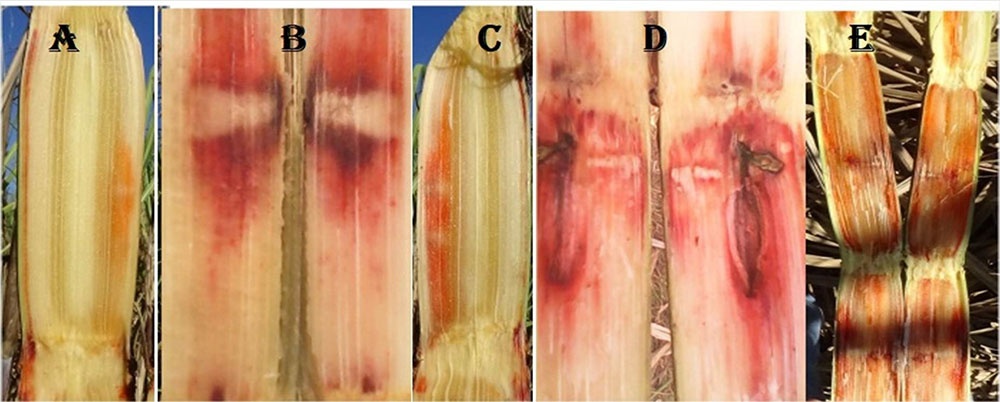
La pudrición roja del tallo es una enfermedad ampliamente distribuida en el mundo y ocasiona grandes pérdidas en las plantaciones cañeras. El objetivo de este trabajo fue determinar la severidad de Colletotrichum falcatum en patrones de resistencia de caña de azúcar y su estabilidad ente la enfermedad. Las parcelas se establecieron en el bloque experimental del Instituto de Investigaciones de la Caña de Azúcar ubicado en Mayabeque en el mes de octubre de los años del 2014 al 2019 con los patrones de resistencia a la enfermedad. La inoculación artificial del hongo se efectuó a los 12 meses de edad en 25 tallos elegidos al azar en cada cultivar. La evaluación se realizó cuatro meses después. Se efectuó análisis de varianza (ANOVA) de clasificación simple y prueba de comparación de medias por Tukey (p < 0,05), para comparar los porcentajes de severidad de la enfermedad en los cultivares evaluados y los años; así como una regresión lineal simple para relacionar los porcentajes de severidad de la enfermedad con las precipitaciones, temperaturas máximas, mínimas y medias, así como la humedad relativa (p < 0,01). La severidad de la enfermedad mostró diferencias significativas, con un amplio contraste entre el altamente resistente y el altamente susceptible. En los años 2014, 2015 y 2018 se alcanzaron los mayores porcentajes de severidad; aunque tienen poca relación con los valores de las variables meteorológicas estudiadas en este período. Se ratifica a esta época del año como la propicia para la inoculación con C. falcatum para evaluar su comportamiento ante la pudrición roja.
Detalles del artículo

Esta obra está bajo una licencia internacional Creative Commons Atribución-NoComercial 4.0.
Aquellos autores/as que tengan publicaciones con esta revista, aceptan los términos siguientes de la Licencia CC Reconocimiento-NoComercial 4.0 Internacional (CC BY-NC 4.0):
Usted es libre de:
- Compartir — copiar y redistribuir el material en cualquier medio o formato
- Adaptar — remezclar, transformar y crear a partir del material
El licenciador no puede revocar estas libertades mientras cumpla con los términos de la licencia.
Bajo las condiciones siguientes:
- Reconocimiento — Debe reconocer adecuadamente la autoría, proporcionar un enlace a la licencia e indicar si se han realizado cambios. Puede hacerlo de cualquier manera razonable, pero no de una manera que sugiera que tiene el apoyo del licenciador o lo recibe por el uso que hace.
- NoComercial — No puede utilizar el material para una finalidad comercial.
- No hay restricciones adicionales — No puede aplicar términos legales o medidas tecnológicas que legalmente restrinjan realizar aquello que la licencia permite.
La revista no se responsabiliza con las opiniones y conceptos emitidos en los trabajos, son de exclusiva responsabilidad de los autores. El Editor, con la asistencia del Comité de Editorial, se reserva el derecho de sugerir o solicitar modificaciones aconsejables o necesarias. Son aceptados para publicar trabajos científico originales, resultados de investigaciones de interés que no hayan sido publicados ni enviados a otra revista para ese mismo fin.
La mención de marcas comerciales de equipos, instrumentos o materiales específicos obedece a propósitos de identificación, no existiendo ningún compromiso promocional con relación a los mismos, ni por los autores ni por el editor.
Citas
Olahan GS, Fatoba PO, Balogun OS. Incidence of smut and red rot diseases of sugarcane in southern part of niger state, north central Nigeria. Science World Journal. 2021; 15(2): 73-75. ISSN: 1597-6343. Available from: https://www.google.com/url?sa=t&source=web&rct=j&opi=89978449&url=https://www.scienceworldjournal.org/article/view/20545/13637
Chinea A, Zayas E, Bruner S. Inventario de enfermedades de la caña de azúcar en Cuba: tercera etapa. Revista Cuba & Caña. 2019;22(3):8-14. ISSN: 1028-6527. Available from: https://scholar.google.com/scholar?hl=es&as_sdt=0%2C5&q=Inventario+de+enfermedades+de+la+ca%C3%B1a+de+az%C3%BAcar+en+Cuba%3A+tercera+etapa&btnG=
Mayorga SA, Centeno SP, Toapanta OG, Haro YE. Efecto de Colletotrichum falcatum en los parámetros productivos de caña de azúcar, revisión integral y estrategias de manejo. Polo del Conocimiento. 2025; 10(7): 280-301. Available from: https://doi.org/10.23857/pc.v10i7.9889.
Kurian JA, Jehani M, Mohamed JM, Vaja S. Assessment and management of diverse isolates of Colletotrichum falcatum associated with red rot disease in sugarcane. International Journal of Research in Agronomy. 2024; 7(7): 417-425. Available from: https://doi.org/10.33545/2618060X.2024.v7.i7e.1062.
Ann J, Syafawati J, Mohd SRA, Edwina J, Ali H, Shah MR. Mitigating the repercussions of climate change on diseases affecting important crop commodities in Southeast Asia, for food security and environmental sustainability-A review. Frontiers in Sustainable Food Systems. 2023; 6.: 1-23. Available from: https://doi.org/10.3389/fsufs.2022.1030540.
Viswanathan R. Changing scenario of sugarcane diseases in India since introduction of hybrid cane varieties: Path travelled for a century. Journal of Sugarcane Research. 2018; 8(1): 1-35. Available from: https://www.researchgate.net/publication/304572467.
Silva TC, Moreira SI, Felizardo LM, Martins RM, Suzuki AN, Faria, et al. Dry rot Caused by the complex Colletotrichum falcatum and Thielaviopsis paradoxa emerges as a key stalk disorder in newly expanded sugarcane plantations from northwestern São Paulo, Brazil. Agronomy. 2023; 13 (2729): 1-20. Available from: https://doi.org/10.3390/agronomy13112729.
Ahmad Z, Asad M, Fatima A, Gul S, Tabassum S, Ismat B, et al. Molecular diagnosis of red rot of sugarcane in Pakistan and in vitro control of isolated pathogen using rhizobacteria. Plant Protection Science. 2023; 59(2): 124-133. Available from: https://doi.org/10.17221/45/2022-PPS.
Romero JV, Diaz AE. Recomendaciones tecnológicas para el mejoramiento del sistema productive de caña de azúcar para panela en el occidente de Nariño. Mosquera. Agrosavia. 2022. ISBN: 978-958-740-618-4. Available from: https://editorial.agrosavia.co/index.php/publicaciones/catalog/book/310
Jernisha J, Poorniammal R, Sivakumar U, Harish S, Sethuraman K. Plant growth promoting microorganisms and emerging biotechnological approaches for sgarcane disease anagement. Journal of Pure and Applied Microbiology. 2024; 8(4): 2205-2217. Available from: https://doi.org/10.22207/JPAM.18.4.27.
Jernisha J, Poorniammal R, Sivakumar U, Harish S, Sethuraman K. Plant growth promoting microorganisms and emerging biotechnological approaches for sugarcane disease management. Journal of Pure and Applied Microbiology. 2024; 18(4): 2205-2217. Available from: https://doi.org/10.22207/JPAM.18.4.27.
Riaz S, Mustafa G, Khan MS, Abbas MA. Exploring mycoparasitic potential of indigenous Trichoderma strains for the effective control of red rot disease in sugarcane. Asian Asian J Agric & Biol. 2025; 1: 1-9. Available from: https://doi.org/10.35495/ajab.2024.136.
Abdallah A, Batista JA, Maced N. Colletotrichum falcatum e complexo de espécies de Fusarium spp. na cana-de-açúcar: caracterização das doenças e estratégias de controle. Revista Caderno Pedagógico. 2024; 21(5): 1-21. Available from: https://doi.org/10.54033/cadpedv21n5-134.
Magarey R. Field guide diseases of australian sugarcane. Australia. Sugar Research Australia Limited. 2022. ISBN: 978-0-949678-43-0. Available from: https://scholar.google.com/scholar?q=related:r071rQlDNpEJ:scholar.google.com/&scioq=Field+guide+diseases+of+australian+sugarcane.+Australia.+&hl=es&as_sdt=0,5
Silva FR, Resende MLV, Ferreira LC, Adesina O, Xavier KV. Molecular characterization and pathogenicity of Colletotrichum falcatum causing red rot on sugarcane in Southern Florida. Journal Fungi. 2024; 10(742): 1-18. Available from: https://doi.org/10.3390/jof10110742.
Sharma AS, Kalia A, Sharma A, Sidhu MS, Sanghera GS, Chhabra G, et al. Expression of Trichoderma spp. endochitinase gene improves red rot disease resistance in transgenic sugarcane. PLOS ONE. 2024; 19(9): 1-21. Available from: https://doi.org/10.1371/journal.pone.0310306.
Viswanathan R. Red rot of sugarcane (Colletotrichum falcatum Went). CAB Reviews. 2021a; 16(23): 1-57. Available from: https://doi.org/10.1079/PAVSNNR202116023.
Thineshkumar J1, Surendran1 K, IndianrajN. Recent advances in control of red rot in sugarcane-An overview. International Journal of Advanced Research in Science, Communication and Technology. 2023; 3(2): 193-196. Available from: https://doi.org/10.48175/IJARSCT-8378193.
Hossain MI, Ahmad K, Vadamalai G, Siddiqui Y, Saad N, Ahmed OH, et al. Phylogenetic analysis and genetic diversity of Colletotrichum falcatum isolates causing sugarcane red rot disease in Bangladesh. Biology. 2021; 10; 862. Available from: https://doi.org/10.3390/biology10090862.
Cavalcanti FE, Santos MJ, Silva JM, Silva JRA, Costa JF, Feijó FM, et al. Colletotrichum species associated with sugarcane red rot in Brazil. Fungal Biology. 2022; 126(4): 290-299. Available from: https://doi.org/10.1016/j.funbio.2022.02.002.
Cursi DE, Hoffmann HP, Barbosa GVS, Bressiani JA, Gazaffi R, Chapola RG, et al. History and current status of sugarcane breeding, germplasm development and molecular genetics in Brazil. Sugar Technology. 2021; 24(1): 112-133. Available from: https://doi.org/10.1007/s12355-021-00951-1.
Hossain MI, Ahmad K, Siddiqui Y, Saad N, Rahman Z, Haruna AO, et al. Curren and prospective strategies on detecting and managing Colletotrichum falcatum causing red rot of sugarcane. Agronomy. 2020; 10(1253):1-19. Available from: https://doi.org/10.3390/agronomy10091253.
Ul-Hassan M, Walayat HM, Akhlaq M, Shahzad M, Yasin M, Muzaffar M, et al. Evaluation of new sugarcane genotypes for biometric traits, resistance to red rot and borers complex under agro-climatic conditions of Faisalabad, Pakistan. International Journal of Agriculture & Bbiology. 2020; 23(3): 623-629. ISSN: 1560-8530. Available from: https://www.google.com/url?sa=t&source=web&rct=j&opi=89978449&url=https://www.cabidigitallibrary.org/doi/full/10.5555/20203268857
Viswanathan R. Sustainable sugarcane cultivation in India through threats of red rot by varietal management. Sugar Technology. 2021b; 23: 239-253. Available from: https://doi.org/10.1007/s12355-020-00882-3.
Khan HMWA, Ul-Hassan M, Mudassir MA, Afzal MS, Yasin M, Ahmad MF, et al. Resistance to red rot disease (Colletotrichum falcatum) varies among different germplasm sources of sugarcane. International Journal of Agriculture & Biology. 2021; 25(2): 381-387. Available from: https://www.google.com/url?sa=t&source=web&rct=j&opi=89978449&url=https://www.researchgate.net/figure/Resistance-of-sugarcane-genotypes-against-red-rot-disease_tbl3_339200131
Mahata G, Sardar S. Evaluation of elite sugarcane clones/varieties against red rot disease (Colletotrichum falcatum) and their suitability in crop improvement programme. Agricultural Science and Technology. 2022; 14(1): 28-33. Available from: https://doi.org/10.15547/ast.2022.01.004.
Ravichandran V, Ganapathy S, Shanmuganathan M, Jayakumar J, Gayathry G, Saravanan PA, et al. Resistance of sugarcane clones (Saccharum spp.) to red rot disease (Collectorichum falcatum Went) and analysis of resistant clone by FTIR. International Journal of Plant & Soil Science. 2023; 35(18): 1250-1256. Available from: https://www.google.com/url?sa=t&source=web&rct=j&opi=89978449&url=https://journalijpss.com/index.php/IJPSS/article/view/3391
Hernández A, Pérez JM, Bosch D, Castro N. Clasificación de los suelos de Cuba. La Habana. INCA-IS. 2015. Available from: https://www.google.com/url?sa=t&source=web&rct=j&opi=89978449&url=https://ediciones.inca.edu.cu/files/libros/clasificacionsueloscuba_%25202015.pdf
Alfonso F, Montalván J, Casero T, Delgado J. Adecuación del sistema evaluativo de la resistencia a la pudrición roja del tallo de la caña de azúcar (Colletotrichum falcatum Went) en el programa de mejora de la caña de azúcar. Revista Cuba & Caña. 2016; 19(1): 1-4. ISSN: 1028-6527. Available from: https://www.cuba-cane.inica.azcuba.cu/index.php/cyc/article/view/66
Towsend GR, Heuberger JV. Methods for estimating losses caused by diseases in fungicide experiments. Plant Disease Report, 1943; 24: 340-343. Available from: https://www.scirp.org>reference..
Dubey S, Minnatullah MD, Maurya S, Chaudhary CS, Singh SP, Kumar B. Effect of weather parameters on incidence of red rot disease in sugarcane. Journal of Pharmacognosy and Phytochemistry. 2020; 9(2): 1053-1055. Available from: https://www.google.com/url?sa=t&source=web&rct=j&opi=89978449&url=https://www.phytojournal.com/archives/2020.v9.i2.10993/effect-of-weather-parameters-on-incidence-of-red-rot-disease-in-sugarcane
Martínez IE, Perdomo LT, Sterling A, Hoyos JD. Intensidad de los síntomas de las principales patologías foliares presentes en 10 variedades de caña panelera (Saccharum spp) en dos zonas agroecológicas del Departamento de Caquetá (2019). Scientia et Technica. 2021; 26(3): 343-352. ISSN: 0122-1701. Available from: https://elibrary.ru/item.asp?id=74259545
Viswanathan R, Selvakumar R, Manivannan K, Nithyanantham R, Kaverinathan K. Behaviour of soil borne inoculum of Colletotrichum falcatum in causing red rot in sugarcane varieties with varying disease resistance. Sugar Technology. 2020; 22(3): 485-497. Available from: https://doi.org/10.1007/s12355-020-00800-7.
Atiq M, Akram A, Ahmed N, Nawaz A, Usman M, Jabbar A, et al. Management tactics towards red rot; cancer of sugarcan-a review. Journal of Xi’an Shiyou University, Natural Science Edition. 2023; 19(06): 263-281. ISSN: 1673-064X. Available from: https://www.xisdxjxsu.asia/viewarticle.php?aid=2360
Shukla P, Kumarm A, Kumarm M, Raghuvanshi HR, Kumar A, Mishra PK. Red rot disease (Colletotrichum falcatum) of sugarcane and their integrated management. Just Agriculture. 2022; 3(4): 1-4. ISSN: 2582-8223. Available from: https://justagriculture.in/files/newsletter/2022/december/42.%20Red%20Rot%20Disease%20%28Colletotrichum%20falcatum%29%20of%20Sugarcane%20and%20their%20Integrated%20Management.pdf
Salotti I, Ji T, Rossi V. Temperature requirements of Colletotrichum spp. belonging to different clades. Frontiers in Plant Science. 2022; 13: 1-20. Available from: https://doi.org/10.3389/fpls.2022.953760.