Analysis of growth and yield of soybean cultivars in the dry season
Article Sidebar
Main Article Content
Abstract
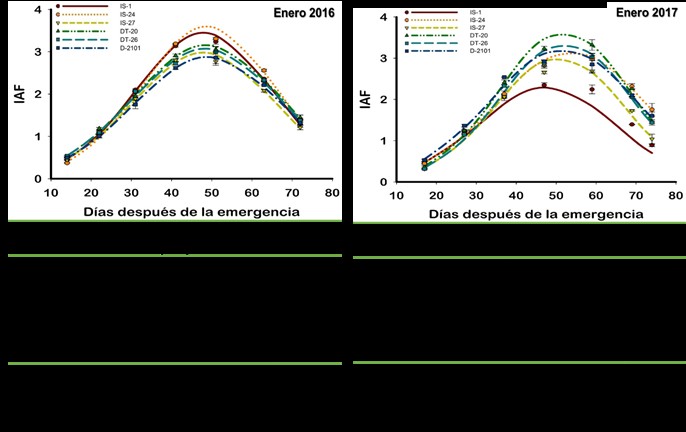
With the objective of analyzing the growth and yield of soybean cultivars in the cold season, this work was developed in areas of the Scientific and Technological Base Unit, Los Palacios, Pinar del Río, belonging to the National Institute of Agricultural Sciences. Soybean cultivars Incasoy-1, Incasoy-24, Incasoy-27, DT-20, DT-26 and D-2101 were used, which were sown on a Hydromorphic Gley Nodular Ferruginous Petroferric soil, on two different years (January 2016 and 2017), corresponding to the cold season. A randomized block experimental design with six treatments (the cultivars) and four replications was used, and the total dry weight of the aerial part (g) and the leaf area (m2) were determined in each experimental plot. The growth dynamics of these variables was fitted to a second-degree polynomial exponential mathematical function, and the leaf area index (LAI) and the absolute growth rate (AGR) were calculated. Agricultural yield (t ha-1) was also determined, performing a confidence interval from the standard deviation on the obtained means, with a probability of 95 % confidence. The results showed influence of the sowing date on the different growth indicators, both in the maximum value reached by the variable, and in the moments in which it was achieved, while it was possible to infer that the greater the accumulation of biomass, a higher yield was reached, highlighting the cultivars DT-20 and DT-26.
Article Details

This work is licensed under a Creative Commons Attribution-NonCommercial 4.0 International License.
Those authors who have publications with this journal accept the following terms of the License Attribution-NonCommercial 4.0 International (CC BY-NC 4.0):
You are free to:
- Share — copy and redistribute the material in any medium or format
- Adapt — remix, transform, and build upon the material
The licensor cannot revoke these freedoms as long as you follow the license terms.
Under the following terms:
- Attribution — You must give appropriate credit, provide a link to the license, and indicate if changes were made. You may do so in any reasonable manner, but not in any way that suggests the licensor endorses you or your use.
- NonCommercial — You may not use the material for commercial purposes.
- No additional restrictions — You may not apply legal terms or technological measures that legally restrict others from doing anything the license permits.
The journal is not responsible for the opinions and concepts expressed in the works, they are the sole responsibility of the authors. The Editor, with the assistance of the Editorial Committee, reserves the right to suggest or request advisable or necessary modifications. They are accepted to publish original scientific papers, research results of interest that have not been published or sent to another journal for the same purpose.
The mention of trademarks of equipment, instruments or specific materials is for identification purposes, and there is no promotional commitment in relation to them, neither by the authors nor by the publisher.
References
- Taiz, L., E. Zeiger, I. M. Moller and A. Murphy. Plant Physiology & Development. 6th ed. Sinauer Associates, Sunderland, MA, USA; 2014. 756 p. URL: https://biologywala.com/wp-content/uploads/2021/06/compressed-6th-edi.-Plant-Physiology-by-Lincoln-Taiz-Eduardo-Zeiger-biologywala.com-compressed.pdf
- Keating BA, Thorburn PJ. Modelling crops and cropping systems-Evolving purpose, practice and prospects. European Journal of Agronomy. 2018; 100: 163-176. https://doi.org/10.1016/j.eja.2018.04.007
- Rosário V, do R, Silva AA, da Brito DS, Pereira JD, Silva CO, et al. Drought stress during the reproductive stage of two soybean lines. Pesquisa Agropecuária Brasileira. 2020; 55. doi. org/10.1590/S1678-3921.pab2020.v55.01736. URL: https://www.scielo.br/j/pab/a/x5kNjfTrzcCSNFNVFQsyjfs/?format=pdf&lang=en
- Aguilar C, González SV, Juárez P, Alia I, Palemón F, Arenas YR et al. Análisis de crecimiento de epazote (Chenopodium ambrosioides L.) cultivado en invernadero. Biotecnia. 2021; 23(2): 113-119. https://doi.org/10.18633/biotecnia.v23i2.1394
- Jan M, Tanaka Y, Sakoda K, Shiraiwa T, Nelson RL. Physiological analysis of leaf photosynthesis of backcross-derived progenies from soybean (Glycine max (L.) Merrill) and G. tomentella Hayata. Plant Production Science. 2020. https://doi.org/10.1080/1343943X.2020.1807369
- Corassa GM, Telmo JC, Strieder ML, Schwalbert R, Pires JL, Carter PR, et al. Tasas óptimas de siembra de soja por rendimiento ambiental en el sur de Brasil. Agronomy Journal. 2018;110(6):1-9. https://doi.org/10.2134/agronj2018.04.0239
- Jo, Kang, Om, Cha, Ri. Growth, photosynthesis and yield of soybean in ridge-furrow intercropping system of soybean and flax. Field Crops Research. 2022; 275. doi.org/10.1016/j.fcr.2021.108329. URL: https://www.sciencedirect.com/science/article/abs/pii/S0378429021002756
- Toledo D, de la Osa Y, Gonzales T, Delgado MA, Hurtado Y. SOYIG-20 y SOYIG-22: nuevas variedades de soya (Glycine max L. Merrill) introducidas para las condiciones climáticas de Cuba. Cultivos Tropicales. 2020; 41(1). URL: http://scielo.sld.cu/pdf/ctr/v41n1/1819-4087-ctr-41-01-e07.pdf
- Hernández AJ, Pérez JMJ, Bosch DI, Castro NS. Clasificación de los suelos de Cuba. 1st ed. Mayabeque, Cuba: Ediciones INCA; 2015, 93 p. URL: https://inca.edicionescervantes.com/index.php/ediciones/lib
- Ortiz HR, Enríquez GA, Nápoles MC, Soto N, Mederos A, González MC. Reseña de la tecnología de producción de soya (Glycine max (L.) Merrill) en Cuba. Ediciones INCA. San José las Lajas, Mayabeque; 2023, 156 p. ISBN: 978-959-7258-15-5 URL: https://www.researchgate.net/publication/372133438_Instructivo_tecnico_de_la_soya_en_Cuba_2023
- Almanza PJ, Tovar YP, Velandia JD. Comportamiento de la biomasa y de las tasas de crecimiento de dos variedades de lulo (Solanum quitoense Lam.) en Pachavita, Boyacá. Revista Ciencia y Agricultura. 2016; 13(1): 67-76. URL: https://www.redalyc.org/journal/5600/560062814006/html/
- Basal O, Szabó A. Physiology and yield of three soybeans (Glycine max (L.) Merrill) cultivars different in maturity timing as affected by water deficiency. International Journal of Health and Life-Sciences. 2018; 4(3): 46-59. https://doi.org/10.20319/lijhls.2018.43.4659
- Anna H, Tommaso S, Michael B, Tobias K, Markus K, Claas N. Future yields of double-cropping systems in the Southern Amazon, Brazil, under climate change and technological development. Agricultural Systems. 2020; 177. https://doi.org/10.1016/j.agsy.2019.102707
- Saryoko A, Fukuda Y, Lubis I, Homma K, Shiraiwa T. Physiological activity and biomass production in crop canopy under a tropical environment in soybean cultivars with temperate and tropical origins. Field Crops Research. 2018;216:209-16. https://doi.org/10.1016/j.fcr.2017.11.012. Hartwell L, Zhanga L, Boote KJ, Hauser BA. Elevated temperature intensity, timing, and duration of exposure affect soybean internode elongation, mainstem node number, and pod number per plant. The Crop Journal. 2018; 6: 148-161. https://doi.org/10.1016/j.cj.2017.10.005
- Board JE, Kahlon CS. Soybean yield formation: What controls it and how it can be improved. In: El-Shemy HA, editor. Soybean physiology and biochemistry. Published by InTech, Janeza Trdine 9, 51000 Rijeka, Croatia; 2011. p.1-38. URL: https://www.intechopen.com/chapters/22761
- Malek MA, Mondal MA, Ismail MR, Rafii MY, Berahim Z. Physiology of seed yield in soybean: Growth and dry matter production. African Journal of Biotechnology. 2012; 11(30): 7643-7649. https://doi.org/10.5897/AJB11.3879
- Egli DB. Crop growth rate and the establishment of sink size: a comparison of maize and soybean. Journal of Crop Improvement. 2019. https://doi.org/10.1080 /15427528.2019.1597797
- Monzon JP, Cafaro N, Cerrudo A, Canepa M, Rattalino JI, Specht J et al. Critical period for seed number determination in soybean as determined by crop growth rate, duration, and dry matter accumulation. Field Crops Research. 2021; 261. https://doi.org/10.1016/j.fcr.2020.108016