Efecto antagónico in vitro de Trichoderma asperellum frente a Moniliophthora perniciosa
Barra lateral del artículo
Contenido principal del artículo
Resumen
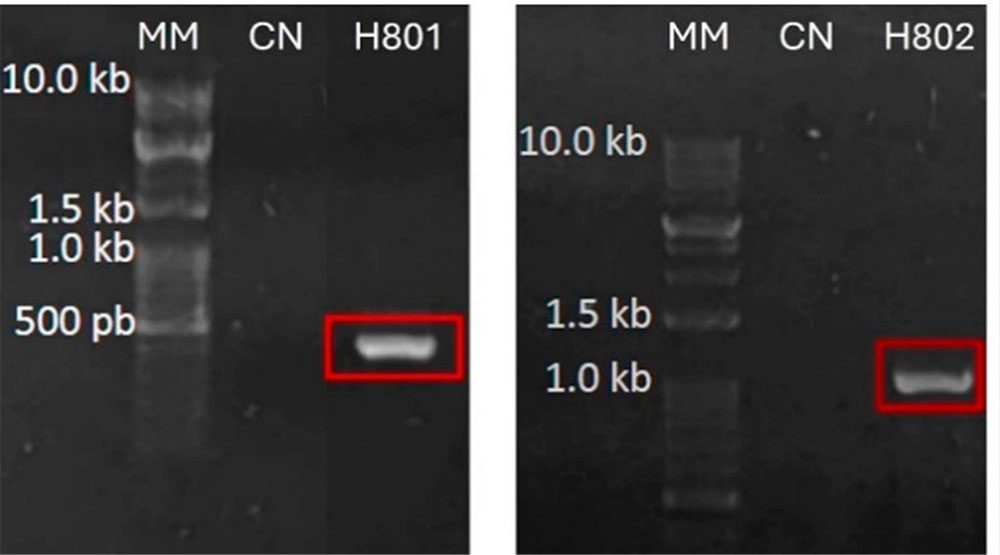
El estudio de hongos fitopatógenos en plantaciones de cacao es fundamental para proteger los cultivos y desarrollar estrategias de control efectivas. El estudio tuvo como objetivo evaluar el efecto antagónico in vitro de Trichoderma asperellum frente a Moniliophthora perniciosa causante de la enfermedad “escoba de bruja”. Se aislaron e identificaron molecularmente ambas especies (M. perniciosa de ramas de cacao (Theobroma cacao L.) enfermas y T. asperellum de la rizosfera) utilizando las técnicas de Barcoding ITS y Beta tubulina. Se aplicó el modelamiento matemático de crecimiento exponencial, para modelar el crecimiento de M. perniciosa en presencia del hongo antagonista T. asperellum, se aplicó el cálculo diferencial logístico basado en el modelo de Lotka-Volterra para competencia. El ensayo contó con 5 réplicas con sus respectivos controles. El análisis molecular confirmó la presencia de M. perniciosa 98 % y T. asperellum 100 % de identidad. Los ensayos in vitro demostraron que T. asperellum inhibe eficazmente a M. perniciosa mediante competencia. El modelo Lotka-Volterra predijo el dominio de T. asperellum. En conclusión, los resultados moleculares, in vitro y de modelado, proporcionan una base sólida para considerar a T. asperellum como un prometedor agente de biocontrol para la enfermedad "escoba de bruja" del cacao en condiciones controladas.
Detalles del artículo

Esta obra está bajo una licencia internacional Creative Commons Atribución-NoComercial 4.0.
Aquellos autores/as que tengan publicaciones con esta revista, aceptan los términos siguientes de la Licencia CC Reconocimiento-NoComercial 4.0 Internacional (CC BY-NC 4.0):
Usted es libre de:
- Compartir — copiar y redistribuir el material en cualquier medio o formato
- Adaptar — remezclar, transformar y crear a partir del material
El licenciador no puede revocar estas libertades mientras cumpla con los términos de la licencia.
Bajo las condiciones siguientes:
- Reconocimiento — Debe reconocer adecuadamente la autoría, proporcionar un enlace a la licencia e indicar si se han realizado cambios. Puede hacerlo de cualquier manera razonable, pero no de una manera que sugiera que tiene el apoyo del licenciador o lo recibe por el uso que hace.
- NoComercial — No puede utilizar el material para una finalidad comercial.
- No hay restricciones adicionales — No puede aplicar términos legales o medidas tecnológicas que legalmente restrinjan realizar aquello que la licencia permite.
La revista no se responsabiliza con las opiniones y conceptos emitidos en los trabajos, son de exclusiva responsabilidad de los autores. El Editor, con la asistencia del Comité de Editorial, se reserva el derecho de sugerir o solicitar modificaciones aconsejables o necesarias. Son aceptados para publicar trabajos científico originales, resultados de investigaciones de interés que no hayan sido publicados ni enviados a otra revista para ese mismo fin.
La mención de marcas comerciales de equipos, instrumentos o materiales específicos obedece a propósitos de identificación, no existiendo ningún compromiso promocional con relación a los mismos, ni por los autores ni por el editor.
Citas
Vera-Rodríguez JH, Duarte-Cuesta JM, del Rocío Villamar-Aveiga M, Sevilla-Carrasco JD, Ortiz-Mata JD, Gavin-Moyano CS, et al. Morphological characterization, molecular identification, and phylogenetic analysis of Lasiodiplodia theobromae associated with CCN-51 cacao plants in Ecuador. Sci Agropecu [Internet]. 2025 Aug 8 [cited 2025 Sep 8];16(4):513-9. Available from: https://doi.org/10.17268/sci.agropecu.2025.039
Peralta SLP, Herrera CW, Castro B del RG. Estimación de pérdidas económicas en Cacao causado por Escoba de Bruja (Crinipellis Perniciosa) y Monilia (Monilia Roreri) en pequeños productores. Rev la Univ del Zulia [Internet]. 2024;15(42):179-92. Available from: https://doi.org/10.46925//rdluz.42.10
Sánchez MAL, Aguayo AAA, Campoverde AG. El Análisis comparativo sobre la incidencia de las tres principales enfermedades en el cacao CCN-51, en el cantón La Troncal, provincia del Cañar, Ecuador. Rev Científica Ciencias Nat y Ambient [Internet]. 2018;12(1). Available from: https://doi.org/10.53591/cna.v12i1.271
Villa-Martínez A, Pérez-Leal R, Morales-Morales HA, Basurto-Sotelo M, Soto-Parra JM, Martínez-Escudero E. Situación actual en el control de Fusarium spp. y evaluación de la actividad antifúngica de extractos vegetales. Acta agronómica [Internet]. 2015;64(2):194-205. Available from: https://doi.org/10.15446/acag.v64n2.43358
Bobadilla CCC, Ruíz JRC. Efecto antifúngico del aceite esencial de Origanum vulgare sobre el crecimiento micelial de Rhizoctonia solani. Sagasteguiana [Internet]. 2015;3(1):79-86. Available from: https://revistas.unitru.edu.pe/index.php/REVSAGAS/article/view/2011
Jeres-Caguana GA, Montaño-Roldan VL, Ordoñez-Zuñiga NL, Vera-Rodriguez JH, Lucas-Vidal LR. Efecto biorremediador de la espirulina y Trichoderma spp. en suelo contaminado con plomo (Pb). Multidiscip Collab J [Internet]. 2025;3(2):1-12. Available from: https://doi.org/10.70881/mcj/v3/n2/48
Vera J, Sarango Y, Villamar M, Ortiz J, Sevilla-Carrasco J, Duarte J LL. Effect of herbicides on the growth of beneficial microorganisms in rhizospheric soil. Rev Fac Agron [Internet]. 2025;42(2):e254222. Available from: https://www.produccioncientificaluz.org/index.php/agronomia/article/view/43831
Parraguirre-Lezama C, Romero-Arenas O, Cruz Coronel A, Mauricio-Gutiérrez A, Contreras-Paredes CA, Rivera Tapia A. Toxicidad de fungicidas de contacto en cuatro especies de Trichoderma, un enfoque de compatibilidad in vitro. Rev Mex Fitopatol [Internet]. 2025;43(1). Available from: https://doi.org/10.18781/r.mex.fit.2402-7
Rios-Catota DV, Álvarez-Sánchez AR, Vera-Rodríguez JH. Biosíntesis de nanopartículas de plata mediante Trichoderma asperellum y su impacto en el crecimiento vegetativo del maíz (Zea mays L.). Multidiscip Collab J [Internet]. 2025;3(2):148-58. Available from: https://doi.org/10.70881/mcj/v3/n2/57
Cruz A, Rivero D, Echevarría A, Rodríguez AT. Manejo de hongos fitopatógenos en Oryza sativa con la aplicación de Trichoderma asperellum. Cultiv Trop [Internet]. 2022;43(4):1-5. Available from: https://cu-id.com/2050/v43n4e01
Duarte-Leal Y, Lamz-Piedra A, Martínez-Coca B. Antagonismo in vitro de aislamientos de Trichoderma asperellum Samuels, Lieckfeldt & Nirenberg frente a Sclerotium rolfsii Sacc. Rev protección Veg [Internet]. 2017;32(3):0. Available from: http://scielo.sld.cu/scielo.php?pid=S1010-27522017000300003&script=sci_arttext
Martínez B, Infante D, Reyes Y. Trichoderma spp. y su función en el control de plagas en los cultivos. Rev Protección Veg [Internet]. 2013;28(1):1-11. Available from: http://scielo.sld.cu/scielo.php?pid=s1010-27522013000100001&script=sci_arttext
Mesa-Vanegas AM, Marin A, Calle-Osorno J. Metabolitos secundarios en Trichoderma spp. y sus aplicaciones biotecnológicas agrícolas. Actual biológicas [Internet]. 2019;41(111):32-44. Available from: https://doi.org/10.17533/udea.acbi.v41n111a02
Camacho-Luna V, Flores-Moctezuma HE, Rodríguez-Monroy M, Montes-Belmont R, Sepúlveda-Jiménez G. Inducción de la respuesta de defensa de plantas de cebolla en la interacción con Trichoderma asperellum y Alternaria porri. Rev Mex ciencias agrícolas [Internet]. 2021;12(4):685-98. Available from: https://doi.org/10.29312/remexca.v12i4.2683
Tirado-Gallego PA, Lopera-Álvarez A, Ríos-Osorio LA. Estrategias de control de Moniliophthora roreri y Moniliophthora perniciosa en Theobroma cacao L.: revisión sistemática. Cienc y Tecnol Agropecu [Internet]. 2016;17(3):417-30. Available from: http://dx.doi.org/10.21930/rcta.vol17_num3_art:517
Lopes MA, Gomes DS, Koblitz MGB, Pirovani CP, de Mattos Cascardo JC, Góes-Neto A, et al. Use of response surface methodology to examine chitinase regulation in the basidiomycete Moniliophthora perniciosa. Mycol Res [Internet]. 2008;112(3):399-406. Available from: https://doi.org/10.1016/j.mycres.2007.10.017
Garcia O, Macedo JAN, Tibúrcio R, Zaparoli G, Rincones J, Bittencourt LMC, et al. Characterization of necrosis and ethylene-inducing proteins (NEP) in the basidiomycete Moniliophthora perniciosa, the causal agent of witches’ broom in Theobroma cacao. Mycol Res [Internet]. 2007;111(4):443-55. Available from: https://doi.org/10.1016/j.mycres.2007.01.017
Rivera-Fernández RD, Valarezo-Beltron O, Macías LV, Chavarría-Párraga JE, Cedeño ÁMG. Efecto de la poda fitosanitaria sobre la enfermedad escoba de bruja en el cultivo de cacao. Intropica Rev del Inst Investig Trop [Internet]. 2014;9(1):129-36. Available from: https://dialnet.unirioja.es/servlet/articulo?codigo=5111585
Almestar-Montenegro J, Leiva-Espinoza S, Borjas-Ventura R, Valderrama-Palacios D, León-Rojas F, Castro-Cepero V, et al. Efecto de la poda y la remoción de frutos sobre las enfermedades de la mazorca de cacao en Copallín, Amazonas, Perú. Idesia (Arica) [Internet]. 2024;42(4):69-77. Available from: http://dx.doi.org/10.4067/s0718-34292024000400069
Hernández-Villegas J. Incidencia de la escoba de bruja (Crinipellis perniciosa) sobre el rendimiento de dos agroecosistemas de cacao con diferentes condiciones de manejo. Bioagro [Internet]. 2016;28(1):59-64. Available from: https://ve.scielo.org/scielo.php?pid=S1316-33612016000100008&script=sci_arttext
White TJ, Bruns T, Lee S, Taylor J. Amplification and direct sequencing of fungal ribosomal RNA genes for phylogenetics. PCR Protoc a Guid to methods Appl [Internet]. 1990;18(1):315-22. Available from: https://doi.org/10.1016/B978-0-12-372180-8.50042-1
Glass NL, Donaldson GC. Development of primer sets designed for use with the PCR to amplify conserved genes from filamentous ascomycetes. Appl Environ Microbiol [Internet]. 1995;61(4):1323-30. Available from: https://doi.org/10.1128/aem.61.4.1323-1330.1995
Guigón-López C, Guerrero-Prieto V, Vargas-Albores F, Carvajal-Millán E, Ávila-Quezada GD, Bravo-Luna L, et al. Identificación molecular de cepas nativas de Trichoderma spp. su tasa de crecimiento in vitro y antagonismo contra hongos fitopatógenos. Rev Mex Fitopatol [Internet]. 2010;28(2):87-96. Available from: https://www.scielo.org.mx/scielo.php?pid=S0185-33092010000200002&script=sci_arttext
Mondego JMC, Carazzolle MF, Costa GGL, Formighieri EF, Parizzi LP, Rincones J, et al. A genome survey of Moniliophthora perniciosa gives new insights into Witches’ Broom Disease of cacao. BMC Genomics [Internet]. 2008;9:1-25. Available from: https://doi.org/10.1186/1471-2164-9-548
Cano MA. Interacción de microorganismos benéficos en plantas: Micorrizas, Trichoderma spp. y Pseudomonas spp. Una revisión. Rev UDCA Actual Divulg Científica [Internet]. 2011;14(2):15-31. Available from: http://www.scielo.org.co/scielo.php?pid=S0123-42262011000200003&script=sci_arttext