Morfo-agronomic behavior of pineapple plants 'MD2' with foliar applications of efficient microorganisms
Article Sidebar
Main Article Content
Abstract
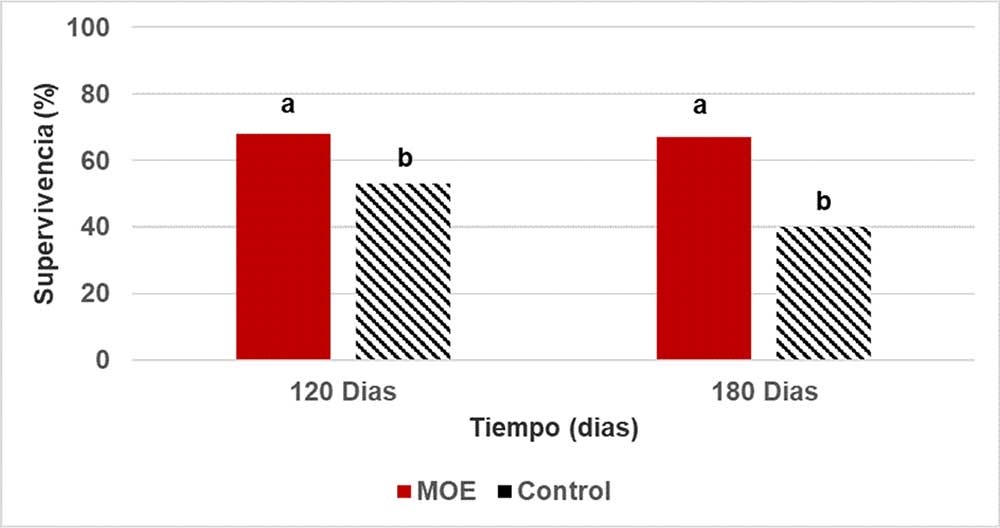
Pineapple (Ananas comosus var. comosus) is the most economically important species within the Bromeliaceae family. For year, it has been one of main export resources in many countries, especially the cultivar 'MD2', which, due to its soluble solids content, aroma and color, has been preferred in global markets. Although its organoleptic qualities have made it a consumer favorite, the 'MD2' is more susceptible to fungal diseases than the ´Cayenne´ and ´Champaka´ varieties, and more demanding in terms of agrotechnical management. This study aims to determine the morfo-agronomic aspects of 'MD2' pineapple plant and fruits. Clonal suckers weigh approximately 300 g were used, and the morphological indicators evaluated were survival (%) at 120 and 180 days. Quality indicators analyses of the 'MD2' fruits was also conducted: fresh fruit mass with crown (kg), fresh fruit mass without crown (kg), crown-to fruit mass ratio, soluble solids content (oBrix), acidity content (%), ascorbic acid content (mg of ascorbic acid in 100 ml of juice). The results showed that foliar application of efficient microorganisms increased the survivor and fresh mass of the plants. These increases led to higher fresh fruit mass without affecting the fruits quality.
Article Details

This work is licensed under a Creative Commons Attribution-NonCommercial 4.0 International License.
Those authors who have publications with this journal accept the following terms of the License Attribution-NonCommercial 4.0 International (CC BY-NC 4.0):
You are free to:
- Share — copy and redistribute the material in any medium or format
- Adapt — remix, transform, and build upon the material
The licensor cannot revoke these freedoms as long as you follow the license terms.
Under the following terms:
- Attribution — You must give appropriate credit, provide a link to the license, and indicate if changes were made. You may do so in any reasonable manner, but not in any way that suggests the licensor endorses you or your use.
- NonCommercial — You may not use the material for commercial purposes.
- No additional restrictions — You may not apply legal terms or technological measures that legally restrict others from doing anything the license permits.
The journal is not responsible for the opinions and concepts expressed in the works, they are the sole responsibility of the authors. The Editor, with the assistance of the Editorial Committee, reserves the right to suggest or request advisable or necessary modifications. They are accepted to publish original scientific papers, research results of interest that have not been published or sent to another journal for the same purpose.
The mention of trademarks of equipment, instruments or specific materials is for identification purposes, and there is no promotional commitment in relation to them, neither by the authors nor by the publisher.
References
FAOSTAT. Food and agriculture organization of the United Stated Nations (FAOSTAT) Roma2024. Available from: www.fao.org/faostat/
Bartholomew D. 'MD2' Pineapple transforms the world’s pineapple fresh fruit export industry. Newsletter Pineapple International Society Horticultural Sciences. 2009, 18:2-5. Available from: https://www.researchgate.net/publication/304196454_Fruits_production_of_pineapple_Ananas_comosus_L_Merr_MD-2_from_vitroplants
Kraamwinkel CT, Beaulieu A, Dias T, Howison RA. Planetary limits to soil degradation. Communications Earth & Environment. 2021, 2(1):249. DOI: http://doi.org/10.1038/s43247-021-00323-3.
de Araujo Avila GM, Gabardo G, Clock DC, de Lima Junior OS. Use of efficient microorganisms in agriculture. Research, Society and Development. 2021, 10(8):e40610817515-e. DOI: http://doi.org/10.33448/rsd-v10i8.17515.
Saranraj P, Jayaprakash A, Devi V, Al-Tawaha A, Al-Tawaha A, editors. Isolation and nitrogen fixing efficiency of Gluconacetobacter diazotrophicus associated with sugarcane: A review. IOP Conference Series: Earth and Environmental Science; 2021: IOP Publishing. Available from: https://www.google.com/url?sa=t&source=web&rct=j&opi=89978449&url=https://iopscience.iop.org/article/10.1088/1755-1315/788/1/012171
Wang C, Kuzyakov Y. Energy use efficiency of soil microorganisms: Driven by carbon recycling and reduction. Global Change Biology. 2023, 29(22):6170-87. DOI: http://doi.org/10.1111/gcb.16925.
NR-279. Metodología de Análisis de Suelo recomendada por el Instituto Nacional de Suelos y Fertilizantes La Habana, Cuba: Ministerio de Agricultura 1987. Available from: https://www.nconline.disaic.cu/index.php?page=m_search_norms.public.search_norms&Block=Cat%E1logo.
Carrillo-Sosa Y, Terry-Alfonso E, Ruiz-Padrón J, Villegas ME, Delgado G. Efecto del LEBAME en la germinación de semillas de tomate (Solanum lycopersicum L.). Cultivos Tropicales. 2017, 38(3):30-5. Available from: https://ediciones.inca.edu.cu/index.php/ediciones
Díaz YH. Effect of growth regulators albite y Lebame in joint action with phyto-lamp in the synthesis of yacon active compounds. Innovative in Agriculture; 2019. Available from: https://www.google.com/url?sa=t&source=web&rct=j&opi=89978449&url=https://repository.rudn.scienceadmin.com/ru/records/article/record/56989/
Terry-Alfonso E, Ruiz-Padrón J, Carrillo-Sosa Y, Díaz de Villegas ME, Delgado-Arrieta G. Resultados del Lebame en cultivos hortícolas de interés económico. ICIDCA. 2016;50(3):9-12. Available from: http://www.redalyc.org/articulo.oa?id=223152661002
González P, Ramírez J, Reyes R, Rivera R. Biofertilization with Gluconacetobacter diazotrophicus and Funneliformis mosseae in Guinea grass (Megathyrsus maximus cv. Likoni). Cuban Journal of Agricultural Science. 2022, 56(3). Available from: https://www.cjascience.com/index.php/CJAS/article/view/1059/1419.
Dibut-Álvarez BL, Ortega-García M, Ríos-Rocafull Y. Estudio de la asociación Gluconacetobacter diazotrophicus-viandas tropicales. Efecto sobre el rendimiento en condiciones de extensión. Cultivos Tropicales. 2021, 42(3). Available from: https://ediciones.inca.edu.cu/index.php/ediciones/article/view/1597/3079.
Velasco-Jiménez A, Castellanos-Hernández O, Acevedo-Hernández G, Aarland RC, Rodríguez-Sahagún A. Bacterias rizosféricas con beneficios potenciales en la agricultura. Terra Latinoamericana. 2020, 38(2):333-45. DOI: http://doi.org/10.28940/terra.v38i2.470.
Ceballos-Aguirre N, Cuellar JA, Restrepo GM, Sánchez ÓJ. Effect of the Application of Gluconacetobacter diazotrophicus and Its Interaction with Nitrogen and Phosphorus Fertilization on Carrot Yield in the Field. International Journal of Agronomy. 2023, 2023. DOI: http://doi.org/10.1155/2023/6899532.
García-Velázquez L, Gallardo A. El ciclo global del nitrógeno. Una visión para el ecólogo terrestre. Ecosistemas. 2017, 26(1):4-6. DOI: http://doi.org/10.7818/ECOS.2017.26-1.02.
Díaz AS, Fernández GP, Gómez JMI. Efecto de fermentados minerales e IHPLUS BF en el crecimiento de Morus alba (L.) var. Yu-12 en vivero. Avances en investigación agropecuaria. 2024, 28(1):ágs 72-86. DOI: http://doi.org/10.53897/RevAIA.24.28.07.
Zulueta JB, Fernández GP, Gómez MM, Salas RM, Amaro OA, Oropesa Y, et al. Manejo de la fertilización del maíz (Zea mayz) basado en abono fermentado con biochar, IHPLUS BF® y caldo sulfocálcico. Pastos, forrajes y otras plantas de interés para la ganadería/Convención 2022. Available from: https://www.researchgate.net/publication/ 366232725_Manejo_de_la_fertilizacion_del_maiz_Zea_mayz_basado_en_abono_fermentado_con_biochar_IHPLUS_BFR_y_caldo_sulfocalcico
Navarro LR, Fernández GP, Lorenzo MJS, Novo DF. Efecto agroproductivo de un abono basado en compost con IHPLUS® BF y biochar en el cultivo de papa (Solanum tuberosum L.). Pastos, forrajes y otras plantas de interés para la ganadería/Convención 2022. Available from: https://www.researchegate.net/publication/366231317.
Vásquez Jiménez J, Bartholomew D, Wilkerson C, Hoogenboom G, Vargas Leitón B. Optimizing agronomic practices for pineapple (Ananas comosus (L). Merr.‘MD-2’cultivar) production based on growth stages. Fruits. 2023, 78(3):1-10. Available from: https://doi.org/10.17660/th2023/011.
Bartholomew DP, Paul R, Rohrbach K. The Pineapple. Botany, production and uses. I ed. Bartholomew DP, Paul R, Rohrbach K, editors. Wallingford, UK: CABI; 2003. 320 p. Available from: https://www.google.com/url?sa=t&source=web&rct=j&opi=89978449&url=https://patricklepetit.jalbum.net/_AGRICULTURE/LIBRARY/The%2520Pineapple,%2520Botany.pdf
Rodrı́guez R, Lorente G, Rodrı́guez R, Pérez O, Garcı́a O, Lobaina Y, et al. Evaluation of three fertilization systems for ‘MD-2’pineapple plants. Acta Horticulturae. 2019, 1239(4):27-32. DOI: http://doi.org/10.17660/ActaHortic.2019.1239.4.
Carvajal Ortiz C, González García M, Valle Yanes B, Becquer Rabelo R, Rodríguez Sanchez R, González-Olmedo J. Bromatological characterization of fruits of 'MD-2' pineapple plants produced by micropropagation. Acta Horticulturae. 2017, 1239(12):99-104. DOI: http://doi.org/10.17660/ActaHortic.2019.1239.12.