Effect of Trichoderma harzianum and Pseudomonas fluorescens on the control of anthracnose in mango fruit (Mangifera indica L.) during post-harvest
Article Sidebar
Main Article Content
Abstract
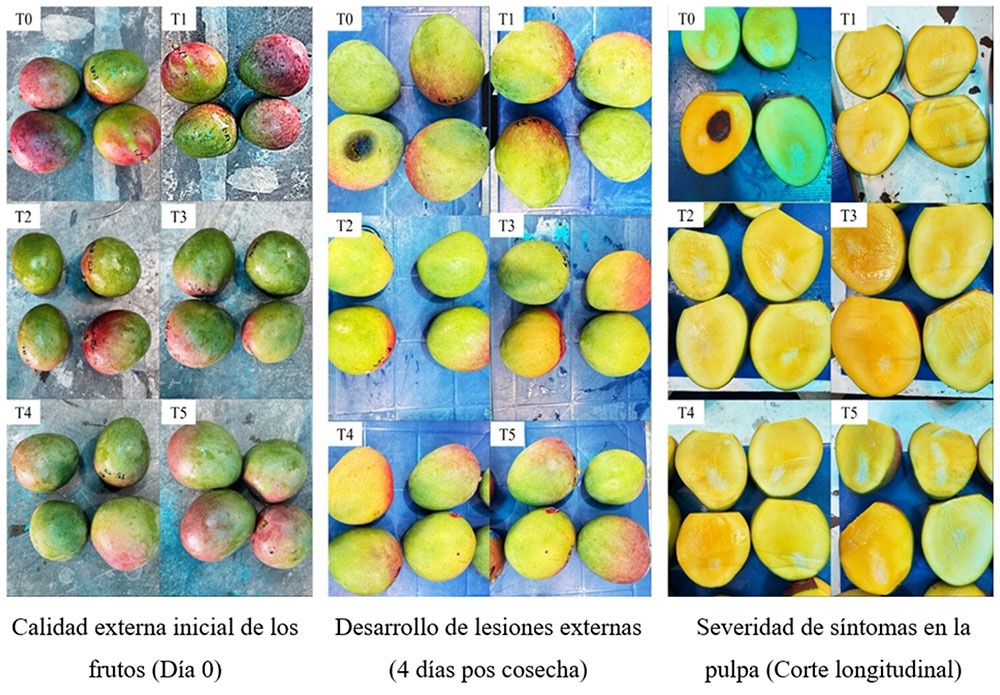
The objective of the study was to evaluate the effect of Trichoderma harzianum and Pseudomonas fluorescens on the control of anthracnose in post-harvest mango fruit. An experimental study was conducted on Tommy Atkins mangoes using beneficial microorganisms at different concentrations as treatments. A completely randomized design was established with six treatments and ten replicates; the microorganisms were applied by spraying for four months. The incidence, severity, and total soluble solids (°Brix) were evaluated, and the data were analyzed using ANOVA and Tukey (α = 0.05). Molecular identification confirmed the high purity of T. harzianum (KF624792), P. fluorescens (MG977684), and the pathogen C. gloeosporioides (MH700455). The results showed that all treatments with beneficial microorganisms achieved 0% incidence, while the control treatment had a 10 % incidence with visible necrotic lesions. In addition, the consortium of both microorganisms (T5) recorded the highest concentration of soluble solids (15 °Brix), showing an improvement in fruit quality. The use of biological control microorganisms, both individually and in consortium, strengthened the fruit's defense mechanisms against C. gloeosporioides, providing post-harvest protection, increasing °Brix, and extending the shelf life of mangoes.
Article Details

This work is licensed under a Creative Commons Attribution-NonCommercial 4.0 International License.
Those authors who have publications with this journal accept the following terms of the License Attribution-NonCommercial 4.0 International (CC BY-NC 4.0):
You are free to:
- Share — copy and redistribute the material in any medium or format
- Adapt — remix, transform, and build upon the material
The licensor cannot revoke these freedoms as long as you follow the license terms.
Under the following terms:
- Attribution — You must give appropriate credit, provide a link to the license, and indicate if changes were made. You may do so in any reasonable manner, but not in any way that suggests the licensor endorses you or your use.
- NonCommercial — You may not use the material for commercial purposes.
- No additional restrictions — You may not apply legal terms or technological measures that legally restrict others from doing anything the license permits.
The journal is not responsible for the opinions and concepts expressed in the works, they are the sole responsibility of the authors. The Editor, with the assistance of the Editorial Committee, reserves the right to suggest or request advisable or necessary modifications. They are accepted to publish original scientific papers, research results of interest that have not been published or sent to another journal for the same purpose.
The mention of trademarks of equipment, instruments or specific materials is for identification purposes, and there is no promotional commitment in relation to them, neither by the authors nor by the publisher.
References
Wang P, Luo Y, Huang J, Gao S, Zhu G, Dang Z, et al. The genome evolution and domestication of tropical fruit mango. Genome Biol. 2020;21(1):60. Available from: https://doi.org/10.1186/s13059-020-01959-8
Lebaka VR, Wee Y-J, Ye W, Korivi M. Nutritional composition and bioactive compounds in three different parts of mango fruit. Int J Environ Res Public Health. 2021;18(2):741. Available from: https://doi.org/10.3390/ijerph18020741
Galsurker O, Diskin S, Maurer D, Feygenberg O, Alkan N. Fruit stem-end rot. Horticulturae. 2018;4(4):50. Available from: https://doi.org/10.3390/horticulturae4040050
Ardila CEC, Ramirez LA, Ortiz FAP. Spectral analysis for the early detection of anthracnose in fruits of Sugar Mango (Mangifera indica). Comput Electron Agric. 2020;173:105357. Available from: https://doi.org/10.1016/j.compag.2020.105357
Dofuor AK, Quartey NK-A, Osabutey AF, Antwi-Agyakwa AK, Asante K, Boateng BO, et al. Mango anthracnose disease: the current situation and direction for future research. Front Microbiol. 2023;14:1168203. Available from: https://doi.org/10.3389/fmicb.2023.1168203
Zakaria L. Diversity of Colletotrichum species associated with anthracnose disease in tropical fruit crops: A review. Agriculture. 2021;11(4):297. Available from: https://doi.org/10.3390/agriculture11040297
Nandeesha C V, Akbari LF, Jaiswal A, Harsha BR, Patil B, Bhaliya CM, et al. Control efficacy and yield response of different fungicides evaluated against anthracnose of green gram. Crop Prot. 2023;174:106432. Available from: https://doi.org/10.1016/j.cropro.2023.106432
Boersma SJ, Depuydt DJ, Vyn RJ, Gillard CL. Fungicide efficacy for control of anthracnose of dry bean in Ontario. Crop Prot. 2020;127:104979. Available from: https://doi.org/10.1016/j.cropro.2019.104979
Lengai GMW, Fulano AM, Muthomi JW. Improving access to export market for fresh vegetables through reduction of phytosanitary and pesticide residue constraints. Sustainability. 2022;14(13):8183. Available from: https://doi.org/10.3390/su14138183
Rodríguez JHV, Sarango Y, Aveiga M del RV, Mata JDO, Sevilla-Carrasco JD, Cuesta JMD, et al. Effect of herbicides on the growth of beneficial microorganisms in rhizospheric soil. Revista La Facultad de Agronomía La Univ Del Zulia. 2025;42(2). Available from: https://doi.org/10.47280/RevFacAgron(LUZ).v42.n2.VI
Jeres-Caguana GA, Montaño-Roldan VL, Ordoñez-Zuñiga NL, Vera-Rodriguez JH, Lucas-Vidal LR. Efecto biorremediador de la espirulina y Trichoderma spp. en suelo contaminado con plomo (Pb). Multidiscip Collab J. 2025;3(2):1-12. Available from: https://doi.org/10.70881/mcj/v3/n2/48
Carpio M, Vera J, Yugsan F, Gavin C, Barzallo D. Biofertilizer enriched with Paenibacillus polymyxa and Trichoderma sp. for radish cultivation. Revista Caatinga. 2025;38:e13759-e13759. Available from: https://doi.org/10.1590/1983-21252025v3813759rc
Jisha MS, Linu MS, Sreekumar J. Induction of systemic resistance in chilli (Capsicum annuum L.) by Pseudomonas aeruginosa against anthracnose pathogen Colletotrichum capsici. J Trop Agric. 2018;56(2). Available from: https://jtropag.kau.in/index.php/ojs2/article/view/586
Lahkar J, Goswami D, Deka S, Ahmed G. Novel approaches for application of biosurfactant produced by Pseudomonas aeruginosa for biocontrol of Colletotrichum capsici responsible for anthracnose disease in chilli. Eur J plant Pathol. 2018;150(1):57-71. Available from: https://doi.org/10.1007/s10658-017-1252-3
Vera-Rodríguez JH, del Rocío Villamar-Aveiga M, Herrera-Feijoo RJ, Sevilla-Carrasco JD, Moreno D, Gavin-Moyano CS, et al. Detection of Diaporthe sp. in cacao plants (cv. CCN 51) in Guayas Province, Ecuador. Revista LA Fac Agron LA Univ DEL ZULIA. 2025;42(4). Available from: https://doi.org/10.47280/RevFacAgron(LUZ).v42.n4.III
Niebles JS, Escobar JP, Centeno KV, Cotrina DC, Gómez RM, Abanto RL, et al. Control de Colletotrichum “agente causal de la antracnosis en el fruto del mango (Mangifera indica L.)” aplicando metabolitos de Trichoderma. Revista Ciencias Biológicas y Ambient. 2022;1(1). Available from: https://doi.org/10.33326/29585309.2022.1.1597
Jiménez FAN, Ortiz ÁMM. Alternativas para el control de antracnosis (Colletotrichum spp) en maracuyá (Passiflora edulis). Revista Sist Prod Agroecol. 2018;9(2):2-17. Available from: https://revistas.unillanos.edu.co/index.php/sistemasagroecologicos/article/view/714
Schubert R, Werner S, Cirka H, Rödel P, Tandron Moya Y, Mock H-P, et al. Effects of arbuscular mycorrhization on fruit quality in industrialized tomato production. Int J Mol Sci. 2020;21(19):7029. Available from: https://doi.org/10.3390/ijms21197029