Respuesta de líneas promisorias de arroz en finca del municipio Los Palacios, Cuba
Barra lateral del artículo
Contenido principal del artículo
Resumen
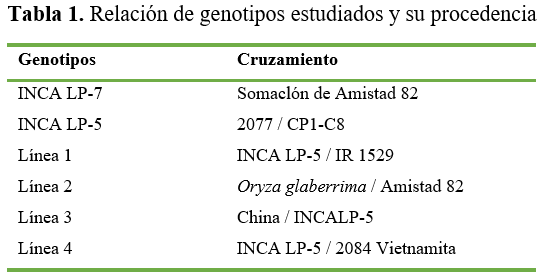
El ensayo se llevó a cabo en una finca perteneciente a la Cooperativa de Créditos y Servicios Abel Santamaría del municipio Los Palacios. El material vegetal estudiado estuvo constituido por seis genotipos de arroz, cuatro nuevas líneas avanzadas obtenidas mediante el método de hibridaciones y los cultivares comerciales INCA LP-5, de ciclo corto e INCA LP-7, de ciclo medio. Se utilizó un diseño Completamente Aleatorizado compuesto por seis tratamientos con tres réplicas cada uno y se evaluaron 11 caracteres cualitativos y nueve cuantitativos. Los datos obtenidos fueron procesados mediante un análisis de varianza de clasificación simple (ANOVA) y se docimaron las medias con la Prueba de Rangos Múltiples de Duncan al 5 %. Para los caracteres cualitativos, los resultados mostraron que todos los genotipos se caracterizaron por tener porte erecto, carencia de pigmentación antociánica, lígulas de tipo hendida, ausencia de aristas, resistencia al acame y color paja del grano paddy. Entre los nuevos genotipos, las líneas 3 y 4 presentaron las hojas y panículas más largas, un buen comportamiento de granos llenos por panícula y masa del grano, así como un bajo número de granos vanos, además de los mejores valores en las variables panículas por metro cuadrado y rendimiento, respectivamente. La línea 2 presentó el ciclo más corto y mostró valores altos de panículas por metro cuadrado y rendimiento. El estudio sistemático de análisis de la diversidad genética es esencial para explotar lo inherente a la variabilidad y ampliar la base genética de cultivares de arroz.
Detalles del artículo

Esta obra está bajo una licencia internacional Creative Commons Atribución-NoComercial 4.0.
Aquellos autores/as que tengan publicaciones con esta revista, aceptan los términos siguientes de la Licencia CC Reconocimiento-NoComercial 4.0 Internacional (CC BY-NC 4.0):
Usted es libre de:
- Compartir — copiar y redistribuir el material en cualquier medio o formato
- Adaptar — remezclar, transformar y crear a partir del material
El licenciador no puede revocar estas libertades mientras cumpla con los términos de la licencia.
Bajo las condiciones siguientes:
- Reconocimiento — Debe reconocer adecuadamente la autoría, proporcionar un enlace a la licencia e indicar si se han realizado cambios. Puede hacerlo de cualquier manera razonable, pero no de una manera que sugiera que tiene el apoyo del licenciador o lo recibe por el uso que hace.
- NoComercial — No puede utilizar el material para una finalidad comercial.
- No hay restricciones adicionales — No puede aplicar términos legales o medidas tecnológicas que legalmente restrinjan realizar aquello que la licencia permite.
La revista no se responsabiliza con las opiniones y conceptos emitidos en los trabajos, son de exclusiva responsabilidad de los autores. El Editor, con la asistencia del Comité de Editorial, se reserva el derecho de sugerir o solicitar modificaciones aconsejables o necesarias. Son aceptados para publicar trabajos científico originales, resultados de investigaciones de interés que no hayan sido publicados ni enviados a otra revista para ese mismo fin.
La mención de marcas comerciales de equipos, instrumentos o materiales específicos obedece a propósitos de identificación, no existiendo ningún compromiso promocional con relación a los mismos, ni por los autores ni por el editor.
Citas
OECD/FAO. OECD-FAO Agricultural Outlook 2022-2031. OECD Ediciones, Paris. 2022. https://doi.org/10.1787/f1b0b29c-en
Rajan J. 5 Emerging Challenges in Rice Cultivation Faced by Farmers: Organica’s Solutions to High Yield and Crop Management. Organica Biotech. 2023. Available from: https://organicabiotech.com/5-emerging-challenges-in-rice-cultivation-faced-by-farmers-organicas-solutions-to-high-yield-and-crop-management/
Parida AK, Sekhar S, Panda BB, Sahu G and Shaw BP. Effect of Panicle Morphology on Grain Filling and Rice Yield: Genetic Control and Molecular Regulation. Front. Genet. 2022, 13:876198. https://doi.org/10.3389/fgene.2022.876198
Bothmer R, Díaz O, Fagerström T, Jansson S, Ortega-Klose F, Ortiz R, Sánchez MA. Más allá de los OGM, ciencia y fitomejoramiento para una agricultura sostenible. 2022. 204 p. ISBN: 978-956.404.859-8. https://doi.org/10.13140/RG.2.2.31906.71360
Calero A, Pérez Y, Quintero E, González Y. Densidades de plantas adecuadas para incrementar el rendimiento agrícola del arroz. Centro Agrícola. 2021;48(1):28-36. Available from: http://scielo.sld.cu/scielo.php?script=sci_arttext&pid=S0253-57852021000100028&lng=es&tlng=es
Martínez N. Arroz, el grano estrella de la cocina cubana. Radio Reloj. 2023. Available from: https://www.radioreloj.cu/comentarios/arroz-el-grano-estrella-de-la-cocina-cubana/
Hernández A, Pérez J, Bosch D, Castro N. Clasificación de los suelos de Cuba 2015. Instituto Nacional de Ciencias Agrícolas, Cuba: EDICIONES INCA. 2015. 93 p. Available from: https://isbn.cloud/9789597023777/clasificacion-de-los-suelos-de-cuba-2015/
MINAG. Instructivo Técnico Cultivo de Arroz. Instituto de Investigaciones del Arroz, MINAG. 2014. 73 p. Available from: https://isbn.cloud/9789597210863/instructivo-tecnico-cultivo-de-arroz/
IRRI. Standard Evaluation System (SES) for Rice. Quinta Edición. Filipinas. 2013. 55p. Available from: https://www.clrri.org/ver2/uploads/SES_5th_edition.pdf
Soe I, Tamu A, Asante MD, Nyadanu D, Akromah R. Genetic diversity analyses of rice germplasm using morphological traits. Journal of Plant Breeding and Crop Science. 2019, 11(4), pp. 128-136. https://doi.org/10.5897/JPBCS2018.0786
Ghosh M. Morpho-agronomic DUS Characterization of Scented Harinakhuri Rice Landrace of Coastal West Bengal. Indian Journal of Plant Genetic Resources: Vol. 32 No. 03 (2019): Indian Journal of Plant Genetic Resources. https://doi.org/10.5958/0976-1926.2019.00045.7
Ospina JO, Ligarreto GA. Caracterización morfoagronómica del banco de germoplasma de FEDEARROZ-FNA en tres ambientes del trópico colombiano. Agronomía Costarricense. 2019, 43(2): 139-155. Available from: https://revistas.ucr.ac.cr/index.php/agrocost/article/view/38204
Devi WJ, Vivekananda Y, Uddin A, Laishram JM, Chakraborty S. Morpho-agronomic characterization and evaluation of a gene-based marker in three aromatic pigmented Chakhao rice accessions of Manipur. Oryza 2020, 57(2), p.100-107. https://doi.org/10.35709/ory.2020.57.2.3
Sasmita P, Kodir K.A. Inventory and morphological characterization of local upland rice in the highlands of South Sumatra province. IOP Conference Series: Earth and Environmental Science 2020. 482(1), p. 012049. IOP Ediciones. https://doi.org/10.1088/1755-1315/482/1/012049
Roy S, Banerjee A, Kumar J, Verma BC, Mandal NP. Genetic Diversity of Gora Rice (Oryza sativa L.) Landraces of Chotanagpur Plateau Region in Eastern India. Indian Journal Plant Genetic Resour. 2021, 34(2): 196–205. https://doi.org/10.5958/0976-1926.2021.00018.8
Zúñiga A, Carrodeguas A. Variabilidad morfo-agronómica en genotipos de arroz en el Pacífico Central, Costa Rica. Ciencia y Agricultura. 2022, 19(1). https://doi.org/10.19053/01228420
Luqman T, Qamar Z, Tabasum A. Genetic characterization of coarse and basmati rice (Oryza sativa L.) through microsatellite markers and morpho-agronomic traits. Genet Resour Crop Evol. 2023,70, 2307-2320. https://doi.org/10.1007/s10722-023-01620-w
Gao J, Liang H, Huang J, Qing D, Wu H, Zhou W, Chen W, Pan Y, Dai G, Gao L, Deng G. Development of the PARMS marker of the TAC1 gene and its utilization in rice plant architecture breeding. Euphytica. 2021, 217(49). https://doi.org/10.1007/s10681-020-02747-y
Guo W, Chen L, Herrera-Estrella L, Cao D, Phan Tran LS. Altering Plant Architecture to Improve Performance and Resistance. Trends in Plant Science. 2020, 25(11), p. 1154-1170. https://doi.org/10.1016/j.tplants.2020.05.009
Gao H, Wang W, Wang Y. Molecular mechanisms underlying plant architecture and its environmental plasticity in rice. Mol Breeding. 2019, 39, 167. https://doi.org/10.1007/s11032-019-1076-2
Díaz S, Morejón R, David D, Castro R. Evaluación morfoagronómica de cultivares tradicionales de arroz (Oryza sativa L.) colectados en fincas de productores de la provincia Pinar del Río. [en línea]. Cultivos Tropicales, 2015, 36(2), pp. 131-141. Available from: http://scielo.sld.cu/scielo.php?script=sci_arttext&pid=S0258-59362015000200018&lng=es&nrm=iso.
Manjunatha GA, Elsy CR, Rajendran P, Joseph J, Francies RM, Krishnan S. Agro-morphological characterization of rice (Oryza sativa L.) landraces of Wayanad, Kerala. Journal of Pharmacognosy and Phytochemistry. 2018, 7(2): 1409-1414. Available from: https://www.phytojournal.com/archives/2018.v7.i2.3549/agro-morphological-characterization-of-rice-oryza-sativa-l-landraces-of-wayanad-kerala.
Demac Y, Tashid S, Ghimirayc M, Chhogyel N. Morpho-agronomic Analysis of New Rice Germplasm at Agriculture Research and Development Centre, Bajo. Bhutanese Journal of Agriculture. 2019, 2(1) 13-25. Available from: https://www.bja.gov.bt/wp-content/uploads/2019/06/2-1.pdf
Degiovanni B, Víctor M, Martínez R, César P, Motta O. Producción eco-eficiente del arroz en América Latina. CIAT. 2010. Available from: https://books.google.es/books
Ortuoste RM. 2016. Panicle Exertion Enhancement of Hybrid Rice (PSB RC72H) As Influenced By Sowing Frequency, Male to Female Row Ratio and Gibberellic Acid. Journal of Agriculture and Veterinary Science. 2016, 9(4): 30-35. https://doi.org/10.9790/2380-0904023035
Avakyan ER, Dzhamirze RR. Rice lodging resistance. RUDN Journal of Agronomy and Animal Industries. 2018, 13(4: 366-372. https://doi.org/10.22363/2312-797X-2018-13-4-366-372
Li F, Numa H, Hara N, Sentoku N, Ishii T, Fukuta Y, Nishimura N, Kato H. Identification of a locus for seed shattering in rice (Oryza sativa L.) by combining bulked segregant analysis with whole-genome sequencing. Mol Breeding. 2019, 39: 36. https://doi.org/10.1007/s11032-019-0941-3
Liyun J, Xin M, Shuangshaung Z, Yanyan T, Fengxia L, Ping G, Yongcai F, Zuofeng Z, Hongwei C, Chuanqing S, Lubin T. The APETALA2-like transcription factor SUPERNUMRARY BRACT controls rice seed shattering and seed size. Plant Cell. 2019. https://doi.org/10.1105/tpc.18.00304
He Y, Li L, Zhang Z, Wu JL. Identification and Comparative Analysis of Premature Senescence Leaf Mutants in Rice (Oryza sativa L.). Int. J. Mol. Sci. 2018, 19, 140. https://doi.org/10.3390/ijms19010140
Lee D, Lee G, Kim B, Jang S, Lee Y, Yu Y, Seo J, Kim S, Lee Y-H, Lee J, Kim S, Koh HJ. Identification of a Spotted Leaf Sheath Gene Involved in Early Senescence and Defense Response in Rice. Front. Plant Sci. 2018, 9:1274. https://doi.org/10.3389/fpls.2018.01274
Wang B, Zhang Y, Bi Z, Liu Q, Xu T, Yu N, Cao L. Impaired Function of the Calcium-Dependent Protein Kinase, OsCPK12, Leads to Early Senescence in Rice (Oryza sativa L.). Frontiers in plant science. 2019, 10, 52. https://doi.org/10.3389/fpls.2019.00052
Ramkumar MK, Senthil S, Gaikwad K, Pandey R, Chinnusamy V, et al. A Novel Stay-Green Mutant of Rice with Delayed Leaf Senescence and Better Harvest Index Confers Drought Tolerance. Plants. 2019; 8(10):375. https://doi.org/10.3390/plants8100375
Shin D, Lee S, Kim TH, et al. Natural variations at the Stay-Green gene promoter control lifespan and yield in rice cultivars. Nature Communication. 2020; 11, 2819. https://doi.org/10.1038/s41467-020-16573-2
Zang Y, Yao Y, Xu Z, Wang B, Mao Y, et al. The Relationships among “STAY-GREEN” Trait, Post-Anthesis Assimilate Remobilization, and Grain Yield in Rice (Oryza sativa L.). International Journal of Molecular Science. 2022, 23, 13668. https://doi.org/10.3390/ijms232213668
Lim KS. New Parameters for Seedling Vigor Developed via Phenomics. Appl. Sci. 2019. 9 (9), 1752. https://doi.org/10.3390/app9091752
Shuaib M, Bahadur S, Hussain F. Enumeration of genetic diversity of wild rice through phenotypic trait analysis. ScienceDirect. 2020, 21. https://doi.org/10.1016/j.genrep.2020.100797
Makino Y, Hirooka Y, Homma K, Kondo R, Liu TS, Tang L. Effect of flag leaf length of erect panicle rice on the canopy structure and biomass production after heading. Agronomy & Crop Ecology. 2022, 25(1). https://doi.org/10.1080/1343943X.2021.1908152
Duan E, Wang Y, Li X, Lin Q, Zhang T, Wang Y. OsSHI1 regulates plant architecture through modulating the transcriptional activity of IPA1 in rice. Plant Cell. 2019, 31, 1026-1042. https://doi.org/10.1105/tpc.19.00023
Deveshwar P, Prusty A, Sharma S, Tyagi AK. Phytohormone-mediated molecular mechanisms involving multiple genes and QTL govern grain number in rice. Front. Genet. 2020, 11:586462. https://doi.org/10.3389/fgene.2020.586462
Zhao H, Mo Z, Lin Q, Pan S, Duan M, Tian H, Wang S, Tang X. Relationships between grain yield and agronomic traits of rice in southern China. Chilean Journal of agricultural research. 2019. https://doi.org/10.4067/S0718-58392020000100072
Gouda G, Gupta M, Donde R, Mohapatra T, Vadde R, Behera L. Marker-assisted selection for grain number and yield-related traits of rice (Oryza sativa L.). Physiol. Mol. Biol. Plants 2020, 26, 885–898. https://doi.org/10.1007/s12298-020-00773-7.
Wu X, Liang Y, Gao H, Wang J, Zhao Y, Hua L. Enhancing rice grain production by manipulating the naturally evolved cis-regulatory element-containing inverted repeat sequence of OsREM20. Mol. Plant. 2021, 14, 997–1011. https://doi.org/10.1016/j.molp.2021.03.016
Xiao N, Pan C H, Li YH, Wu YY, Cai Y, Lu Y. Genomic insight into balancing high yield, good quality, and blast resistance of japonica rice. Genome Biol. 2021, 22:283. https://doi.org/10.1186/s13059-021-02488-8
Yin C, Zhu Y, Li X, Lin Y. Molecular and genetic aspects of grain number determination in Rice (Oryza sativa L.). Int. J. Mol. Sci. 2021, 22, 728. https://doi.org/10.3390/ijms22020728.
Li G, Xu B, Zhang Y, Xu Y, Khan N, Xie J. RGN1 controls grain number and shapes panicle architecture in rice. Plant Biotechnol. J. 2022, 20, 158–167. https://doi.org/10.1111/pbi.13702
Tuhina-Khatun M, Hanafi MM, Rafii M, Wong MY, Salleh FM, Ferdous J. Genetic variation, heritability, and diversity analysis of upland Rice Oriza sativa (L.) genotypes based on quantitative traits. Biomed. Res. Int. 2015:290861. https://doi.org/10.1155/2015/290861.
Roy S, Shil, P. Assessment of genetic heritability in Rice breeding lines based on morphological traits and caryopsis ultrastructure. Sci. Rep. 2020, 10:7830. https://doi.org/10.1038/s41598-020-63976-8
Li M, Zhu D, Jiang M, Luo D, Jiang X, Ji G, Li L, Zhou W. Dry matter production and panicle characteristics of high yield and good taste indica hybrid rice varieties Journal of Integrative Agriculture. 2023, 22(5): 1338-1350. https://doi.org/10.1016/j.jia.2022.08.033
Quintero E. Factores limitantes para el crecimiento y productividad del arroz en Entre Ríos, Argentina. [Tesis Doctoral] Universidad da Coruña. 2009. 167p. Available from: https://ruc.udc.es/dspace/handle/2183/5680
Amegan E, Efisue A, Akoroda M, Shittu A, Tonegnikes F. Genetic Diversity of Korean Rice (Oryza Sativa L.) Germplasm for Yield and Yield Related Traits for Adoption in Rice Farming System in Nigeria. International Journal of Genetics and Genomics. 2020, 8(1): 19-28. https://doi.org/10.11648/j.ijgg.20200801.13
Pérez N. Obtención de cultivares de arroz (Oryza sativa L.) resistentes a Pyricularia griseaSacc. Con buen comportamiento agronómico. [Tesis Doctoral] Instituto Nacional de Ciencias Agrícolas, Mayabeque. 2012. 118p.