Response of promising lines of rice in Los Palacios municipality, Cuba
Article Sidebar
Main Article Content
Abstract
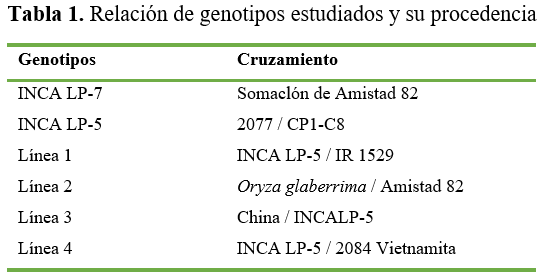
The trial was carried out on a farm belonging to the Credit and Service Cooperative Abel Santamaría in Los Palacios municipality. The analyzed plant material consisted of six rice genotypes, four new advanced lines obtained through the hybridization method and the commercial cultivars INCA LP-5 of short cycle and INCA LP-7 of medium cycle. A completely randomized design consisting of six treatments with three replicates each was used and 11 qualitative and nine quantitative traits were evaluated. The data obtained were processed by simple rank analysis of variance (ANOVA) and the means were decimated by Duncan's Multiple Range Test at 5 %. For qualitative traits, the results showed that all genotypes were characterized by erect growth habit, lack of anthocyanin pigmentation, cleft-type ligule, absence of ridges, and resistance to lodging and straw color of the paddy grain. Among the new genotypes, lines 3 and 4 showed the longest leaves and panicles, a good performance of full grains per panicle and grain mass, as well as a low number of empty grains, in addition to the best values in the characters panicles per square meter and yield, respectively. Line 2 presented the shortest cycle and showed high values of panicles per square meter and yield. The systematic study of genetic diversity analysis is essential to take full advantage of the inherent variability and broaden the genetic base of rice cultivars.
Article Details

This work is licensed under a Creative Commons Attribution-NonCommercial 4.0 International License.
Those authors who have publications with this journal accept the following terms of the License Attribution-NonCommercial 4.0 International (CC BY-NC 4.0):
You are free to:
- Share — copy and redistribute the material in any medium or format
- Adapt — remix, transform, and build upon the material
The licensor cannot revoke these freedoms as long as you follow the license terms.
Under the following terms:
- Attribution — You must give appropriate credit, provide a link to the license, and indicate if changes were made. You may do so in any reasonable manner, but not in any way that suggests the licensor endorses you or your use.
- NonCommercial — You may not use the material for commercial purposes.
- No additional restrictions — You may not apply legal terms or technological measures that legally restrict others from doing anything the license permits.
The journal is not responsible for the opinions and concepts expressed in the works, they are the sole responsibility of the authors. The Editor, with the assistance of the Editorial Committee, reserves the right to suggest or request advisable or necessary modifications. They are accepted to publish original scientific papers, research results of interest that have not been published or sent to another journal for the same purpose.
The mention of trademarks of equipment, instruments or specific materials is for identification purposes, and there is no promotional commitment in relation to them, neither by the authors nor by the publisher.
References
OECD/FAO. OECD-FAO Agricultural Outlook 2022-2031. OECD Ediciones, Paris. 2022. https://doi.org/10.1787/f1b0b29c-en
Rajan J. 5 Emerging Challenges in Rice Cultivation Faced by Farmers: Organica’s Solutions to High Yield and Crop Management. Organica Biotech. 2023. Available from: https://organicabiotech.com/5-emerging-challenges-in-rice-cultivation-faced-by-farmers-organicas-solutions-to-high-yield-and-crop-management/
Parida AK, Sekhar S, Panda BB, Sahu G and Shaw BP. Effect of Panicle Morphology on Grain Filling and Rice Yield: Genetic Control and Molecular Regulation. Front. Genet. 2022, 13:876198. https://doi.org/10.3389/fgene.2022.876198
Bothmer R, Díaz O, Fagerström T, Jansson S, Ortega-Klose F, Ortiz R, Sánchez MA. Más allá de los OGM, ciencia y fitomejoramiento para una agricultura sostenible. 2022. 204 p. ISBN: 978-956.404.859-8. https://doi.org/10.13140/RG.2.2.31906.71360
Calero A, Pérez Y, Quintero E, González Y. Densidades de plantas adecuadas para incrementar el rendimiento agrícola del arroz. Centro Agrícola. 2021;48(1):28-36. Available from: http://scielo.sld.cu/scielo.php?script=sci_arttext&pid=S0253-57852021000100028&lng=es&tlng=es
Martínez N. Arroz, el grano estrella de la cocina cubana. Radio Reloj. 2023. Available from: https://www.radioreloj.cu/comentarios/arroz-el-grano-estrella-de-la-cocina-cubana/
Hernández A, Pérez J, Bosch D, Castro N. Clasificación de los suelos de Cuba 2015. Instituto Nacional de Ciencias Agrícolas, Cuba: EDICIONES INCA. 2015. 93 p. Available from: https://isbn.cloud/9789597023777/clasificacion-de-los-suelos-de-cuba-2015/
MINAG. Instructivo Técnico Cultivo de Arroz. Instituto de Investigaciones del Arroz, MINAG. 2014. 73 p. Available from: https://isbn.cloud/9789597210863/instructivo-tecnico-cultivo-de-arroz/
IRRI. Standard Evaluation System (SES) for Rice. Quinta Edición. Filipinas. 2013. 55p. Available from: https://www.clrri.org/ver2/uploads/SES_5th_edition.pdf
Soe I, Tamu A, Asante MD, Nyadanu D, Akromah R. Genetic diversity analyses of rice germplasm using morphological traits. Journal of Plant Breeding and Crop Science. 2019, 11(4), pp. 128-136. https://doi.org/10.5897/JPBCS2018.0786
Ghosh M. Morpho-agronomic DUS Characterization of Scented Harinakhuri Rice Landrace of Coastal West Bengal. Indian Journal of Plant Genetic Resources: Vol. 32 No. 03 (2019): Indian Journal of Plant Genetic Resources. https://doi.org/10.5958/0976-1926.2019.00045.7
Ospina JO, Ligarreto GA. Caracterización morfoagronómica del banco de germoplasma de FEDEARROZ-FNA en tres ambientes del trópico colombiano. Agronomía Costarricense. 2019, 43(2): 139-155. Available from: https://revistas.ucr.ac.cr/index.php/agrocost/article/view/38204
Devi WJ, Vivekananda Y, Uddin A, Laishram JM, Chakraborty S. Morpho-agronomic characterization and evaluation of a gene-based marker in three aromatic pigmented Chakhao rice accessions of Manipur. Oryza 2020, 57(2), p.100-107. https://doi.org/10.35709/ory.2020.57.2.3
Sasmita P, Kodir K.A. Inventory and morphological characterization of local upland rice in the highlands of South Sumatra province. IOP Conference Series: Earth and Environmental Science 2020. 482(1), p. 012049. IOP Ediciones. https://doi.org/10.1088/1755-1315/482/1/012049
Roy S, Banerjee A, Kumar J, Verma BC, Mandal NP. Genetic Diversity of Gora Rice (Oryza sativa L.) Landraces of Chotanagpur Plateau Region in Eastern India. Indian Journal Plant Genetic Resour. 2021, 34(2): 196–205. https://doi.org/10.5958/0976-1926.2021.00018.8
Zúñiga A, Carrodeguas A. Variabilidad morfo-agronómica en genotipos de arroz en el Pacífico Central, Costa Rica. Ciencia y Agricultura. 2022, 19(1). https://doi.org/10.19053/01228420
Luqman T, Qamar Z, Tabasum A. Genetic characterization of coarse and basmati rice (Oryza sativa L.) through microsatellite markers and morpho-agronomic traits. Genet Resour Crop Evol. 2023,70, 2307-2320. https://doi.org/10.1007/s10722-023-01620-w
Gao J, Liang H, Huang J, Qing D, Wu H, Zhou W, Chen W, Pan Y, Dai G, Gao L, Deng G. Development of the PARMS marker of the TAC1 gene and its utilization in rice plant architecture breeding. Euphytica. 2021, 217(49). https://doi.org/10.1007/s10681-020-02747-y
Guo W, Chen L, Herrera-Estrella L, Cao D, Phan Tran LS. Altering Plant Architecture to Improve Performance and Resistance. Trends in Plant Science. 2020, 25(11), p. 1154-1170. https://doi.org/10.1016/j.tplants.2020.05.009
Gao H, Wang W, Wang Y. Molecular mechanisms underlying plant architecture and its environmental plasticity in rice. Mol Breeding. 2019, 39, 167. https://doi.org/10.1007/s11032-019-1076-2
Díaz S, Morejón R, David D, Castro R. Evaluación morfoagronómica de cultivares tradicionales de arroz (Oryza sativa L.) colectados en fincas de productores de la provincia Pinar del Río. [en línea]. Cultivos Tropicales, 2015, 36(2), pp. 131-141. Available from: http://scielo.sld.cu/scielo.php?script=sci_arttext&pid=S0258-59362015000200018&lng=es&nrm=iso.
Manjunatha GA, Elsy CR, Rajendran P, Joseph J, Francies RM, Krishnan S. Agro-morphological characterization of rice (Oryza sativa L.) landraces of Wayanad, Kerala. Journal of Pharmacognosy and Phytochemistry. 2018, 7(2): 1409-1414. Available from: https://www.phytojournal.com/archives/2018.v7.i2.3549/agro-morphological-characterization-of-rice-oryza-sativa-l-landraces-of-wayanad-kerala.
Demac Y, Tashid S, Ghimirayc M, Chhogyel N. Morpho-agronomic Analysis of New Rice Germplasm at Agriculture Research and Development Centre, Bajo. Bhutanese Journal of Agriculture. 2019, 2(1) 13-25. Available from: https://www.bja.gov.bt/wp-content/uploads/2019/06/2-1.pdf
Degiovanni B, Víctor M, Martínez R, César P, Motta O. Producción eco-eficiente del arroz en América Latina. CIAT. 2010. Available from: https://books.google.es/books
Ortuoste RM. 2016. Panicle Exertion Enhancement of Hybrid Rice (PSB RC72H) As Influenced By Sowing Frequency, Male to Female Row Ratio and Gibberellic Acid. Journal of Agriculture and Veterinary Science. 2016, 9(4): 30-35. https://doi.org/10.9790/2380-0904023035
Avakyan ER, Dzhamirze RR. Rice lodging resistance. RUDN Journal of Agronomy and Animal Industries. 2018, 13(4: 366-372. https://doi.org/10.22363/2312-797X-2018-13-4-366-372
Li F, Numa H, Hara N, Sentoku N, Ishii T, Fukuta Y, Nishimura N, Kato H. Identification of a locus for seed shattering in rice (Oryza sativa L.) by combining bulked segregant analysis with whole-genome sequencing. Mol Breeding. 2019, 39: 36. https://doi.org/10.1007/s11032-019-0941-3
Liyun J, Xin M, Shuangshaung Z, Yanyan T, Fengxia L, Ping G, Yongcai F, Zuofeng Z, Hongwei C, Chuanqing S, Lubin T. The APETALA2-like transcription factor SUPERNUMRARY BRACT controls rice seed shattering and seed size. Plant Cell. 2019. https://doi.org/10.1105/tpc.18.00304
He Y, Li L, Zhang Z, Wu JL. Identification and Comparative Analysis of Premature Senescence Leaf Mutants in Rice (Oryza sativa L.). Int. J. Mol. Sci. 2018, 19, 140. https://doi.org/10.3390/ijms19010140
Lee D, Lee G, Kim B, Jang S, Lee Y, Yu Y, Seo J, Kim S, Lee Y-H, Lee J, Kim S, Koh HJ. Identification of a Spotted Leaf Sheath Gene Involved in Early Senescence and Defense Response in Rice. Front. Plant Sci. 2018, 9:1274. https://doi.org/10.3389/fpls.2018.01274
Wang B, Zhang Y, Bi Z, Liu Q, Xu T, Yu N, Cao L. Impaired Function of the Calcium-Dependent Protein Kinase, OsCPK12, Leads to Early Senescence in Rice (Oryza sativa L.). Frontiers in plant science. 2019, 10, 52. https://doi.org/10.3389/fpls.2019.00052
Ramkumar MK, Senthil S, Gaikwad K, Pandey R, Chinnusamy V, et al. A Novel Stay-Green Mutant of Rice with Delayed Leaf Senescence and Better Harvest Index Confers Drought Tolerance. Plants. 2019; 8(10):375. https://doi.org/10.3390/plants8100375
Shin D, Lee S, Kim TH, et al. Natural variations at the Stay-Green gene promoter control lifespan and yield in rice cultivars. Nature Communication. 2020; 11, 2819. https://doi.org/10.1038/s41467-020-16573-2
Zang Y, Yao Y, Xu Z, Wang B, Mao Y, et al. The Relationships among “STAY-GREEN” Trait, Post-Anthesis Assimilate Remobilization, and Grain Yield in Rice (Oryza sativa L.). International Journal of Molecular Science. 2022, 23, 13668. https://doi.org/10.3390/ijms232213668
Lim KS. New Parameters for Seedling Vigor Developed via Phenomics. Appl. Sci. 2019. 9 (9), 1752. https://doi.org/10.3390/app9091752
Shuaib M, Bahadur S, Hussain F. Enumeration of genetic diversity of wild rice through phenotypic trait analysis. ScienceDirect. 2020, 21. https://doi.org/10.1016/j.genrep.2020.100797
Makino Y, Hirooka Y, Homma K, Kondo R, Liu TS, Tang L. Effect of flag leaf length of erect panicle rice on the canopy structure and biomass production after heading. Agronomy & Crop Ecology. 2022, 25(1). https://doi.org/10.1080/1343943X.2021.1908152
Duan E, Wang Y, Li X, Lin Q, Zhang T, Wang Y. OsSHI1 regulates plant architecture through modulating the transcriptional activity of IPA1 in rice. Plant Cell. 2019, 31, 1026-1042. https://doi.org/10.1105/tpc.19.00023
Deveshwar P, Prusty A, Sharma S, Tyagi AK. Phytohormone-mediated molecular mechanisms involving multiple genes and QTL govern grain number in rice. Front. Genet. 2020, 11:586462. https://doi.org/10.3389/fgene.2020.586462
Zhao H, Mo Z, Lin Q, Pan S, Duan M, Tian H, Wang S, Tang X. Relationships between grain yield and agronomic traits of rice in southern China. Chilean Journal of agricultural research. 2019. https://doi.org/10.4067/S0718-58392020000100072
Gouda G, Gupta M, Donde R, Mohapatra T, Vadde R, Behera L. Marker-assisted selection for grain number and yield-related traits of rice (Oryza sativa L.). Physiol. Mol. Biol. Plants 2020, 26, 885–898. https://doi.org/10.1007/s12298-020-00773-7.
Wu X, Liang Y, Gao H, Wang J, Zhao Y, Hua L. Enhancing rice grain production by manipulating the naturally evolved cis-regulatory element-containing inverted repeat sequence of OsREM20. Mol. Plant. 2021, 14, 997–1011. https://doi.org/10.1016/j.molp.2021.03.016
Xiao N, Pan C H, Li YH, Wu YY, Cai Y, Lu Y. Genomic insight into balancing high yield, good quality, and blast resistance of japonica rice. Genome Biol. 2021, 22:283. https://doi.org/10.1186/s13059-021-02488-8
Yin C, Zhu Y, Li X, Lin Y. Molecular and genetic aspects of grain number determination in Rice (Oryza sativa L.). Int. J. Mol. Sci. 2021, 22, 728. https://doi.org/10.3390/ijms22020728.
Li G, Xu B, Zhang Y, Xu Y, Khan N, Xie J. RGN1 controls grain number and shapes panicle architecture in rice. Plant Biotechnol. J. 2022, 20, 158–167. https://doi.org/10.1111/pbi.13702
Tuhina-Khatun M, Hanafi MM, Rafii M, Wong MY, Salleh FM, Ferdous J. Genetic variation, heritability, and diversity analysis of upland Rice Oriza sativa (L.) genotypes based on quantitative traits. Biomed. Res. Int. 2015:290861. https://doi.org/10.1155/2015/290861.
Roy S, Shil, P. Assessment of genetic heritability in Rice breeding lines based on morphological traits and caryopsis ultrastructure. Sci. Rep. 2020, 10:7830. https://doi.org/10.1038/s41598-020-63976-8
Li M, Zhu D, Jiang M, Luo D, Jiang X, Ji G, Li L, Zhou W. Dry matter production and panicle characteristics of high yield and good taste indica hybrid rice varieties Journal of Integrative Agriculture. 2023, 22(5): 1338-1350. https://doi.org/10.1016/j.jia.2022.08.033
Quintero E. Factores limitantes para el crecimiento y productividad del arroz en Entre Ríos, Argentina. [Tesis Doctoral] Universidad da Coruña. 2009. 167p. Available from: https://ruc.udc.es/dspace/handle/2183/5680
Amegan E, Efisue A, Akoroda M, Shittu A, Tonegnikes F. Genetic Diversity of Korean Rice (Oryza Sativa L.) Germplasm for Yield and Yield Related Traits for Adoption in Rice Farming System in Nigeria. International Journal of Genetics and Genomics. 2020, 8(1): 19-28. https://doi.org/10.11648/j.ijgg.20200801.13
Pérez N. Obtención de cultivares de arroz (Oryza sativa L.) resistentes a Pyricularia griseaSacc. Con buen comportamiento agronómico. [Tesis Doctoral] Instituto Nacional de Ciencias Agrícolas, Mayabeque. 2012. 118p.