Analysis of phenotypic traits for the differentiation of Mussa sp. clones and their association with environmental variables
Article Sidebar
Main Article Content
Abstract
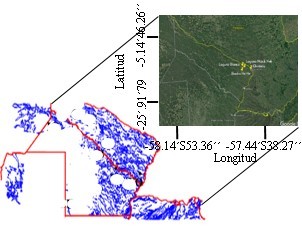
In order to determine morphological characteristics of Musa sp´ clones collected in Riacho He He, Laguna Blanca, Clorinda, and Laguna Naick-Neck, Formosa province, banana standard descriptor from IPGRI-INIBAP/CIRAD and Banana and Plantain Breeding International Network, were used. Nine quantitative descriptors related to the plant, to the leaves, and to the fruits were studied. Outstanding descriptors were observed in detail. Data was analyzed through Multivariate Variance Analyses, Components Principal Analysis and Regression Trees. The comparisons between provenances were highly significant and phenotypic characteristics were associated with one environmental variable. The Principal Component Analysis explained 87 % of the phenotypic variance in two extracted components. A genetic improvement program is very important to obtain new clones due to traits can be highly heritable.
Article Details

This work is licensed under a Creative Commons Attribution-NonCommercial 4.0 International License.
Those authors who have publications with this journal accept the following terms of the License Attribution-NonCommercial 4.0 International (CC BY-NC 4.0):
You are free to:
- Share — copy and redistribute the material in any medium or format
- Adapt — remix, transform, and build upon the material
The licensor cannot revoke these freedoms as long as you follow the license terms.
Under the following terms:
- Attribution — You must give appropriate credit, provide a link to the license, and indicate if changes were made. You may do so in any reasonable manner, but not in any way that suggests the licensor endorses you or your use.
- NonCommercial — You may not use the material for commercial purposes.
- No additional restrictions — You may not apply legal terms or technological measures that legally restrict others from doing anything the license permits.
The journal is not responsible for the opinions and concepts expressed in the works, they are the sole responsibility of the authors. The Editor, with the assistance of the Editorial Committee, reserves the right to suggest or request advisable or necessary modifications. They are accepted to publish original scientific papers, research results of interest that have not been published or sent to another journal for the same purpose.
The mention of trademarks of equipment, instruments or specific materials is for identification purposes, and there is no promotional commitment in relation to them, neither by the authors nor by the publisher.
References
Ermini J, Tenaglia G, Pratta G. Molecular Diversity in Selected Banana clones (Mussa AAA Cavendish) Adapted to the Subtropical Enviroment of Formosa Province (Argentina). American Journal of Plant Sciences. 2018. https://doi.org/10.4236/ajps.2018.912181
Bustamante Intriago E. Selección de material genético de banano cv. Williams (Musa AAA) resistente a sigatoka negra (Mycosphaerella fijiensis Morelet), mutados con radiación gamma. Quevedo. 2019. UTEQ. p 63. http://repositorio.uteq.edu.ec/handle/43000/3842
Cedeño Vera, J., y Puerta Napa, A. Caracterización morfoagrómica de 51 selecciones élites de plátano CV. Barraganete (Musa AAB Simmonds) en el valle del Río Carrizal. Proyecto de investigación. Escuela de Ingeniería Agrícola. Escuela Superior Politécnica Agropecuaria de Manabí Manuel Félix López.2023.
Di Rienzo J, Casanoves F, Balzarini M, González L, Tablada M, Robledo C. InfoStat Software Estadístico. 2017.
IPGRI. Descriptores para el Banano (Musa sp.). INIBAP, Montpellier.1996. ISBN: 92- 9043-307-8.
Mera C. Caracterización agronómica y sanitaria de mutantes de banano cv. Williams en la Estación Experimental Tropical Pichilingue, Provincia de Los Ríos. Tesis de Grado. Guayaquil, Guayas, Ecuador: Universidad de Guayaquil. 2019. p 78. http://repositorio.ug.edu.ec/handle/redug/39405
Mozombite Tello M. Caracterización botánica y evaluación preliminar del rendimiento en tres ecotipos de Musa paradisiaca L. Tesis para optar el título profesional de Ingeniero Agrónomo. Facultad de Ciencias Agrarias. Universidad Nacional de San Martín- Tarapoto. 2019. p 54. http://hdl.handle.net/11458/3601
Navia M. Caracterización morfológica de cultivares recolectados de banano y plátano. Lima, Perú: PIA. 2019. http://repositorio.uteq.edu.ec/handle/43000/6089
Zambrano Saltos C. Caracterización morfológica de un banco de germoplasma de banano cv. Williams proveniente de mutagénesis física en la Estación Experimental Tropical Pichilingue. Proyecto de Investigación previo a la obtención del título de Ingeniero Agrónomo. Facultad de Ciencias Agrarias. Universidad Técnica Estatal de Quevedo. 2020. p 77. http://repositorio.uteq.edu.ec/handle/43000/6089
Gerónimo F, Ibarra Q, Navia M, Aguirre G. Caracterización morfológica de plátano (Musa paradisíaca L.) en la Provincia NorYungas de la Paz y Provincia Chapare de Cochabamba, Bolivia. Agrociencias Amazonia. 2013;1(2):35-41. https://es.scribd.com/document/307843358/Caracterizacion-Morfologica-de-Platano-Musa-Paradisiaca-l-en-La-Provincia#download
Buitrago Bitar, M., Enrique Valencia, A., Londoño Caicedo, J., Muñoz Flores, J., Villegas Estrada, B., & Santana Fonseca, G. Molecular and morphological characterization of Musa spp. (Zingiberales: musaceae) cultivars. Bol. Cient. Mus. Hist. Nat. Univ. Caldas. 2020; 24(1). ISSN 0123-3068. https://doi.org/10.17151/bccm.2020.24.1.2
Mera C. Caracterización agronómica y sanitaria de mutantes de banano cv. Williams en la Estación Experimental Tropical Pichilingue, Provincia de Los Ríos. Tesis de Grado. Guayaquil, Guayas, Ecuador: Universidad de Guayaquil; 2019. 78 p. https://repositorio.uteq.edu.ec/server/api/core/bitstreams/cc8e8ff2-4881-4a52-ac70-df45316aa8ad/content
Navia Montaño M. Caracterización morfológica de cultivares recolectados de banano y plátano. Lima, Perú: PIA ACC-UMSS08. 2019. https://docplayer.es/140038862-Pia-acc-umss-o8-caracterizacion-morfologica-de-cultivares-recolectados.html
Torres Cabrera D, García Águila L, Bermúdez Caraballoso I, Sarría Z, Hurtado Ribalta O, Delgado E, Pérez A, Fernández Martínez O. Respuesta morfo-agronómica y organoléptica de cinco cultivares de banano (Musa sp.) en condiciones de campo. Biotecnología Vegetal. 2020; 20 (1): 43 – 50. ISSN 2074-8647, RNPS: 2154. https://revista.ibp.co.cu/index.php/BV/article/view/654/pdf
15. Roser, L. Genética del paisaje en poblaciones de Prosopis alba de la provincia de Santiago del Estero. (info:eu-repo/semantics/doctoralThesis). Universidad de Buenos Aires. Facultad de Ciencias Exactas y Naturales. Universidad de Buenos Aires. 2017. https://hdl.handle.net/20.500.12110/tesis_n5874_Roser
Fontana, L., Pérez, V. y Luna .C. Efecto del origen geográfico sobre la calidad morfológica de plantas de Prosopis alba (Fabaceae). 2018. Rev. Biol. Trop, 66;(2), 593-604. Inst. J. Trop. Biol. ISSN 0034-7744. http://dx.doi.org/10.15517/rbt.v66i2.33383
Fredrick, C., Muthuri, C., Ngamau, K. & Sinclair, F. (2015). Provenance variation in seed morphological characteristics. germination and early seedling growth of Faidherbia albida. Journal of Horticulture and Forestry, 7 (5), 127-140. https://doi.org.10.5897/JHF2015.0392
Vega, M.V. (2023). Instalación de un huerto experimental y evaluación fenotípica de Neltuma alba (Fabaceae) para la estimación ex situ de parámetros genéticos: heredabilidad y diferenciación entre procedencias. Tesis para optar el título de Doctor en Recursos Naturales. Facultad de Ciencias Agrarias. Universidad Nacional del Nordeste. Corrientes. Argentina.