Identificación de hongos fitopatógenos causantes de manchas foliares en caña de azúcar ecuatoriana variedad EC-08
Barra lateral del artículo
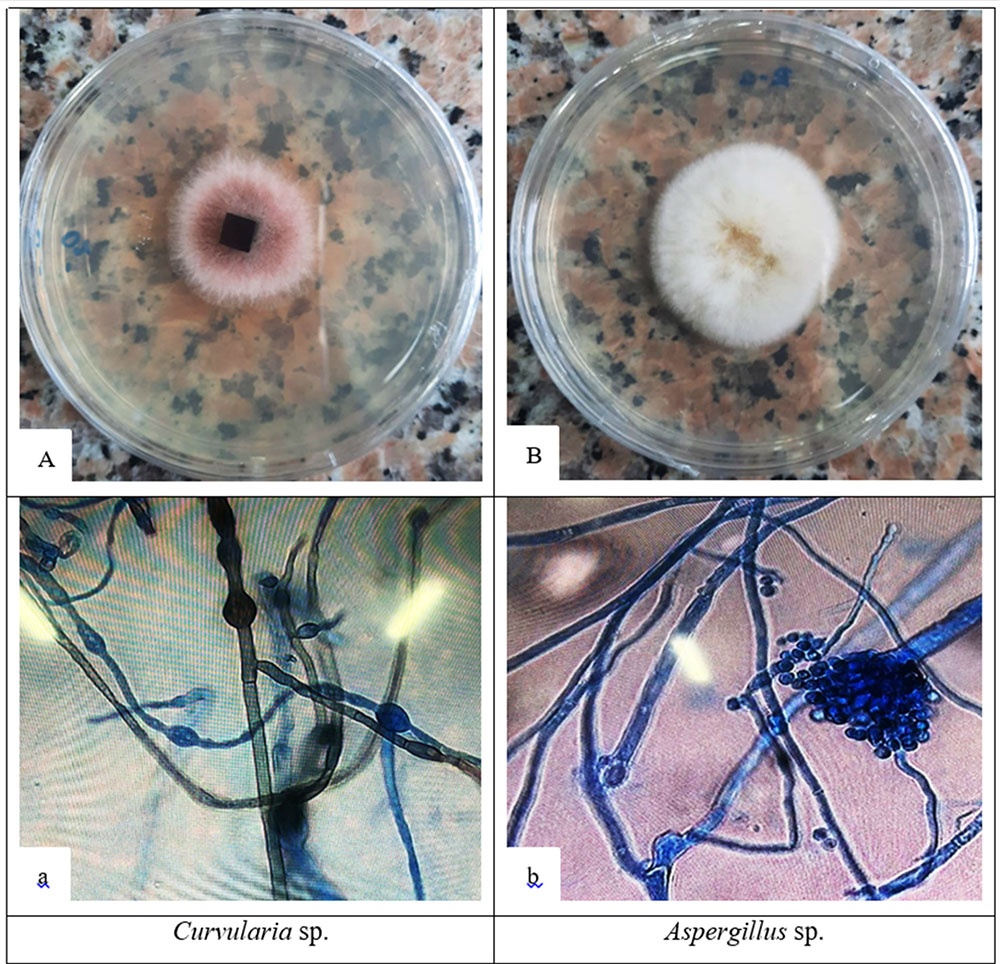
Contenido principal del artículo
Resumen
La identificación de hongos fitopatógenos en caña de azúcar es fundamental para establecer estrategias de control eficaces, que garanticen la sostenibilidad y la producción de esta importante gramínea. El objetivo del estudio fue identificar los agentes fúngicos causantes de las manchas necróticas en las hojas de caña de azúcar variedad EC-08. Tras la desinfección, las muestras de hojas con síntomas fueron sembradas en un medio de cultivo agar papa dextrosa (PDA). Se obtuvieron cultivos puros para el análisis molecular mediante la extracción de ácido desoxirribonucleico (ADN) y espaciador transcrito interno (ITS). Además, se realizó un análisis metagenómico utilizando metabarcoding de secuenciación masiva paralela (ITS), y las secuencias se identificaron utilizando BLAST. Los resultados del análisis molecular ITS arrojaron un 100 % de ADN puro en los fragmentos amplificados. La electroforesis en gel de agarosa al 1 % visualizó bandas para las especies: Curvularia petersonii (535 pb), Aspergillus arachidicola (536 pb) y Rhinocladiella sp. (529 pb) según las lecturas de secuenciación SANGER, mientras que el resultado del perfil taxonómico detectó un 100 % de Fusarium pseudoanthophilum y un 97 % de Nigrospora osmanthi. En conclusión, los métodos de código de barras ITS y metacódigo de barras permitieron identificar los hongos fitopatógenos C. petersonii, A. arachidicola, Rhinocladiella sp., F. pseudoanthophilum y N. osmanthi como causas de la necrosis foliar en este cultivar.
Detalles del artículo

Esta obra está bajo una licencia internacional Creative Commons Atribución-NoComercial 4.0.
Aquellos autores/as que tengan publicaciones con esta revista, aceptan los términos siguientes de la Licencia CC Reconocimiento-NoComercial 4.0 Internacional (CC BY-NC 4.0):
Usted es libre de:
- Compartir — copiar y redistribuir el material en cualquier medio o formato
- Adaptar — remezclar, transformar y crear a partir del material
El licenciador no puede revocar estas libertades mientras cumpla con los términos de la licencia.
Bajo las condiciones siguientes:
- Reconocimiento — Debe reconocer adecuadamente la autoría, proporcionar un enlace a la licencia e indicar si se han realizado cambios. Puede hacerlo de cualquier manera razonable, pero no de una manera que sugiera que tiene el apoyo del licenciador o lo recibe por el uso que hace.
- NoComercial — No puede utilizar el material para una finalidad comercial.
- No hay restricciones adicionales — No puede aplicar términos legales o medidas tecnológicas que legalmente restrinjan realizar aquello que la licencia permite.
La revista no se responsabiliza con las opiniones y conceptos emitidos en los trabajos, son de exclusiva responsabilidad de los autores. El Editor, con la asistencia del Comité de Editorial, se reserva el derecho de sugerir o solicitar modificaciones aconsejables o necesarias. Son aceptados para publicar trabajos científico originales, resultados de investigaciones de interés que no hayan sido publicados ni enviados a otra revista para ese mismo fin.
La mención de marcas comerciales de equipos, instrumentos o materiales específicos obedece a propósitos de identificación, no existiendo ningún compromiso promocional con relación a los mismos, ni por los autores ni por el editor.
Citas
García R, Guevara DAS, Poma JPP, Sancho D, Sarabia D, Heredia FJM. Utilización de tres métodos químicos para la conservación de caña de azúcar (Saccharum officinarum L.), variedad POJ 93, en Pastaza, Ecuador. La Técnica. 2018;(19):61-74. Available from: https://doi.org/10.33936/la_tecnica.v0i19.1308
Hoang AT, Lam TT, Thi HTP, Nguyen Thi H, Pham HP, Doan Thi L,et al. Identification of Nigrospora sphaerica and Curvularia lunata as causal agents of leaf spot disease in cantaloupe (Cucumis melo L.) in Southern Vietnam. Australas Plant Pathol. 2025;1-10. Available from: https://doi.org/10.1007/s13313-025-01028-3
LaO Hechavarria M de la L. Genotipificación y fuentes de resistencia de los agentes causales de virus del mosaico y hoja amarilla de la caña de azúcar. An La Acad Ciencias Cuba [Internet]. 2018;18(1):1-6. Available from: https://revistaccuba.sld.cu/index.php/revacc/article/view/363
Aliya SSS, Nusaibah SA, Mahyudin MM, Yusop MR. Pathogenicity, enzymatic assays, and differential metabolomics to assess the virulence of fungal pathogens responsible for complex circular leaf spot (CCLS) disease of rubber trees in Malaysia. Physiol Mol Plant Pathol. 2025;136:102582. Available from: https://doi.org/10.1016/j.pmpp.2025.102582
Centro de Investigación de la Caña de Azúcar de Ecuador (CINCAE). Manejo de enfermedades [Internet]. 2026. Available from: https://cincae.org/areas-de-investigacion/manejo-de-enfermedades/
Arauz EEC, Gaitán YYG, Gómez IES, Estrada SPC. Diagnóstico de enfermedades bacterianas en el cultivo de café (Coffea arabica L.) y sensibilidad in vitro a bactericidas de uso agrícola. La Calera. 2023;23(40). Available from: https://doi.org/10.5377/calera.v23i40.15831
Jeger M, Beresford R, Bock C, Brown N, Fox A, Newton A, et al. Global challenges facing plant pathology: multidisciplinary approaches to meet the food security and environmental challenges in the mid-twenty-first century. CABI Agric Biosci. 2021;2(1):1-18. Available from: https://doi.org/10.1186/s43170-021-00042-x
Castillo Carrillo CI. Biodiversity in Ecuador and its immense potential for agricultural pest control. In: Agricultural, Forestry and bioindustry biotechnology and biodiscovery. springer; 2020. p. 143-61. Available from: https://doi.org/10.1007/978-3-030-51358-0_9
Martínez G, Rey JC, Pichardo REP, Manzanilla EE. Marchitez por Fusarium raza tropical 4: Estado actual y presencia en el continente americano. Agron Mesoam [Internet]. 2020;31(1):259-76. Available from: http://dx.doi.org/10.15517/am.v31i1.37925
Guerrero AMC, González M. Micorrizas Autóctonas como Indicadores de Salud y Calidad del Suelo. RECITIUTM [Internet]. 2024;10(2):51-64. Available from: http://201.249.78.46/index.php/recitiutm/article/view/265/pdf
Taniwaki MH, Pitt JI, Magan N. Aspergillus species and mycotoxins: occurrence and importance in major food commodities. Curr Opin Food Sci. 2018;23:38-43. Available from: https://doi.org/10.1016/j.cofs.2018.05.008
Khan NA, Asaf S, Ahmad W, Jan R, Bilal S, Khan I, et al. Diversity, lifestyle, genomics, and their functional role of Cochliobolus, Bipolaris, and Curvularia species in environmental remediation and plant growth promotion under biotic and abiotic stressors. J Fungi. 2023;9(2):254. Available from: https://doi.org/10.3390/jof9020254
Li L, Zhang X, Tan X, Sun B, Wu B, Yu M, et al. Rhinoclactones AE, resorcylic acid analogs from desert plant endophytic fungus Rhinocladiella similis. Molecules. 2019;24(7):1405. Available from: https://doi.org/10.3390/molecules24071405
Zhong J, Situ J, He C, He J, Kong G, Li H, et al. A virulent milRNA of Fusarium oxysporum f. sp. cubense impairs plant resistance by targeting banana AP2 transcription factor coding gene MaPTI6L. Hortic Res. 2025;12(4):uhae361. Available from: https://doi.org/10.1093/hr/uhae361
Badiwe M, Fialho RO, Stevens C, Lombard P-H, van Niekerk J. Fusarium species associated with diseases of Citrus: A comprehensive review. J Fungi. 2025;11(4):263. Available from: https://doi.org/10.3390/jof11040263
Solórzano-Solórzano JA, Zambrano SMV, Olmedo JBV. Fusarium spp. en el cultivo de maíz: Identificación, distribución geográfica, sintomatología, micotoxinas, ciclo de la enfermedad, control, y desafíos actuales y futuros. Sci Agropecu. 2024;15(4):537-56. Available from: http://dx.doi.org/10.17268/sci.agropecu.2024.040
Yang K, Yang X, Li M, Li D, Huang X, Li C. Occurrence of Nigrospora osmanthi causing leaf spot on Artemisia argyi in China. Crop Prot. 2025;191:107142. Available from: https://doi.org/10.1016/j.cropro.2025.107142
Ugalde-Monge B, Artavia-Carmona R, Hilje-Rodríguez I, Peraza-Padilla W. Identificación morfológica y molecular de potenciales hongos nematófagos en fincas bananeras de la región huetar atlántica de Costa Rica. Agron Costarric. 2024;48(2):111-31. Available from: https://doi.org/10.15517/rac.v48i2.62489
Vera-Rodríguez JH, Villamar-Aveiga MR, Herrera-Feijoo RJ, Sevilla-Carrasco JD, Moreno D, Gavin-Moyano CS, et al. Detection of Diaporthe sp. in cacao plants (cv. CCN 51) in Guayas Province, Ecuador. Rev Fac Agron Univ Zulia. 2025;42(4). Available from: https://doi.org/10.47280/RevFacAgron(LUZ).v42.n4.III
Ćurčić NŽ, Miljanić JA, Bočarov SAS, Vukelić ID, Bodroža SMI. PCR-RFLP method in combination with on-chip electrophoresis as a tool for determining of variability between important species of Aspergillus. Food Feed Res. 2024;51(1):31-9. Available from: https://doi.org/10.5937/ffr0-49318
Paloi S, Luangsa-Ard JJ, Mhuantong W, Stadler M, Kobmoo N. Intragenomic variation in nuclear ribosomal markers and its implication in species delimitation, identification and barcoding in fungi. Fungal Biol Rev. 2022;42:1-33. Available from: https://doi.org/10.1016/j.fbr.2022.04.002
Moore GG, Mack BM, Beltz SB, Puel O. Genome sequence of an aflatoxigenic pathogen of Argentinian peanut, Aspergillus arachidicola. BMC Genomics. 2018;19(1):189. Available from: https://doi.org/10.1186/s12864-018-4576-2
Iturrieta-González I, Gené J, Wiederhold N, García D. Three new Curvularia species from clinical and environmental sources. MycoKeys. 2020;68:1. Available from: https://doi.org/10.3897/mycokeys.68.51667
Tan YP, Crous PW, Shivas RG. Cryptic species of Curvularia in the culture collection of the Queensland Plant Pathology Herbarium. MycoKeys. 2018;(35):1. Available from: https://doi.org/10.3897/mycokeys.35.25665
Madrid H, Hernandez-Restrepo M, Gené J, Cano J, Guarro J, Silva V. New and interesting chaetothyrialean fungi from Spain. Mycol Prog. 2016;15(10):1179-201. Available from: https://doi.org/10.1007/s11557-016-1239-z
Crous PW, Wingfield MJ, Schumacher RK, Akulov A, Bulgakov TS, Carnegie AJ, et al. New and interesting fungi. 3. Fungal Syst Evol. 2020;6:157. Available from: https://doi.org/10.3114/fuse.2018.01.08
Amobonye A, Bhagwat P, Ranjith D, Mohanlall V, Pillai S. Characterization, pathogenicity and hydrolytic enzyme profiling of selected Fusarium species and their inhibition by novel coumarins. Arch Microbiol. 2021;203(6):3495-508. Available from: https://doi.org/10.1007/s00203-021-02335-1
Petrović E, Vrandečić K, Ćosić J, Siber T, Godena S. Antifungal efficacy of essential oils and their predominant components against olive fungal pathogens. Agriculture. 2025;15(3):340. Available from: https://doi.org/10.3390/agriculture15030340
Oskay F, Karataş A. Pinus nigra subsp. pallasiana ve Pinus sylvestris tohumlarında Diplodia sapinea’nın yoğunluğu. Turkish J For. 2021;22(3):218-28. Available from: https://doi.org/10.18182/tjf.799849
Shabeer S, Tahira R, Jamal A. Fusarium spp. mycotoxin production, diseases and their management: An overview. Pakistan J Agric Res. 2021;34(2):278. Available from: https://dx.doi.org/10.17582/journal.pjar/2021/34.2.278.293