Detection of phytopathogenic fungi that cause leaf spots in Ecuadorian sugarcane EC-08 variety
Article Sidebar
Main Article Content
Abstract
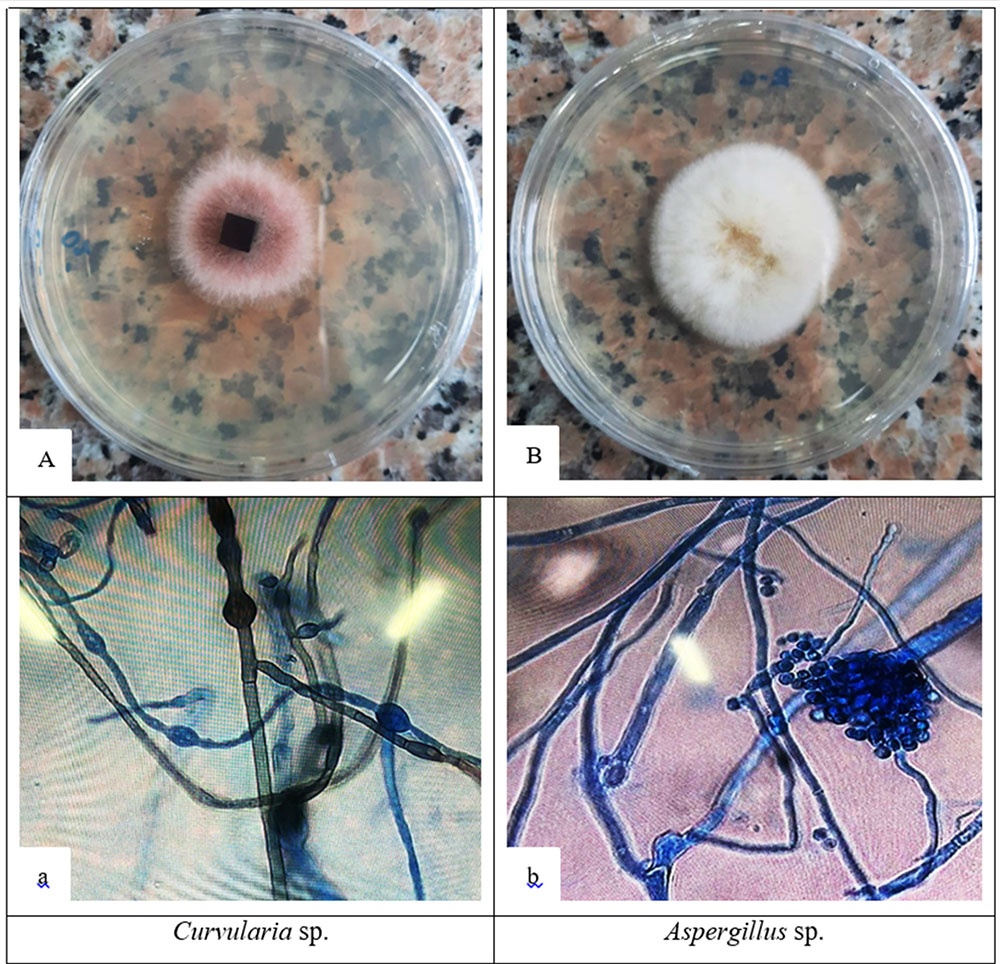
The importance of identifying phytopathogenic fungi in sugarcane is crucial for establishing effective control strategies that ensure the sustainability and production of this important grass. The study aimed to identify the fungal causal agents that cause necrotic leaf spots in the EC-08 variety of sugarcane. After disinfection, the samples were inoculated in potato dextrose agar (PDA) culture medium. Pure cultures were obtained for molecular analysis by extracting deoxyribonucleic acid (DNA) and internal transcribed spacer (ITS). In addition, a metagenomic analysis was performed using parallel mass sequencing metabarcoding (ITS), and the sequences were identified using BLAST. The results of the ITS molecular analysis yielded 100 % pure DNA in the amplified fragments. Agarose gel electrophoresis at 1 % visualized bands for the species: Curvularia petersonii (535 bp), Aspergillus arachidicola (536 bp), and Rhinocladiella sp. (529 bp) based on SANGER sequencing readings, while the taxonomic profile result detected 100 % Fusarium pseudoanthophilum and 97 % Nigrospora osmanthi. In conclusion, ITS barcoding and metabarcoding methods enabled the identification of the phytopathogenic fungi C. petersonii, A. arachidicola, Rhinocladiella sp., F. pseudoanthophilum, and N. osmanthi as causes of leaf necrosis in this cultivar.
Article Details

This work is licensed under a Creative Commons Attribution-NonCommercial 4.0 International License.
Those authors who have publications with this journal accept the following terms of the License Attribution-NonCommercial 4.0 International (CC BY-NC 4.0):
You are free to:
- Share — copy and redistribute the material in any medium or format
- Adapt — remix, transform, and build upon the material
The licensor cannot revoke these freedoms as long as you follow the license terms.
Under the following terms:
- Attribution — You must give appropriate credit, provide a link to the license, and indicate if changes were made. You may do so in any reasonable manner, but not in any way that suggests the licensor endorses you or your use.
- NonCommercial — You may not use the material for commercial purposes.
- No additional restrictions — You may not apply legal terms or technological measures that legally restrict others from doing anything the license permits.
The journal is not responsible for the opinions and concepts expressed in the works, they are the sole responsibility of the authors. The Editor, with the assistance of the Editorial Committee, reserves the right to suggest or request advisable or necessary modifications. They are accepted to publish original scientific papers, research results of interest that have not been published or sent to another journal for the same purpose.
The mention of trademarks of equipment, instruments or specific materials is for identification purposes, and there is no promotional commitment in relation to them, neither by the authors nor by the publisher.
References
García R, Guevara DAS, Poma JPP, Sancho D, Sarabia D, Heredia FJM. Utilización de tres métodos químicos para la conservación de caña de azúcar (Saccharum officinarum L.), variedad POJ 93, en Pastaza, Ecuador. La Técnica. 2018;(19):61-74. Available from: https://doi.org/10.33936/la_tecnica.v0i19.1308
Hoang AT, Lam TT, Thi HTP, Nguyen Thi H, Pham HP, Doan Thi L,et al. Identification of Nigrospora sphaerica and Curvularia lunata as causal agents of leaf spot disease in cantaloupe (Cucumis melo L.) in Southern Vietnam. Australas Plant Pathol. 2025;1-10. Available from: https://doi.org/10.1007/s13313-025-01028-3
LaO Hechavarria M de la L. Genotipificación y fuentes de resistencia de los agentes causales de virus del mosaico y hoja amarilla de la caña de azúcar. An La Acad Ciencias Cuba [Internet]. 2018;18(1):1-6. Available from: https://revistaccuba.sld.cu/index.php/revacc/article/view/363
Aliya SSS, Nusaibah SA, Mahyudin MM, Yusop MR. Pathogenicity, enzymatic assays, and differential metabolomics to assess the virulence of fungal pathogens responsible for complex circular leaf spot (CCLS) disease of rubber trees in Malaysia. Physiol Mol Plant Pathol. 2025;136:102582. Available from: https://doi.org/10.1016/j.pmpp.2025.102582
Centro de Investigación de la Caña de Azúcar de Ecuador (CINCAE). Manejo de enfermedades [Internet]. 2026. Available from: https://cincae.org/areas-de-investigacion/manejo-de-enfermedades/
Arauz EEC, Gaitán YYG, Gómez IES, Estrada SPC. Diagnóstico de enfermedades bacterianas en el cultivo de café (Coffea arabica L.) y sensibilidad in vitro a bactericidas de uso agrícola. La Calera. 2023;23(40). Available from: https://doi.org/10.5377/calera.v23i40.15831
Jeger M, Beresford R, Bock C, Brown N, Fox A, Newton A, et al. Global challenges facing plant pathology: multidisciplinary approaches to meet the food security and environmental challenges in the mid-twenty-first century. CABI Agric Biosci. 2021;2(1):1-18. Available from: https://doi.org/10.1186/s43170-021-00042-x
Castillo Carrillo CI. Biodiversity in Ecuador and its immense potential for agricultural pest control. In: Agricultural, Forestry and bioindustry biotechnology and biodiscovery. springer; 2020. p. 143-61. Available from: https://doi.org/10.1007/978-3-030-51358-0_9
Martínez G, Rey JC, Pichardo REP, Manzanilla EE. Marchitez por Fusarium raza tropical 4: Estado actual y presencia en el continente americano. Agron Mesoam [Internet]. 2020;31(1):259-76. Available from: http://dx.doi.org/10.15517/am.v31i1.37925
Guerrero AMC, González M. Micorrizas Autóctonas como Indicadores de Salud y Calidad del Suelo. RECITIUTM [Internet]. 2024;10(2):51-64. Available from: http://201.249.78.46/index.php/recitiutm/article/view/265/pdf
Taniwaki MH, Pitt JI, Magan N. Aspergillus species and mycotoxins: occurrence and importance in major food commodities. Curr Opin Food Sci. 2018;23:38-43. Available from: https://doi.org/10.1016/j.cofs.2018.05.008
Khan NA, Asaf S, Ahmad W, Jan R, Bilal S, Khan I, et al. Diversity, lifestyle, genomics, and their functional role of Cochliobolus, Bipolaris, and Curvularia species in environmental remediation and plant growth promotion under biotic and abiotic stressors. J Fungi. 2023;9(2):254. Available from: https://doi.org/10.3390/jof9020254
Li L, Zhang X, Tan X, Sun B, Wu B, Yu M, et al. Rhinoclactones AE, resorcylic acid analogs from desert plant endophytic fungus Rhinocladiella similis. Molecules. 2019;24(7):1405. Available from: https://doi.org/10.3390/molecules24071405
Zhong J, Situ J, He C, He J, Kong G, Li H, et al. A virulent milRNA of Fusarium oxysporum f. sp. cubense impairs plant resistance by targeting banana AP2 transcription factor coding gene MaPTI6L. Hortic Res. 2025;12(4):uhae361. Available from: https://doi.org/10.1093/hr/uhae361
Badiwe M, Fialho RO, Stevens C, Lombard P-H, van Niekerk J. Fusarium species associated with diseases of Citrus: A comprehensive review. J Fungi. 2025;11(4):263. Available from: https://doi.org/10.3390/jof11040263
Solórzano-Solórzano JA, Zambrano SMV, Olmedo JBV. Fusarium spp. en el cultivo de maíz: Identificación, distribución geográfica, sintomatología, micotoxinas, ciclo de la enfermedad, control, y desafíos actuales y futuros. Sci Agropecu. 2024;15(4):537-56. Available from: http://dx.doi.org/10.17268/sci.agropecu.2024.040
Yang K, Yang X, Li M, Li D, Huang X, Li C. Occurrence of Nigrospora osmanthi causing leaf spot on Artemisia argyi in China. Crop Prot. 2025;191:107142. Available from: https://doi.org/10.1016/j.cropro.2025.107142
Ugalde-Monge B, Artavia-Carmona R, Hilje-Rodríguez I, Peraza-Padilla W. Identificación morfológica y molecular de potenciales hongos nematófagos en fincas bananeras de la región huetar atlántica de Costa Rica. Agron Costarric. 2024;48(2):111-31. Available from: https://doi.org/10.15517/rac.v48i2.62489
Vera-Rodríguez JH, Villamar-Aveiga MR, Herrera-Feijoo RJ, Sevilla-Carrasco JD, Moreno D, Gavin-Moyano CS, et al. Detection of Diaporthe sp. in cacao plants (cv. CCN 51) in Guayas Province, Ecuador. Rev Fac Agron Univ Zulia. 2025;42(4). Available from: https://doi.org/10.47280/RevFacAgron(LUZ).v42.n4.III
Ćurčić NŽ, Miljanić JA, Bočarov SAS, Vukelić ID, Bodroža SMI. PCR-RFLP method in combination with on-chip electrophoresis as a tool for determining of variability between important species of Aspergillus. Food Feed Res. 2024;51(1):31-9. Available from: https://doi.org/10.5937/ffr0-49318
Paloi S, Luangsa-Ard JJ, Mhuantong W, Stadler M, Kobmoo N. Intragenomic variation in nuclear ribosomal markers and its implication in species delimitation, identification and barcoding in fungi. Fungal Biol Rev. 2022;42:1-33. Available from: https://doi.org/10.1016/j.fbr.2022.04.002
Moore GG, Mack BM, Beltz SB, Puel O. Genome sequence of an aflatoxigenic pathogen of Argentinian peanut, Aspergillus arachidicola. BMC Genomics. 2018;19(1):189. Available from: https://doi.org/10.1186/s12864-018-4576-2
Iturrieta-González I, Gené J, Wiederhold N, García D. Three new Curvularia species from clinical and environmental sources. MycoKeys. 2020;68:1. Available from: https://doi.org/10.3897/mycokeys.68.51667
Tan YP, Crous PW, Shivas RG. Cryptic species of Curvularia in the culture collection of the Queensland Plant Pathology Herbarium. MycoKeys. 2018;(35):1. Available from: https://doi.org/10.3897/mycokeys.35.25665
Madrid H, Hernandez-Restrepo M, Gené J, Cano J, Guarro J, Silva V. New and interesting chaetothyrialean fungi from Spain. Mycol Prog. 2016;15(10):1179-201. Available from: https://doi.org/10.1007/s11557-016-1239-z
Crous PW, Wingfield MJ, Schumacher RK, Akulov A, Bulgakov TS, Carnegie AJ, et al. New and interesting fungi. 3. Fungal Syst Evol. 2020;6:157. Available from: https://doi.org/10.3114/fuse.2018.01.08
Amobonye A, Bhagwat P, Ranjith D, Mohanlall V, Pillai S. Characterization, pathogenicity and hydrolytic enzyme profiling of selected Fusarium species and their inhibition by novel coumarins. Arch Microbiol. 2021;203(6):3495-508. Available from: https://doi.org/10.1007/s00203-021-02335-1
Petrović E, Vrandečić K, Ćosić J, Siber T, Godena S. Antifungal efficacy of essential oils and their predominant components against olive fungal pathogens. Agriculture. 2025;15(3):340. Available from: https://doi.org/10.3390/agriculture15030340
Oskay F, Karataş A. Pinus nigra subsp. pallasiana ve Pinus sylvestris tohumlarında Diplodia sapinea’nın yoğunluğu. Turkish J For. 2021;22(3):218-28. Available from: https://doi.org/10.18182/tjf.799849
Shabeer S, Tahira R, Jamal A. Fusarium spp. mycotoxin production, diseases and their management: An overview. Pakistan J Agric Res. 2021;34(2):278. Available from: https://dx.doi.org/10.17582/journal.pjar/2021/34.2.278.293