Salinity effect on the germination of vegetables cultivars under in vitro conditions
Article Sidebar
Main Article Content
Abstract
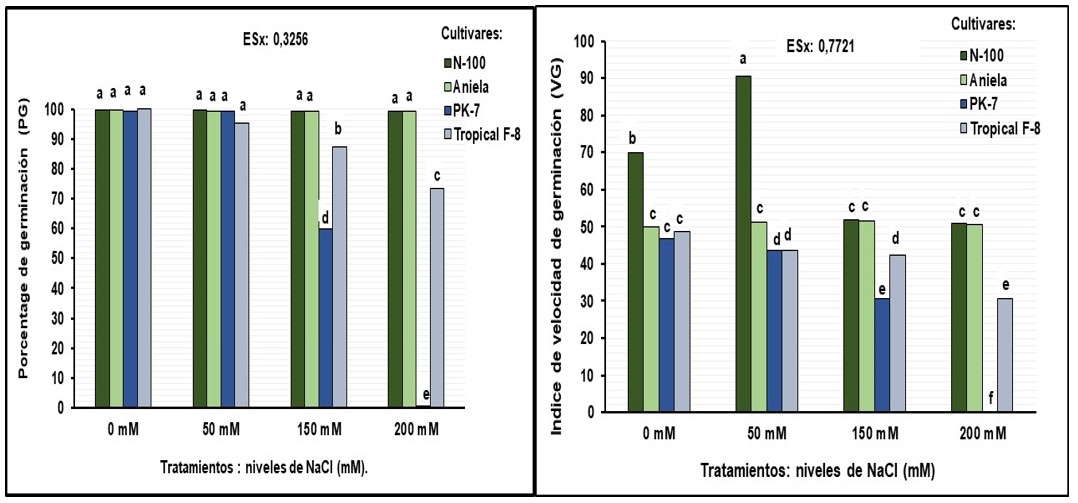
Soil salinization is currently one of the most serious problems facing agriculture, since it significantly affects food production s; for this reason, it is necessary to study cultivars tolerant to these conditions for their inclusion in the country’s production schemes. The study aimed to select different vegetables cultivars for their tolerance to salinity: of vegetables: Tomato (Solanum lycopersicum L.); Lettuce: (Lactuca sativa L.); Chinese cabbage: (Brassica rapa subsp. pekinensis (Lour.) Hanelt; Chinese beet: (Brassica rapa L. subsp. chinensis (L.) Hanelt; another of Broccoli: (Brassica oleracea var, Italica); Carrot: (Daucus carota L.) and Radish: (Raphanus sativus L.). The tolerance of 13 vegetables cultivars to different concentrations of sodium chloride (NaCl) (50 mM, 150 mM, 200 mM), was studied under in vitro conditions. For this purpose, the following were determined: the germination percentage (PG) and the germination speed index (IVG) of the seeds as described by the Maguire index. Of the crops studied the bean cultivars vegetables Chinese cabbage: N-100 Chinese beet: Aniela, another of Broccoli; Lettuce Chile 1185-3 and radish: PS9 and C 88, to present bigger germination percentage to values among 50-200 mM of NaCl, by showing the best results in terms of germination percentage and germination speed index, which is why they constitute promising materials to be used in agroecosystems affected by this condition. The rest of the cultivars didn't tolerate the ranges of salinity that were evaluated in the study.
Article Details

This work is licensed under a Creative Commons Attribution-NonCommercial 4.0 International License.
Those authors who have publications with this journal accept the following terms of the License Attribution-NonCommercial 4.0 International (CC BY-NC 4.0):
You are free to:
- Share — copy and redistribute the material in any medium or format
- Adapt — remix, transform, and build upon the material
The licensor cannot revoke these freedoms as long as you follow the license terms.
Under the following terms:
- Attribution — You must give appropriate credit, provide a link to the license, and indicate if changes were made. You may do so in any reasonable manner, but not in any way that suggests the licensor endorses you or your use.
- NonCommercial — You may not use the material for commercial purposes.
- No additional restrictions — You may not apply legal terms or technological measures that legally restrict others from doing anything the license permits.
The journal is not responsible for the opinions and concepts expressed in the works, they are the sole responsibility of the authors. The Editor, with the assistance of the Editorial Committee, reserves the right to suggest or request advisable or necessary modifications. They are accepted to publish original scientific papers, research results of interest that have not been published or sent to another journal for the same purpose.
The mention of trademarks of equipment, instruments or specific materials is for identification purposes, and there is no promotional commitment in relation to them, neither by the authors nor by the publisher.
References
Hassani A, Azagic A, Shokri N. Global predictions of primary soil salinization under changing climate in the 21 St century. Nature com Munications (2021), 12:6663). https://doi.org/10.38/s4146-021-26907-3
Casas, N., & Galvan, A. Eficiencia de las enmiendas orgánicas en la recuperación de suelos salinos en el distrito de San Vicente De Cañete–Lima, (2019). Retrieved from papers2://publication/uuid/45D7E632-B571-4218-9E47-8B4457FEA9D3
Bronwyn JB, Vera Estrella R, Balderas E, Panto-ja O. Mecanismos de tolerancia a la salinidad en plantas. Biotecnología [Internet]. [citado 5 de abril de 2020]; 2007, 14:263-72. Available from: http://www.ibt.unam.mx/computo/pdfs/libro_ 25_aniv/capitulo_23.pdf
Courel, G. Guía de estudio. Suelos Salinos y Sódicos. Journal of Chemical Information and Modeling, (2019). 53(9), 1689–1699. Retrieved from file:///C:/Users/User/Downloads/Suelos Salinos y sódicos (2).pdf
Organización de las Naciones Unidas para la Alimentación y la Agricultura “Día Mundial del Suelo: la FAO pone de manifiesto la amenaza de la salinización del suelo para la seguridad alimentaria mundial” 22 de dic. De 2021, (2021, dic. 22). Disponible en: https://www.fao.org/global-soilpartnership/resources/highlights/detail/es/c/1461054/
Egamberdieva, D., Wirth, S., Bellingrath-Kimura, S.D., Mishra, J., Arora, N.K. Salt-Tolerant Plant Growth Promoting Rhizobacteria for Enhancing Crop Productivity of Saline Soils. Frontier Microbiology. (2019). 10:2791 https://doi.org/10.3389/fmicb.2019.02791
Abiala MA, Abdelrahman M, Burritt DJ, Tran LP. Salt stress tolerance mechanisms and poten-tial applications of legumes for sustainable reclamation of salt-degraded soils. Land Degrad Dev; (2018). 29(10):3812-22. DOI: https://doi.org/10. 1002/ldr.3095
Blanes Jiménez J, Pabón Balderas EA. Qnas Soñi (hombres del agua) Chipaya: Entre tradición y tecnología, hacia un municipio resiliente [Inter-net]. La Paz: Centro Boliviano de Estudios Mul-tidisciplinarios; 2018 [citado 22 de mayo de 2020]. 182 p. Recuperado a partir de: https://chipaya.org/wp-content/uploads/2018/10/chipaya-1994.pdf
Shahid MA, Sarkhosh A, Khan N, Balal RM, Ali S, Rossi L. Insights into the physiological and biochemical impacts of salt stress on plant growth and development. Agronomy; (2020). 10(7):938. DOI: https://doi.org/10.3390/agrono my10070938
Calone R, Sanoubar R, Lambertini C, Speranza M, Antisari LV, Vianello G. Salt tolerance and Na allocation in Sorghum bicolor under vari-able soil and water salinity. Plants; (2020), 9(5): 561. DOI: https://doi.org/10.3390/plants9050561
Maguire, J. D. Speed of germination, aid in selection and evaluation of seedling emergence vigor. Crop Science, (1962). 2,176-177. https://dl.sciencesocieties.org/publications/cs/abstracts/2/2/CS0020020176
Zhao C, Zhang H, Song C, Zhu JK, Shabala S. Mechanisms of plant responses and adaptation to soil salinity. The innovation; (2020), 1(1):100017. DOI: https://doi.org/10.1016//j.xinn.2020.100017
Tahir, M., Zafar, M. M., Imran, A., Hafeez, M. A., Rasheed, M. S., Mustafa, H. S. B., Ullah, A., Saad, H. M. & Mustafa, B. Response of tomato genotypes against salinity stress at germination and seedling stage. Nature and Science, (2018). 16(4), 10-17. https://doi.org/10.7537/marsnsj160418.03
Abdelaal KA, El Maghraby LM, Elansary H, Hafez YM, Ibrahim EI, El Banna M. Treatment of sweet pepper with stress tolerance-inducing compounds alleviates salinity stress oxidative damage by mediating the physio-biochemical activities and antioxidant systems. Agronomy; (2020). 10 (1):26. DOI: https://doi.org/10.3390/agronomy10010026
González, G. P.; Suárez, N. T. and Marín, J. O. Effect of salinity and seed salt priming on the physiology of adult plants of Solanum Lycopersicum cv. ‘Río Grande’. Braz. J. Bot. (2020). 43(4):775-787. Doi: https://doi.org/10.1007/s40415-020-00636-1.
Aazami, M. A., Rasouli, F., & Ebrahimzadeh, A. Oxidative damage, antioxidant mechanism and gene expression in tomato responding to salinity stress under in vitro conditions and application of iron and zinc oxide nanoparticles on callus induction and plant regeneration. BMC Plant Biology, (2021). 21(1). https://doi.org/10.1186/S12870-021-03379-7
Oloyede OO, Wagstaff C, Methven L. Influence of cabbage (Brassica oleracea) accesion and growing on myrosinase activity, glucosinolates and their hydrilisis products. Foods. (2021), 10 (12): 2903 https://doi.org/10.3390/foods10122903
Linic I, Samec D, Cruz J, Vugcic Bok V, Stran M, Salopek-Sondi B. Involvement of phenolic acids in short term adaptation to salinity stress is especies específic among Brassicacea plants (Basel), (2019), 8 (6): 155 https://doi.org/10.3390/plants8060155
Jamil, Kyeong Bo Lee M, Kwang Yong Jung, Deog Bae Lee, Mi Suk Han and Eui Shik Rha. Salt Stress Inhibits Germination and Early Seedling Growth in Cabbage (Brassica oleracea capitata L.). Pakistan Journal of Biological Sciences, (2007), 10: 910-914. https://doi.org/10.3923/pjbs.2007.910.914
Lesmes, R., A. Molano, D. Miranda y B. Chaves. Evaluation of salt (NaCl) concentrations in irrigation wáter on lettuce (Lactuca sativa L.) ‘Batavia’ growth. Rev. Colomb. Cienc. Hort. (2007), 1(2), 222-235. https://doi.org/10.17584/rcch.2007v1i2.1163
Shahid MA, Sarkhosh A, Khan N, Balal RM, Ali S, Rossi. Insights into the physiological and biochemical impacts of salt stress on plant growth and development. Agronomy; (2020), 10(7):938. DOI: https://doi.org/10.3390/agrono my10070938
De Sousa Basílio Ana Gabriela, Vieira de Sousa Leonardo, Larley da Silva Toshik, Gomes de Moura Joana, De Melo Gonçalves Anderson Carlos, De Melo Filho José Sebastião, Henrique Leal Ygor, Thiago Jardelino Dias. Morfofisiología del rábano (Raphanus sativus L.) bajo estrés salino y tratamientos con ácido ascórbico. Agronomía Colombiana. (2018), 36(3), 257-265. https://10.15446/agron.colomb.v36n3.74149
Hameed, A., Ahmed, M. Z., Hussain, T., Aziz, I., Ahmad, N., Gul, B., & Nielsen, B. L. Effects of Salinity Stress on Chloroplast Structure and Function. Cells, (2021). 10(8). https://doi.org/10.3390/CELLS10082023
Estrada-Trejo, V., Lobato-Ortiz, R., García-de los Santos, G., Carrillo-Castañeda, G., Castillo-González, F., Contreras-Magaña, E., Ayala-Garay, O. J., De la O Olan, M. & Artola Mercadal, A. Diversidad de poblaciones nativas de jitomate para germinación en condiciones salinas. Revista mexicana de ciencias agrícolas, (2014), 5(6), 1067-1079. https://doi.org/10.29312/remexca. v5i6.890
Coca, A.; Carranza, C.; Miranda, D.; Rodríguez, M. NaCl effects on growth, yield and quality parameters in the onion (Allium cepa L.) under controlled phureja Juz. et Buk.). Agron. Colomb. (2012). 33(3), 322-329. https://doi.org/10.15446/agron.colomb.v33n3.50237