Behavior of physiological variables in corn plants (Zea mayz) under controlled deficit irrigation (RDC) in stages
Article Sidebar
Main Article Content
Abstract
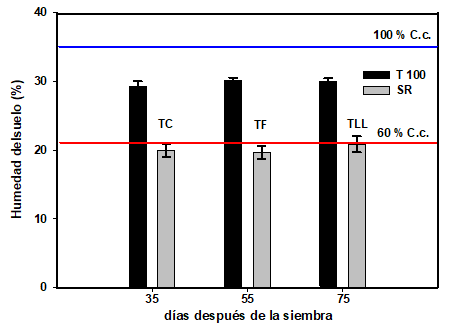
The behavior of physiological variables in corn plants (cultivar P7928) grown in semi-controlled conditions (concrete containers) and applications of controlled deficit irrigation (CDI) strategies in three stages of crop development were studied. The four treatments applied consisted of suspending irrigation for 15 days in the growth (GT), flowering (FT) and grain filling (GF) stages and a control treatment was maintained (T 100) that always received the corresponding water at 100 % of the ETc (standard crop evapotranspiration). At the end of the irrigation suspensions, the following were evaluated: soil moisture, leaf area, aerial dry mass, leaf water potential (Ψf) and its components, total soluble protein content, chlorophylls A, B, A+B and carotenes in leaves. With the application of the CDI treatments, the percentage of soil moisture decreased to 60% of the Field Capacity (C.c.). The results of the evaluations in the plants of each of the treatments (GT, FT and GF) were compared always with the control plants (T 100). Water stress negatively affected growth variables in GT and leaf area turned out to be more sensitive to stress. Regarding the values of Ψf and its components, these indicated that the plants in GF were less sensitive to the suspension of irrigation. Furthermore, water stress favored protein content and did not affect carotene content in any of the stages; while chlorophylls had greater degradation in (FT and GF) plants.
Article Details

This work is licensed under a Creative Commons Attribution-NonCommercial 4.0 International License.
Those authors who have publications with this journal accept the following terms of the License Attribution-NonCommercial 4.0 International (CC BY-NC 4.0):
You are free to:
- Share — copy and redistribute the material in any medium or format
- Adapt — remix, transform, and build upon the material
The licensor cannot revoke these freedoms as long as you follow the license terms.
Under the following terms:
- Attribution — You must give appropriate credit, provide a link to the license, and indicate if changes were made. You may do so in any reasonable manner, but not in any way that suggests the licensor endorses you or your use.
- NonCommercial — You may not use the material for commercial purposes.
- No additional restrictions — You may not apply legal terms or technological measures that legally restrict others from doing anything the license permits.
The journal is not responsible for the opinions and concepts expressed in the works, they are the sole responsibility of the authors. The Editor, with the assistance of the Editorial Committee, reserves the right to suggest or request advisable or necessary modifications. They are accepted to publish original scientific papers, research results of interest that have not been published or sent to another journal for the same purpose.
The mention of trademarks of equipment, instruments or specific materials is for identification purposes, and there is no promotional commitment in relation to them, neither by the authors nor by the publisher.
References
Shu R, Cao X, Wu M. Clarifying regional water scarcity in agriculture based on the theory of blue, green and grey water footprints. Water Resources Management. 2021, 35:1101–1118. https://doi.org/10.1007/s11269-021-02779-6
Ahmed A, Harby M. Potential of Soil Conditioners to Mitigate Deficit on Agricultural Crops: A Review. Water Resources Management. 2024, 38: 2961–2976. https://doi.org/10.1007/s11269-024-03800-4
Kamali MI, Ansari H, Nazari R. Optimization of applied water depth under water limiting conditions. Water Resources Management. 2022, 36:4081–4098. https://doi.org/10.1007/s11269-022-03241-x
El-Nashar W, Elyamany A. Adapting irrigation strategies to mitigate climate change impacts: a value engineering approach. Water Resources Management. 2023, 37:2369–2386. https://doi.org/10.1007/s11269-022-03353-4
Mehrazar A, Massah AR, Gohari A, Mashal L, Rahimikhoob H. Adaptation of water resources system to water scar-city and climate change in the suburb area of megacities. Water Resources Management. 2020, 34:3855–3877. https://doi.org/10.1007/s11269-020-02648-8
Li Q, Chen Y, Sun S K, Zhu M, Xue J, Gao Z, Zhao J, Tang Y. Research on crop irrigation schedules under deficit irrigation—a metaanalysis. Water Resources Management. 2022, 36:4799–4817. https://doi.org/10.1007/s11269-022-03278-y
Ma B, Bao-Luo M, Mc Laughlin N B, Li M, Liu J. Residual effect of Bentonite-Humic Acid Amendment on Soil Health and Crop Performance 4–5 years after initial application in a Dryland Ecosystem. Agronomy. 2022, 12:853. https://doi.org/10.20944/preprints202203. 0008.v1
Chen S, Jiang T, Ma H, He C, Xu F R W, Feng H, Yu Q, Siddique K H M, Dong Q, He J. Dynamic within-season irrigation scheduling for maize production in Northwest China: a method based on weather data fusion and yield prediction by DSSAT. Agricultural and Forest Meteorology. 2020, 285–286, 107928. https://doi.org/10.1016/j.agrformet.2020.107928
Castillo Y, González F, Hervis G, Hirán L, Cisneros E. Impacto del cambio climático en el rendimiento del maíz sembrado en suelo Ferralítico Rojo compactado. Revista Ingeniería Agrícola. 2020, 10 (1), e08, Enero- Instituto de Investigaciones de Ingeniería Agrícola. Disponible en: http://www.redalyc.org/articulo.oa?id=586262449008
FAO. Evapotranspiración del cultivo. Guías para la determinación de los requerimientos de agua de los cultivos. Estudio FAO Riego y Drenaje 56. Roma, 2006.
Song L, Jin J y He J. Effects of severe water stress on maize growth processes in the field. Sustainability. 2019, 11, 5086; https://doi.org/10.3390/su11185086 www.mdpi.com/journal/sustainability
Monteoliva M I, Bustos D y Celina L. Abordajes fisiológicos para el estudio del estrés abiótico en plantas: Disertaciones y protocolos. Buenos Aires, Ediciones INTA, 2019, 87 p. ISBN 978-987-521-986-1
Yufeng Z, Saddique Q, Ajaz A, Jiatun X, , Khan M I, Mu Q, Azmat M, Cai H, Kadambot H, Siddique M. Deficit irrigation improves maize yield and water use efficiency in a semi-arid environment. Agricultural Water Management. 2021, 243 106483. https://doi.org/10.1016/j.agwat.2020.106.483
Balbaa M G, Osman H T, Kandil E E, Javed T, Lamlom S F, Ali H M, Kalaji H M, Wrobel J, Telesiñski A, Brysiewicz A, Ghareeb R Y, Abdelsalam N R y Abdelghany A M. Determination of morpho-physiological and yield traits of maize inbred lines (Zea mays L.) under optimal and drought stress conditions. Front. Plant Sci. 2022, 13: https://doi.org/10.3389/fpls.2022.959203
Mohanapriya B, Ravikesavan R, Senthil N, and Sheela S. Root phenological and physiological response of maize (Zea mays L.) for adaptation under drought stress at vegetative and reproductive stages. Res. Crop. 2023, 24 (2): 287-294. https://doi.org/10.31830/2348-7542.2023.ROC-11162
Golnaz B, Seyed M, Nabavi K, Saeid K K, Mohsen G, Alireza K. Effect of deficit irrigation on physiological, biochemical, and yield characteristics in three baby corn cultivars (Zea mays L.). Heliyon. 2023, 9 e15477. https://doi.org/10.1016/j.heliyon.2023.e15477