Extraction of biopolymer from Cape gooseberry (Physalis peruviana L.) calyx residue for bioplastic synthesis
Article Sidebar
Main Article Content
Abstract
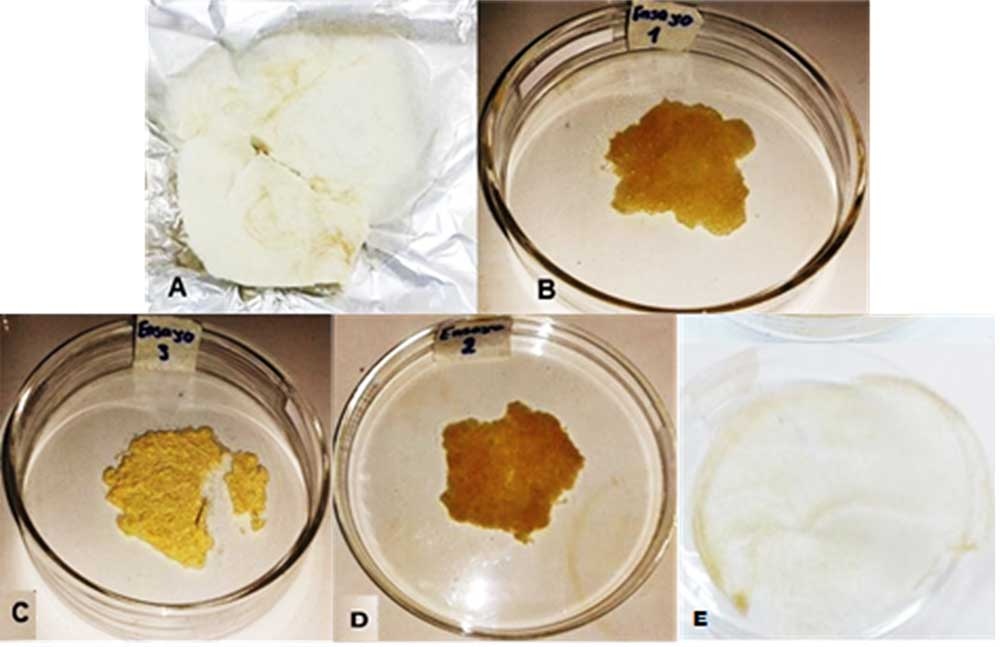
Unlike synthetic polymers, natural polymers (biopolymers) are obtained through processes with a low environmental footprint and, due to their inherent biodegradability, represent an ideal alternative for the production of single-use items such as plates, cups, and straws. The calyx of the Cape gooseberry (Physalis peruviana L.), an agricultural residue, is/ exceptionally rich in structural polysaccharides (cellulose, pectin, and starch), /making it a renewable and low-cost raw material for bioplastification. This study focuses on the development and methodological optimization of an efficient protocol for the extraction and purification of a biopolymer from this residue. The plant material was collected through sampling of natural populations in two Andean ecosystems, from which four distinct extraction experiments were implemented: the “ice-water” method, Soxhlet extraction, cellulose extraction, and a combined cellulose-starch method. The results allowed the establishment of a reliable protocol for obtaining a biopolymer from Physalis peruviana L., confirming it as a sustainable source with potential to replace petrochemical materials and to reduce both agro-industrial waste and plastic pollution.
Article Details

This work is licensed under a Creative Commons Attribution-NonCommercial 4.0 International License.
Those authors who have publications with this journal accept the following terms of the License Attribution-NonCommercial 4.0 International (CC BY-NC 4.0):
You are free to:
- Share — copy and redistribute the material in any medium or format
- Adapt — remix, transform, and build upon the material
The licensor cannot revoke these freedoms as long as you follow the license terms.
Under the following terms:
- Attribution — You must give appropriate credit, provide a link to the license, and indicate if changes were made. You may do so in any reasonable manner, but not in any way that suggests the licensor endorses you or your use.
- NonCommercial — You may not use the material for commercial purposes.
- No additional restrictions — You may not apply legal terms or technological measures that legally restrict others from doing anything the license permits.
The journal is not responsible for the opinions and concepts expressed in the works, they are the sole responsibility of the authors. The Editor, with the assistance of the Editorial Committee, reserves the right to suggest or request advisable or necessary modifications. They are accepted to publish original scientific papers, research results of interest that have not been published or sent to another journal for the same purpose.
The mention of trademarks of equipment, instruments or specific materials is for identification purposes, and there is no promotional commitment in relation to them, neither by the authors nor by the publisher.
References
Rodríguez Sandoval P, Arévalo MI. Los materiales biodegradables, una alternativa a la contaminación de los polímeros sintéticos. Revista de la Escuela de Ingenierías y Tecnologías Unimonserrate [Internet]. 18 de febrero de 2021 [citado 2 de noviembre de 2025];(1):29-37. DOI: http://doi.org/10.29151/reit.n1a3
Wu J, Wang J, Zeng Y, Sun X, Yuan Q, Liu L, et al. Biodegradation: the best solution to the world problem of discarded polymers. Bioresour Bioprocess [Internet]. 1 de diciembre de 2024 [citado 2 de noviembre de 2025];11(1). DOI: http://doi.org/10.1186/s40643-024-00793-1
Dallaev R, Papež N, Allaham MM, Holcman V. Biodegradable polymers: properties, applications, and environmental impact. Polymers (Basel) [Internet]. 1 de julio de 2025 [citado 2 de noviembre de 2025];17(14). DOI: http://doi.org/10.3390/polym17141981
Renneboog R. Química de polímeros [Internet]. 2024. p. 1-10. Available from: https://www.ebsco.com/research-starters/engineering/polymer-chemistry#full-article
Kaur R, Pathak L, Vyas P. Biobased polymers of plant and microbial origin and their applications - a review. Biotechnology for Sustainable Materials [Internet]. 11 de octubre de 2024 [citado 2 de noviembre de 2025];1(1). DOI: http://doi.org/10.1186/s44316-024-00014-x
Vroman I, Tighzert L. Biodegradable polymers. Materials [Internet]. 25 de febrero de 2009 [citado 2 de noviembre de 2025];2(1996-1944):307-44. DOI: http://doi.org/10.3390/ma2020307
Hernández Silva ML, Guzmán Martínez B. Biopolymers used in the manufacture of food packaging. Revista Publicaciones e investigación [Internet]. 19 de agosto de 2009 [citado 17 de octubre de 2025];3(1900-6608):1900-6608. Available from: https://dialnet.unirioja.es/servlet/articulo?codigo=8660003
Shah S, Kumar A. Production and characterization of polyhydroxyalkanoates from industrial waste using soil bacterial isolates. Brazilian Journal Microbiology [Internet]. 15 de febrero de 2021 [citado 2 de noviembre de 2025];52:715-26. DOI: http://doi.org/10.1007/s42770-021-00452-z/Published
Mendoza Reyes O. Fabricación y caracterización física de biopolímeros a base de algas [Internet]. Universidad de Ciencias y Artes de Chiapas; 2024 [citado 17 de octubre de 2025]. Available from: https://repositorio.unicach.mx/bitstream/handle/20.500.12753/5257/Oswaldo%20Reyes.pdf?sequence=1
Altamirano Caicedo MA. Estudio de la cadena productiva de uvilla (Physalis peruviana L.) en la Sierra Norte del Ecuador [Internet]. Universidad de San Francisco de Quito; 2010 [citado 17 de octubre de 2025]. Available from: https://repositorio.usfq.edu.ec/bitstream/23000/950/1/95220.pdf
Escalante M, Santos I, Rojas LB, Lárez Velásquez C. Aprovechamiento de desechos orgánicos: 1. Extracción y caracterización del aceite de semillas de naranja colectadas en expendios ambulantes de jugos. Journal Redalyc [Internet]. 3 de diciembre de 2012 [citado 17 de octubre de 2025];7(3):181-6. Available from: https://www.redalyc.org/pdf/933/93325703004.pdf
Tituaña Pulluquitin IG, Córdova Guambo IV, Tobar Jácome MC, Lascano Sumbana AV. Estudio del proceso de obtención de extractos de plantas medicinales. Revista Caribeña de Ciencias Sociales [Internet]. Mayo de 2018;1-28. Available from: https://www.eumed.net/rev/caribe/2018/05/extractos-plantas-medicinales.html
Durán García ME, Ruiz Navas RA. Diseño de equipos de contacto sólido-líquido a elevadas presiones en el procesamiento de la biomasa. Revista Ciencia y Tecnología [Internet]. 2015 [citado 2 de noviembre de 2025];15(1850-0870):25-40. Available from: https://www.researchgate.net/publication/311881251_Diseno_de_equipos_de_contacto_solido-liquido_a_elevadas_presiones_en_el_procesamiento_de_la_biomasa
Canché-Escamilla G, De Los Santos-Hernández JM, Andrade-Canto S, Gómez-Cruz R. Obtención de celulosa a partir de los desechos agrícolas del banano. Revista Información Tecnológica [Internet]. 2005 [citado 2 de noviembre de 2025];16(1):83-8. DOI: http://doi.org/10.4067/s0718-07642005000100012
Castillo R, Escobar E, Fernández D, Gutiérrez R, Morcillo J, Núñez N, et al. Bioplástico a base de la cáscara del plátano. Revista de Iniciación Científica [Internet]. Agosto de 2015 [citado 2 de noviembre de 2025];1. Available from: https://revistas.utp.ac.pa/index.php/ric/article/view/346/339
Sánchez Vásquez VL, Chenche López OM. Obtención y caracterización de quitosano a partir de residuos de cangrejo rojo (Procambarus clarkii). Reincisol [Internet]. 10 de octubre de 2024 [citado 2 de noviembre de 2025];3(6):3166-79. DOI: http://doi.org/10.59282/reincisol.v3(6)3166-3179
Matas A. Diseño del formato de escalas tipo Likert: Un estado de la cuestión. Revista Electrónica de Investigación Educativa [Internet]. 2018 [citado 2 de noviembre de 2025];20(1):38-47. DOI: http://doi.org/10.24320/redie.2018.20.1.1347
San Andrés M, Chércoles R, De la Roja J, Gómez M. Factores responsables de la degradación química de los polímeros. In: Efectos provocados por la radiación lumínica sobre algunos materiales utilizados en conservación: primeros resultados. Factores responsables de la: Restauración [Internet]. 2006 [citado 2 de noviembre de 2025];283-307. Available from: https://www.cultura.gob.es/dam/jcr:d7cb6b8e-3c5f-41d4-8726-6894ea9ea575/factrespxireinasof.pdf
Coreño-Alonso J, Méndez-Bautista MT. Relationship between structure and properties of polymers. Educación Química [Internet]. 2010 [citado 2 de noviembre de 2025];21(4):291-9. DOI: http://doi.org/10.1016/s0187-893x(18)30098-3
McKeen LW. Introduction to Plastics and Polymers. In: Fatigue and Tribological properties of plastics and elastomers [Internet]. Elsevier; 2010 [citado 2 de noviembre de 2025]. p. 39-50. DOI: http://doi.org/10.1016/b978-0-08-096450-8.00003-x
Alvarado-Rojas M, Castro-Brenes J. Celulosa bacteriana: el biopolímero de la naturaleza. Revista Redalyc [Internet]. 21 de marzo de 2024 [citado 2 de noviembre de 2025];37(2215-3241):162-71. Available from: https://www.scielo.sa.cr/pdf/tem/v37n4/699878907014.pdf
Morán MT, Piñero DC. Redefiniendo la celulosa. La rama verde de los nuevos materiales. Revista Centro de estudios en Diseño y Comunicación [Internet]. Marzo de 2025 [citado 2 de noviembre de 2025];(1668-0227):69-84. Available from: https://dialnet.unirioja.es/servlet/articulo?codigo=10145048
Pérez-Rodríguez ÁT, Batista-Zaldívar MA, Velásquez-Infante JC, García-Arias JM. Acetato de celulosa del bagazo de la caña de azúcar: plastificación y evaluación de propiedades. Ciencias Holguín [Internet]. marzo de 2014 [citado 2 de noviembre de 2025];XX(1027-2127):1-10. Available from: https://www.redalyc.org/pdf/1815/181529931001.pdf
Rodríguez-Alba E, Bernal Dubón AE, Gaitán López HE, Godoy CAK, Salguero Mérida JB, Toledo Hernández EM, et al. La Ciencia de los polímeros biodegradables [Internet]. 2013 mar [citado 2 de noviembre de 2025]. Available from: https://www.ugto.mx/investigacionyposgrado/veranos/images/2021/docs/Monografia_Dr_Martinez_Richa_et_al_La_ciencia_de_los_polimeros.pdf
Pérez-Rodríguez AT, Batista-Zaldívar MA, Velásquez-Infante JC, García-Arias JM, et al. Acetato de celulosa del bagazo de la caña de azúcar: plastificación y evaluación de propiedades. Ciencias Holguín. Ciencias Holguín [Internet]. 2014;XX(1):1-10. Available from: http://www.redalyc.org/articulo.oa?id=181529931001
Flores-Córdova MA, Uribe-Cruz G, Salas-Salazar N, Sáenz-Mendoza A, Calderón-Loera R. Efecto de la temperatura de secado en las propiedades fisicoquímicas, mecánicas y de permeabilidad al vapor de agua de películas de almidón de maíz. Revista Iberoamericana de Polímeros [Internet]. enero de 2024 [citado 2 de noviembre de 2025];25:1-14. Available from: https://reviberpol.org/wp-content/uploads/2024/06/2024-25-1-1-14.pdf
Avérous L, Pollet E. Environmental silicate nano-biocomposites. Green energy and technology [Internet]. 2012 [citado 2 de noviembre de 2025];50. DOI: http://doi.org/10.1007/978-1-4471-4108-2
Rhim JW, Park HM, Ha CS. Bio-nanocomposites for food packaging applications [Internet]. Vol. 38, Progress in Polymer Science. Elsevier Ltd; 2013 [citado 2 de noviembre de 2025]. p. 1629-52. DOI: http://doi.org/10.1016/j.progpolymsci.2013.05.008
Tajeddin B. Cellulose-Based polymers for packaging applications. lignocellulosic polymer composites [Internet]. 2015 [citado 2 de noviembre de 2025]; 1:477-98. Available from: https://www.researchgate.net/publication/278318257_Cellulose-Based_Polymers_for_Packaging_Applications
Afshar S V., Boldrin A, Astrup TF, Daugaard AE, Hartmann NB. Degradation of biodegradable plastics in waste management systems and the open environment: A critical review. J Clean Prod [Internet]. 1 de enero de 2024 [citado 2 de noviembre de 2025];434. DOI: http://doi.org/10.1016/j.jclepro.2023.140000
Singh B, Sharma N. Mechanistic implications of plastic degradation. Polym Degrad Stab [Internet]. marzo de 2008 [citado 2 de noviembre de 2025];93(3):561-84. DOI: http://doi.org/10.1016/j.polymdegradstab.2007.11.008