Participatory evaluation of rice cultivars during diversity fairs in Cuba
Article Sidebar
Main Article Content
Abstract
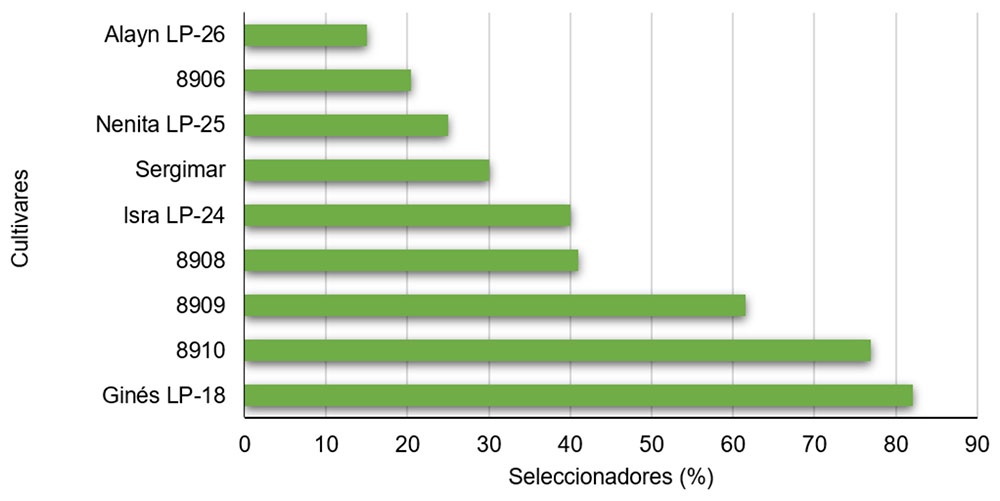
Participatory Variety Selection (PVS) has established itself as an effective tool for the plant breeding in agroecological contexts. This study was conducted at two diversity fairs held in the Rafael Ferro Morales Credit and Service Cooperative (Pinar del Río) and the CCS José Martí (Matanzas), where 20 rice cultivars were evaluated with the aim of identifying those with the greatest acceptance and the agronomic criteria of highest importance from the perspective of participants, defined by producers, technicians, and other local actors in the participatory selection process. The recommendations from the Technical Instruction for Rice Cultivation were followed, adapted by local producers according to their agroecological practices. The data were processed with descriptive statistics using Microsoft Excel 2019, and the most valued selection criteria by the participants were analyzed. Lines 8908, 8909, and 8910, along with the cultivars Ginés LP-18, Isra LP-24, Alayn LP-27, and Roana LP-15, stand out for agronomic traits such as number of panicles, plant architecture, pest resistance, and vegetative cycle. The active participation of women strengthened the inclusive approach of the process. The results show that Participatory Variety Selection allows for the identification of cultivars adapted to local conditions, promotes resilience to climate change, and contributes to food security.
Article Details

This work is licensed under a Creative Commons Attribution-NonCommercial 4.0 International License.
Those authors who have publications with this journal accept the following terms of the License Attribution-NonCommercial 4.0 International (CC BY-NC 4.0):
You are free to:
- Share — copy and redistribute the material in any medium or format
- Adapt — remix, transform, and build upon the material
The licensor cannot revoke these freedoms as long as you follow the license terms.
Under the following terms:
- Attribution — You must give appropriate credit, provide a link to the license, and indicate if changes were made. You may do so in any reasonable manner, but not in any way that suggests the licensor endorses you or your use.
- NonCommercial — You may not use the material for commercial purposes.
- No additional restrictions — You may not apply legal terms or technological measures that legally restrict others from doing anything the license permits.
The journal is not responsible for the opinions and concepts expressed in the works, they are the sole responsibility of the authors. The Editor, with the assistance of the Editorial Committee, reserves the right to suggest or request advisable or necessary modifications. They are accepted to publish original scientific papers, research results of interest that have not been published or sent to another journal for the same purpose.
The mention of trademarks of equipment, instruments or specific materials is for identification purposes, and there is no promotional commitment in relation to them, neither by the authors nor by the publisher.
References
Díaz SH, Morejón R, Pérez N, Castro R. Selección Varietal Participativa (PVS): un enfoque de mejoramiento en arroz dirigido a la población meta. Cultivos Tropicales. 2025;46(2). Available from: https://ediciones.inca.edu.cu/index.php/ediciones/article/view/1871.
FLAR. Ciencia, alianzas y nuevas variedades de arroz para América Latina y el Caribe [Internet]. Fondo Latinoamericano para Arroz de Riego. 2025. Available from: https://flar.org/ciencia-alianzas-y-nuevas-variedades-de-arroz-para-america-latina-y-el-caribe/.
Hoyos N, Andrade R. Más de cien líneas élite de arroz para América Latina y el Caribe serán adoptadas, procedentes de los programas de mejoramiento del arroz (Alianza-FLAR) [Internet]. Alianza Bioversity y CIAT. CGIAR. 2023. Available from: https://alliancebioversityciat.org/es/alianza-en-cgiar.
Delgado H, Silva A, Guarín LA. Evaluación agronómica de líneas de arroz de sabana (Oryza sativa L.) obtenidas mediante mejoramiento poblacional por selección recurrente. Revista U.D.C.A Actualización & Divulgación Científica. 2021;24(2):e1707. DOI: http://doi.org/10.31910/rudca.v24.n2.2021.1707.
González D, Galbán M, Monteagudo JA, Sarduy D. Métodos participativos como vía para la difusión de tecnologías y cultivares de arroz. Agrotecnia. 2018;42(2):50-61. Available from: https://www.grupoagricoladecuba.gag.cu/media/Agrotecnia/pdf/42_2018_2/6.pdf.
Hernández A, Pérez J, Bosch D, Castro N. Clasificación de los suelos de Cuba 2015 [Internet]. Instituto Nacional de Ciencias Agrícolas, Cuba: EDICIONES INCA. 2015. 93 p. Available from: https://isbn.cloud/9789597023777/clasificacion-de-los-suelos-de-cuba-2015/.
MINAG. Instructivo Técnico Cultivo de Arroz. Instituto de Investigaciones del Arroz [Internet]. MINAG. 2014. 73 p. Available from: https://isbn.cloud/9789597210863/ instructivo-tecnico-cultivo-de-arroz/.
Benítez B, Crespo A, Casanova C, Méndez A, Hernández Y, Ortiz R, et al. Impactos de la estrategia de género en el sector agropecuario, a través del Proyecto de Innovación Agropecuaria Local (PIAL). Cultivos Tropicales. 2021;42(1). Available from: http://scielo.sld.cu/scielo.php?script=sci_arttext&pid=S0258-59362021000100004&lng=es&tlng=es.
MINAG. La Estrategia de Género del Sistema de la Agricultura 2021-2025 [Internet]. MINAG 2021. Available from: www.genero.onei.gob.cu/static/documents/informes/Estrategia%20de%20Genero%20de%20Sistema%20de%20la%20agricultura.pdf.
CEPAL. Participación de las mujeres en el sector agrícola y agroalimentario de América Latina y el Caribe [Internet]. CEPAL. 2021. Available from: www.cepal.org/sites/default/files/document/files/presentacion_agg_dag-cepal_ cumbre_cafe_121121.pdf.
Suárez R. 2025. Variedad cubana de arroz confirma su alto potencial productivo. Periódico Granma. Available from: https://www.granma.cu/.
Díaz SH, Morejón R, Pérez, N. ISRA LP-24. Nuevo cultivar de arroz (Oryza sativa L.) de ciclo medio, obtenido por hibridaciones. Cultivos Tropicales. 2022;42(4 s1), e03. Available from: https://ediciones.inca.edu.cu/index.php/ediciones/article/view/1629.
Morejón R, Díaz SH. Respuesta de líneas promisorias de arroz en finca del municipio Los Palacios, Cuba. Cultivos Tropicales. 2025;46(3). Available from: https://ediciones.inca.edu.cu/index.php/ediciones/article/view/1877.
Weltzien E, Rattunde F, Sidibé M, Vom Brocke K, Diallo A, Haussmann B, et al. Long-term collaboration between farmers’ organizations and plant breeding programmes: Sorghum and pearl millet in West Africa [Internet]. In Farmers and plant breeding. 2019. pp. 29-48. Available from: https://cgspace.cgiar.org/server/api/core/bitstreams/7d03bb3e-c45c-4ebe-8e5e-db1586f61a69/content#page=52.
Gauchan D, Joshi KD, Subedi A. Participatory crop improvement and formal release of Jethobudho rice landrace in Nepal [Internet]. LI-BIRD. 2022. Available from: https://libird.org/wp-content/uploads/2022/04/Participatory_crop_improvement_and_formal_release_of_Jethobudho_rice_landrace_in_Nepal_1396.pdf.
Sari N, Hidayat T, Prasetyo B. Participatory Rice breeding in rainfed land to sustainable agriculture. Phyton. 2025;94(7). Available from: https://www.techscience.com/phyton/v94n7/63213.
Reyes MA, Santos RJ, De Guzman C. Enhancing rainfed lowland rice production: Insights from PVS in Central Luzon. Seybold Report. 2023;19(6). Available from: https://admin369.seyboldreport.org/file/V19I06A48_12607101-zEvOp3kw9P0SVGu.pdf.
Teshome A, Mekonnen Y, Abebe T. Participatory rice breeding in rainfed land to sustainable agriculture. Phyton. 2025;94(7). Available from: https://www.techscience.com/phyton/v94n7/63213.
Calero A, Pérez Y, Quintero E, González Y. Densidades de plantas adecuadas para incrementar el rendimiento agrícola del arroz. Centro Agrícola. 2021;48(1):28-36.
Pérez NJ, Díaz G, Rodríguez LM, Hernández T. Evaluación de cultivares de arroz (Oryza sativa L.) de Vietnam, para su introducción en Cuba. Revista Colombiana de Biotecnología. 2023;25(1). DOI: http://doi.org/10.15446/rev.colomb.biote.v25n1.107284.
Li S, Feng Z, Yang B, Li H, Liao F, Gao Y, et al. An intelligent monitoring system of diseases and pests on rice canopy. Frontiers in Plant Science. 2022 Aug 11:13:972286. DOI: http://doi.org/10.3389/fpls.2022.972286.
Diario del Agro. El Ciclo de Vida del Arroz: Un Viaje desde la Siembra hasta la Cosecha [Internet]. 2023. Available from: https://www.diariodelagro.cl/el-ciclo-de-vida-del-arroz-un-viaje-desde-la-siembra-hasta-la-cosecha/.
Justo SB, Mkamilo HG, Danga NO, Huseni R, Ally FS, Mwakapala RA, et al. Genotype and genotype x environment interaction effects on the rice grain yield performance in different agro-ecologies in Tanzania. Journal of Plant Breeding and Crop Science. 2024;16(2):36-45. DOI: http://doi.org/10.5897/JPBCS2024.1038.